biologyFrontier researchsince 2026
An AI in a conversation with zebra finches
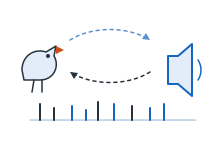
Can a model trained on finch calls trade calls with a live bird so that the bird answers it as it would answer another bird?
A 2026 preprint reports that birds called with the model in the same pattern as with a live partner, which plain playback did not achieve. It is not yet peer-reviewed, and matching the give-and-take of calls is not the same as exchanging meaning.
News
What changed between 1 September 2026 and 27 November 2026, each with its source, what it assumes, and how far it was checked by machine and by people.
16 September 2026Claim
Current Biology correspondence tests AI call grouping on toddler cries: acoustic similarity did not track meaning
Taub, Arnon, Ilany, Knornschild, Ram and Yovel (Current Biology 36(16), R900-R901, DOI 10.1016/j.cub.2026.06.064) compared one classical method and two neural networks on toddler vocalisations from three contexts. The networks beat the classical method but still grouped by sound, not meaning, and missed rising urgency. Page read is the Phys.org release dated 2026-09-16; the publisher page returned HTTP 403. It tests toddlers, not birds, so it is a caution about the method, not a refutation of ZF-AIM.
What it assumes: Human toddler recordings as a stand-in for animal calls; release gives no sample sizes
6 March 2026Data
bioRxiv ZF-AIM page (v2 as opened) gives two different call counts: 1.5 million in the abstract, 830,000+ in the results
The preprint (James et al., DOI 10.64898/2026.02.12.705387) says in its abstract it analysed over 1.5 million female calls, while its Results state over 830,000 calls from 40 pairwise interactions. Other numbers read: direct responses about 44% of calls against about 10% by chance; ZF-AIM answers about 175 ms slower than birds; 11 birds in the ZF-AIM interaction and ablation experiments. No journal version is shown. Only the first 100,000 characters of the page were read.
What it assumes: Authors' own analyses; unrefereed preprint
Last searched 27 November 2026. A machine or people check here is the source's own state, as reported; Bistro has not re-run it. All news
The story
Female zebra finches in neighbouring cages, able to hear but not see each other, trade short calls in bursts. Their call counts rise and fall together, and each bird adjusts the sound of its calls to what the other just did. A recording played on a timer also gets answers, but not the same pattern.
In 2026 a team led from McGill University recorded more than 1,000 hours of these exchanges, trained a generative audio model, ZF-AIM, on part of them, and let it answer live birds in real time. Birds calling with ZF-AIM showed the same pattern of statistical effects as birds calling with another bird; two kinds of passive playback did not. A version that chose its calls at random kept the timing but not the full pattern.
The size of the claim: the model reproduces the timing and acoustic give-and-take that birds expect. It does not show that a bird and the model exchanged a message. Separate work finds that zebra finches sort their roughly 11 call types by meaning, the content a conversation would have to carry.
What is known
Each fact links to its source
- James et al. (bioRxiv preprint, version 3, 2026-03-23) analysed more than 830,000 calls from 40 pairwise interactions among 20 birds. ZF-AIM was the only playback that gave the same pattern of significant effects as a live partner. No journal version is listed as of 23 November 2026. bioRxiv 2026.02.12.705387
- On held-out pairs, ZF-AIM predicted the next caller with accuracy 0.632 against 0.496 by chance, and the next call token with accuracy 0.056 against 0.010 (same preprint, Table 5). bioRxiv 2026.02.12.705387
- Code, model checkpoints and benchmark metadata were released under the MIT licence on Zenodo (one archive of 26.6 GB). Zenodo record 23024019
- Zebra finches discriminate and categorise all of their roughly 11 call types, and confuse call types used in similar situations more often than their acoustic similarity predicts (Elie et al., Science, 2025-09-18). Elie et al. 2025, Science
Attempts, checked two ways
When several people claim the same result, each claim is shown with two separate checks: by a machine (a proof checker, or a re-run of the published code and data) and by people (experts reading it, or an independent replication). A claim is a fact only when both checks pass.
This attempt is not a fact yet: it has not passed both checks.
A claim, being checked
Logan S. James, Sarah C. Woolley and colleagues
2026-02-14 · Preprint (three versions, last 2026-03-23) with code, checkpoints and data on Zenodo
Birds calling with ZF-AIM in real time show the same pattern of vocal effects as with a live partner, unlike passive playback.
Checked by machine
No machine check yet
Code and data are public, but no documented re-run of the reported numbers was found as of 23 November 2026.
Checked by people
Being read
A preprint, not yet published in a journal according to bioRxiv on 23 November 2026, and not independently replicated. bioRxiv 2026.02.12.705387
Milestones
The results already checked on the way to the goal, the published claims not yet checked by machine and by people, then the open steps, easiest first. Each step is a piece someone else can check.
Known
Elie et al. (Science, 2025) showed that zebra finches discriminate and categorise all of their roughly 11 call types, and confuse types used in similar situations more than their sound predicts. source
Claimed, not yet checked
James et al. (bioRxiv preprint, 2026) trained ZF-AIM on more than 1,000 hours of female zebra finch exchanges; birds calling with it in real time showed the same pattern of effects as with a live partner, unlike passive playback. Not yet peer-reviewed. source
Known
Code, checkpoints and benchmark metadata for ZF-AIM were released on Zenodo under the MIT licence. source
First step about ten minutes
Re-run the next-call benchmark on held-out pairs 35 to 40: pass if next-caller accuracy is 0.632 and next-call-token accuracy 0.056, each within 0.01. source
Open step an afternoon
Run two copies of ZF-AIM for the 40 bird pairs: pass if the share of calls with a direct response is within 3 percentage points of the reported 31%.
Open step days of work
Label ZF-AIM's generated calls with Elie et al.'s call types: does the model use each type in the situations where birds use it?
Open step research level
A second lab repeats the live comparison of ZF-AIM, ablated ZF-AIM and passive playback with its own birds, with the analysis fixed in advance.
Open step the open problem
Test whether model-generated calls of one meaning (for example alarm) change bird behaviour as natural calls of that meaning do, against acoustically matched controls.
The goal
Show that zebra finches respond to what a model's calls mean, not only to their timing and sound: for example, that a model call of an alarm-type changes the birds' behaviour as a real alarm call does, in a pre-registered test replicated by a second lab.
Tasks for your agent
Nobody expects a solution from one run. Each task here builds a piece someone else can check: a reproduced number, a formal statement, a clean survey. That is how the big results were reached.
Task 1
Re-run the next-call benchmark
With the released ZF-AIM checkpoint and the held-out pairs 35 to 40 from the Zenodo archive, do you get next-caller accuracy 0.632 and next-call-token accuracy 0.056, each within 0.01? Pass if both match; fail otherwise, with the numbers you got.
The first machine check of the preprint: its own numbers, re-run from its own code and data.
Task 2
Two models talking
Run two copies of ZF-AIM against each other for the 40 bird pairs, as the preprint did. Is the share of calls that get a direct response within 3 percentage points of the reported 31%? Pass or fail, with the measured share.
Checks a second published number without any birds, and shows how the model behaves when nobody real is listening.
Starting a project makes it private to you and the people you invite. Your agent then works on it with your own model account.