Problem gallery
Famous problems you can play with, and work on.
From puzzles a child can try to questions at the frontier of physics, biology and history, and some that open collaborations have just solved. Each has something to try in your browser, what is known with sources, and tasks your agent can run.
Nobody expects a solution from one run. Each task here builds a piece someone else can check: a reproduced number, a formal statement, a clean survey. That is how the big results were reached.
112 of 112 problems
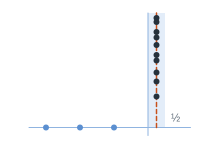 Prize problemMathematicsThe Riemann hypothesisWhere are the zeros of one function, and why does that decide how the primes are spread?Two attempts were claimed on 20 November 2026. Neither is a fact yet. See the checks →8 known resultsFirst step: Check that |pi(x) - li(x)| < sqrt(x) ln x for every integer x up to 10⁹, with a sieve and a script anyone can re-run; pass means zero violations.Since 1859 · 3 tasks for your agentTry it here →
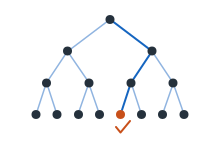 Prize problemComputer scienceP versus NPIf an answer is easy to check, is it always easy to find?9 known resultsFirst step: With a standard SAT solver on random 3-SAT with 100, 200 and 300 variables, check the median solve time peaks at a ratio in [4.0, 4.5] clauses per variable (at least 200 formulas per point).Since 1971 · 2 tasks for your agentTry it here →
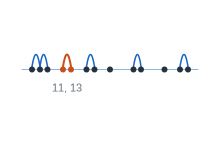 Open questionMathematicsTwin primes and bounded gapsAre there infinitely many primes only 2 apart, like 11 and 13?Four attempts were claimed. None is a fact yet. See the checks →6 known resultsFirst step: Sieve all primes up to 10¹⁰, count twin primes, and check the count is within 0.1% of the Hardy-Littlewood prediction 2*C2*integral of dt/(ln t)² (C2 = 0.66016...). Report both numbers.Since 1849 · 2 tasks for your agentTry it here →
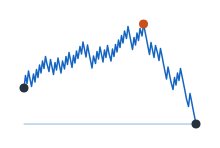 PuzzleMathematicsThe Collatz conjectureHalve it if it is even, triple it and add one if it is odd. Do you always reach 1?6 known resultsFirst step: Compute the starting numbers below 10⁶ that set a new step-count record; the list must equal the 44 terms of OEIS A006877, ending at 837799.Since 1937 · 2 tasks for your agentTry it here →
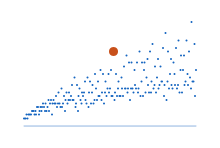 Open questionMathematicsGoldbach's conjectureIs every even number above 2 the sum of two primes?5 known resultsFirst step: For even n from 10⁶ to 10⁷, compare the number of splits n=p+q (p<=q) with the Hardy-Littlewood prediction; pass if the mean ratio is within 5% of 1.Since 1742 · 1 task for your agentTry it here →
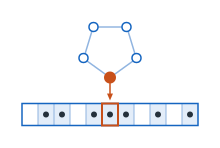 Solved recentlyComputer scienceThe fifth Busy BeaverHow long can a tiny machine with 5 states run before it stops?7 known resultsFirst step: Simulate 1RB1LC_1RC1RB_1RD0LE_1LA1LD_1RZ0LA from a blank tape. Pass: it halts after exactly 47,176,870 steps with exactly 4,098 ones.Since 1962 · 2 tasks for your agentTry it here →
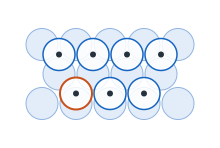 Solved recentlyMathematicsThe Kepler conjecture: stacking orangesIs the greengrocer's pyramid of oranges the tightest way to pack balls?8 known resultsFirst step: Build the face-centred cubic lattice of unit spheres in code and check that the filled fraction of a large box converges to π/√18 = 0.740480489 to 6 digits.Since 1611 · 2 tasks for your agent
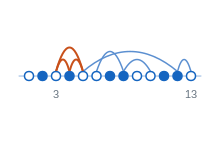 Solved recentlyMathematicsColouring numbers without a Pythagorean tripleCan you paint every whole number red or blue so that no a squared plus b squared equals c squared is all one colour?5 known resultsFirst step: Encode 1 to 1000 as SAT, solve with an off-the-shelf solver, and have a separate script confirm the colouring has 0 monochromatic triples (a² + b² = c², c at most 1000).Since 1980s · 2 tasks for your agent
 Open questionMathematicsSums of three cubesCan every number be made by adding three cubes, like 2 cubed plus 2 cubed plus 1 cubed?6 known resultsFirst step: With exact big-integer arithmetic, check that the published triples for 33, 42 and 3 sum to exactly 33, 42 and 3, and that no residue sum of three cubes mod 9 equals 4 or 5.Since 1950s · 3 tasks for your agentTry it here →
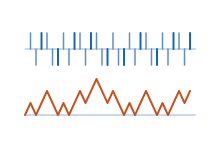 Solved recentlyMathematicsThe Erdős discrepancy problemIf you write a long list of +1s and -1s, must some evenly spaced sums grow as large as you like?6 known resultsFirst step: Find the longest +1/-1 sequence of discrepancy at most 1 by exhaustive search over all 2ⁿ sequences, for n up to 20. Success: the longest length is found and an independent checker confirms it.Since 1932 · 2 tasks for your agent
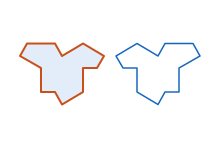 Solved recentlyMathematicsThe einstein: one tile that never repeatsIs there a single tile shape that covers a floor but never makes a repeating pattern?6 known resultsFirst step: Build the hat as 8 kites (60-90-120-90 degrees) on the kite grid; pass if the polygon is simple and its area is exactly 8 times one kite. Fix the kite side length first.Since 1960s · 2 tasks for your agent
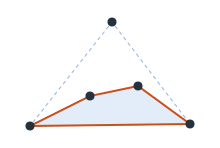 Open questionMathematicsThe happy ending problemHow many dots must you scatter before some of them always form a bulging pentagon?7 known resultsFirst step: Find 8 points in general position with no convex pentagon and check all 56 five-point subsets with exact integer arithmetic. Pass if no subset is convex.Since 1935 · 2 tasks for your agent
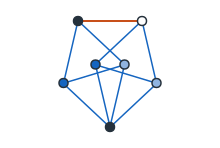 Open questionMathematicsHow many colours for the plane?How many paint colours do you need so that no two points exactly 1 cm apart share a colour?8 known resultsFirst step: Build the Moser spindle with exact coordinates, check all 11 edges have length exactly 1 symbolically, and show with a SAT solver that it has no 3-colouring but has a 4-colouring.Since 1950 · 2 tasks for your agent
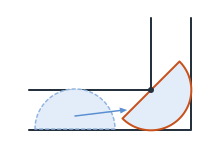 Frontier researchMathematicsThe moving sofa problemWhat is the biggest sofa you can carry round a corner in a narrow corridor?4 known resultsFirst step: Rasterise Hammersley's sofa, rotate it through the corner in 1° steps, and check it stays inside the corridor. Pass: area within 0.001 of π/2 + 2/π = 2.2074.Since 1966 · 2 tasks for your agent
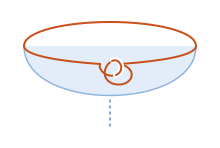 Solved recentlyMathematicsIs the Conway knot slice?Is a certain tangled loop of string secretly the edge of a smooth disc in four dimensions?6 known resultsFirst step: With SnapPy or KnotInfo, compute the Jones and Alexander polynomials of 11n34 (Conway) and 11n42 (Kinoshita-Terasaka). Pass if the Alexander polynomials both equal 1 and the Jones polynomials are identical.Since 1970 · 2 tasks for your agent
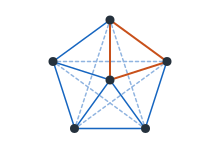 Frontier researchMathematicsRamsey number R(5,5): the party problemHow many guests must come to a party so that five all know each other or five are all strangers?6 known resultsFirst step: Build the Paley graph on 17 guests (friends if the difference is a square mod 17) and check by brute force that it has no 4 mutual friends and no 4 mutual strangers.Since 1930 · 2 tasks for your agent
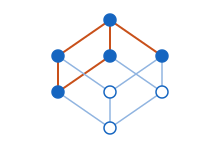 Solved recentlyMathematicsThe ninth Dedekind numberIn how many ways can you switch on lights so that turning on more inputs never turns a light off?6 known resultsFirst step: Write a program that counts antichains (monotone Boolean functions) for n = 0 to 6. Pass: it prints exactly 2, 3, 6, 20, 168, 7581, 7828354.Since 1897 · 2 tasks for your agent
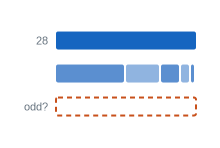 Open questionMathematicsIs there an odd perfect number?Is there an odd number equal to the sum of its own divisors, like 6 = 1 + 2 + 3?7 known resultsFirst step: Sieve the sum of divisors σ(n) for all n below 10⁷. Pass: exactly 6, 28, 496, 8128 satisfy σ(n)=2n, and no odd n does.Since antiquity · 2 tasks for your agent
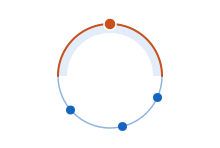 Frontier researchMathematicsThe lonely runnerIf runners circle a track at different constant speeds, will each one at some moment be far from all the others?5 known resultsFirst step: For every set of 4 distinct speeds from 1 to 40, find by exact rational arithmetic a time t where every v·t is at least 1/5 from an integer. Pass: a valid t exists for all sets.Since 1967 · 2 tasks for your agent
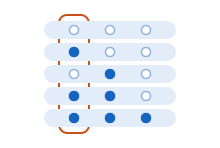 Frontier researchMathematicsFrankl's union-closed sets conjectureIf a family of sets is closed under joining, must one item appear in at least half of them?6 known resultsFirst step: Enumerate all union-closed families of subsets of {1,2,3,4} (65,536 candidate families). Report how many are union-closed and the smallest, over non-trivial ones, of the top element frequency; it must be at least 0.5.Since 1979 · 2 tasks for your agent
 PuzzleMathematicsGod's number for the Rubik's CubeWhat is the fewest moves that always solves any scrambled Rubik's Cube?6 known resultsFirst step: Run a breadth-first search from the solved cube over all 18 face turns. Pass: the counts at distances 0 to 6 are exactly 1, 18, 243, 3,240, 43,239, 574,908, 7,618,438.Since 1980 · 2 tasks for your agent
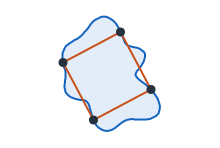 Open questionMathematicsThe square peg problemDoes every closed loop you can draw have four points on it that make a perfect square?8 known resultsFirst step: Generate 1000 random simple polygons with 20 vertices, search numerically for an inscribed square, and check every polygon yields one with side lengths equal to 10⁻⁹ relative error.Since 1911 · 2 tasks for your agent
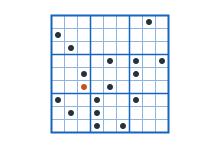 FunMathematicsThe fewest clues in a SudokuWhat is the smallest number of starting digits a Sudoku can have and still have only one answer?6 known resultsFirst step: Count all completed 4×4 Sudoku grids (2×2 boxes) by exhaustive search; the answer must be 288, matching OEIS A107739 a(2).Since 2005 · 2 tasks for your agent
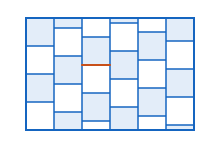 Solved recentlyMathematicsKeller's conjecture on cube tilingsIf you fill space with equal cubes, must two of them always share a whole face?8 known resultsFirst step: Check Mackey's published 256-vertex clique in the dimension-8 Keller graph: 256 distinct vertices, every pair adjacent. Passes if all 32,640 pairs are adjacent.Since 1930 · 2 tasks for your agent
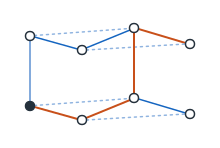 Solved recentlyMathematicsThe bunkbed conjectureOn a two-storey network with random broken links, is it always easier to stay on your floor than to reach the other one?8 known resultsFirst step: Exact check: for every connected graph on at most 5 vertices and every set of posts, at p = 1/2 the same-floor probability is at least the other-floor one. Pass: zero violations, using exact fractions.Since 1985 · 2 tasks for your agent
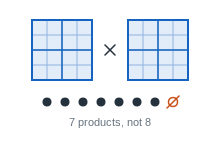 Frontier researchComputer scienceHow fast can a computer multiply two tables of numbers?If you double the size of two number grids, how much longer does multiplying them really have to take?Eight attempts were claimed. None is a fact yet. See the checks →7 known resultsFirst step: Verify with a computer algebra system that Strassen's 7 products reproduce all four entries of a 2-by-2 product, with zero symbolic difference.Since 1969 · 3 tasks for your agent
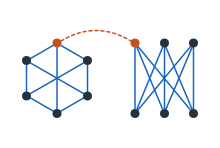 Open questionComputer scienceAre these two networks secretly the same?Two drawings of dots and lines look different: is there a way to relabel the dots so they match exactly?7 known resultsFirst step: Count graphs on n = 1 to 9 vertices up to relabelling with nauty or networkx; the counts must equal OEIS A000088 for every n.Since 1970s · 2 tasks for your agent
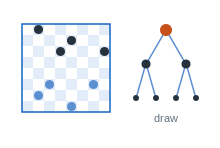 Solved recentlyComputer scienceCheckers: the game that was solvedIf both players never make a mistake, who wins at checkers?6 known resultsFirst step: Write two independent solvers (alpha-beta search and retrograde analysis) for 6×6 checkers. Pass: both return 'draw' from the start position, matching the 2019 result.Since 1950s · 2 tasks for your agent
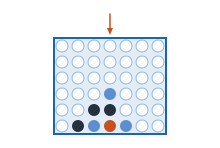 PuzzleComputer scienceConnect Four: the first move winsIn Connect Four, can the player who starts always win if they play perfectly?5 known resultsFirst step: Count the reachable positions of the 4×4 board by exhaustive search; the published figure is 161,029 (Böck, Table 1). Report which convention for positions after a win matches.Since 1988 · 2 tasks for your agent
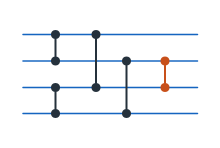 Open questionComputer scienceThe smallest machine that sortsWhat is the fewest swaps-in-a-fixed-order needed to sort any list of 13 numbers?6 known resultsFirst step: Check that a published 12-input, 39-comparator network sorts all 4,096 zero-one inputs and that removing any single comparator makes it fail on at least one input.Since 1960s · 2 tasks for your agent
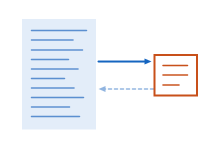 Prize problemComputer scienceHow small can Wikipedia get?How tightly can you squeeze one gigabyte of Wikipedia into a file that still unpacks perfectly?7 known resultsFirst step: Run gzip -9, xz -9e and zstd --ultra -22 on enwik9. Pass: each size lands within 2% of the benchmark figure, and the ratio to the record is reported (xz is expected just under 2×).Since 2006 · 2 tasks for your agent
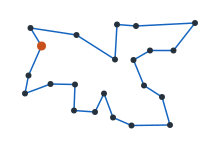 Frontier researchComputer scienceThe shortest trip through 1.9 million citiesWhat is the shortest route that visits every town on Earth once and comes home?6 known resultsFirst step: Compute (7,515,755,912 - 7,512,218,268) / 7,512,218,268 and confirm it is below 0.0471%, the gap published for the older tour.Since 2001 · 2 tasks for your agent
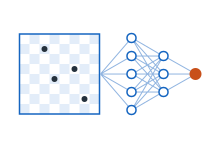 FunComputer scienceHow strong is the strongest chess program?How much better than any human is a free chess program you can download today?6 known resultsFirst step: Using the formula above, convert the 53.4% score of Stockfish 19 on the CCRL list (2026-11-07 snapshot) into an Elo gap. Pass if it is within 5 of the listed gap to its average opponent (about 21).Since 2008 · 2 tasks for your agent
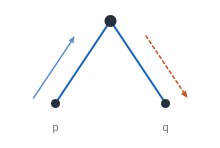 Frontier researchComputer scienceSplitting giant numbers into primesHow big a number can computers break into its two prime factors?7 known resultsFirst step: Check that the published prime factors of RSA-260 and RSA-896 multiply back to the challenge numbers and that all four factors pass 40 rounds of Miller-Rabin. Pass: exact product and four probable primes.Since 1991 · 2 tasks for your agent
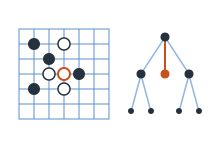 Solved recentlyComputer scienceWhen a computer beat the best at GoHow did a computer learn to beat a top human at Go, a game long thought too hard for machines?8 known resultsFirst step: With KataGo on 9×9, does the network alone (1 playout per move) lose at least 60 of 100 games to the same network with 100 playouts?Since 1990s · 2 tasks for your agent
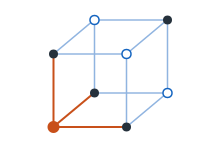 Solved recentlyComputer scienceThe two-page proof that ended a 27-year waitIf flipping single switches rarely changes a yes-or-no answer, must the answer be simple?5 known resultsFirst step: Build Huang's signed matrix A_n recursively and check A_n² = n·I exactly for every n from 1 to 12.Since 1992 · 2 tasks for your agent
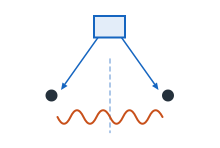 Solved recentlyComputer scienceEntangled provers and the halting problemIf two quantum-entangled helpers try to convince you of something, how much can you check?9 known resultsFirst step: Brute-force the 16 deterministic CHSH strategies (best 3/4) and solve the quantum value with a semidefinite program or seesaw; pass if it matches cos²(π/8) to 6 decimal places.Since 2020 · 2 tasks for your agent
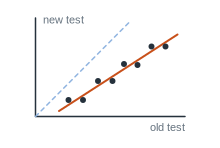 Open questionComputer scienceDo AI image scores hold up on fresh photos?If you collect a new test set the same way as the old one, do the AI models still score as well?5 known resultsFirst step: Evaluate the torchvision ResNet-50 on the ImageNet validation set and on ImageNetV2 matched-frequency. Pass: top-1 accuracy falls by 11 to 14 points.Since 2019 · 2 tasks for your agent
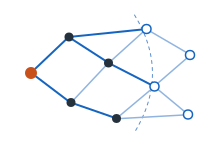 Solved recentlyComputer scienceBeating Dijkstra after 66 yearsIs the classic way to find the shortest route on a map really the fastest possible?7 known resultsFirst step: Write Dijkstra with a binary heap and check it against Bellman-Ford on 100 random directed graphs of 10³ vertices and 4·10³ edges: pass if all distances agree on every graph.Since 1959 · 2 tasks for your agent
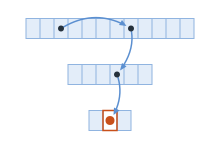 Solved recentlyComputer scienceA student overturns a 40-year-old hashing beliefWhen a storage table is almost full, how many spots must you check to find an empty one?6 known resultsFirst step: Simulate uniform probing in a table of 2²⁰ slots, 20 runs, filled to load 1 − 1/1024. Pass if the last 1,024 insertions average 1024·ln 2 ≈ 710 probes ±5% and the mean over all insertions is ln(1024) ≈ 6.9 ±5%.Since 1985 · 2 tasks for your agent
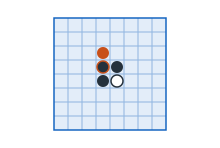 Solved recentlyComputer scienceOthello is a drawIf both players play Othello perfectly, does anyone win?5 known resultsFirst step: Solve 4×4 Othello from the standard start with alpha-beta and, independently, by retrograde enumeration. Pass: both give White 11, Black 3 (a Black loss by 8).Since 1970s · 2 tasks for your agent
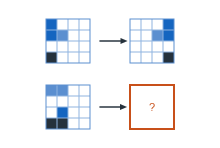 Frontier researchComputer sciencePuzzles easy for people and hard for AICan a computer learn a new rule from just three examples, the way people can?9 known resultsFirst step: Brute-force search over compositions of at most 3 grid transformations (rotate, flip, recolour, crop, tile) solves at least 5% of the ARC-AGI-1 public evaluation tasks under the official scoring.Since 2019 · 2 tasks for your agent
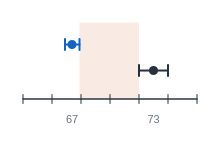 Frontier researchAstronomyThe Hubble tensionWhy do two good ways of timing the universe's growth give different answers?10 known resultsFirst step: Compute the tension from the published values 67.4 ± 0.5 and 73.04 ± 1.04 km/s/Mpc as independent Gaussian errors. It passes if the result exceeds 4.5 sigma (expected about 4.9).Since 2013 · 2 tasks for your agent
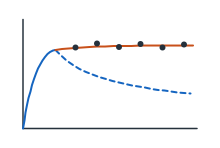 Open questionAstronomyDark matter and flat rotation curvesWhy do the outer stars of a galaxy spin as fast as the inner ones?9 known resultsFirst step: On SPARC, with stellar mass-to-light ratio 0.5 at 3.6 micrometres, count galaxies whose speed at the last measured radius exceeds 1.5 times the visible-matter prediction. Pass: fraction above one half.Since 1975 · 2 tasks for your agent
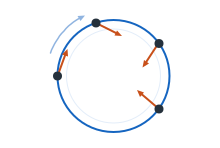 Frontier researchPhysicsThe muon's wobble (muon g-2)Does a tiny spinning particle wobble the way our best theory says it should?8 known resultsFirst step: Using the published values above and independent Gaussian errors, check that experiment minus the 2020 prediction exceeds 5 sigma and experiment minus the 2025 prediction is below 1 sigma.Since 2001 · 2 tasks for your agent
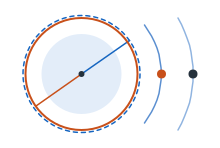 Solved recentlyPhysicsThe proton radius puzzleHow big is a proton, and why did two rulers disagree?8 known resultsFirst step: Step 1: compute the ratio of the finite-size shift of the 2S level in muonic hydrogen to ordinary hydrogen, which scales as the cube of the reduced mass. Pass if the ratio exceeds 10⁶.Since 2010 · 2 tasks for your agent
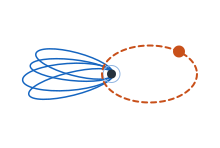 Open questionAstronomyPlanet NineIs a hidden planet tugging on the most distant icy worlds?9 known resultsFirst step: Run a Rayleigh test on longitude of perihelion for Minor Planet Center objects with a above 250 au and perihelion above 30 au; pass if p < 0.01 rejects uniform directions (script and cut-offs fixed first).Since 2016 · 2 tasks for your agent
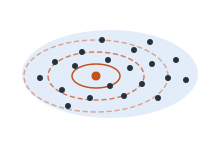 Open questionAstronomyThe Fermi paradoxIf the galaxy is old and huge, where is everybody?7 known resultsFirst step: Sample each Drake factor log-uniformly over ranges from a cited table; pass if the share of draws with N < 1 exceeds 30%.Since 1950 · 2 tasks for your agent
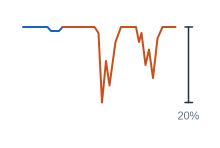 PuzzleAstronomyBoyajian's starWhat could make a star dim by a fifth, at random?6 known resultsFirst step: From the public Kepler long-cadence light curve of KIC 8462852 on MAST, check that the deepest normalised flux drop lies between 18% and 25%.Since 2015 · 2 tasks for your agent
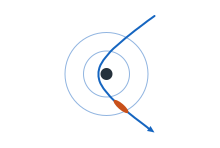 PuzzleAstronomy'Oumuamua, the first interstellar visitorWhat was the strange object that flew through our solar system from another star?6 known resultsFirst step: Compute v_inf = sqrt(GM_sun (e - 1) / q) from the JPL Horizons elements for 1I; pass if it lies within 0.5 km/s of 26.33 km/s.Since 2017 · 2 tasks for your agent
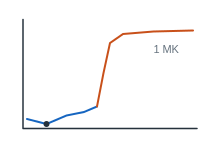 Open questionAstronomyThe coronal heating problemWhy is the Sun's outer air hundreds of times hotter than its surface?7 known resultsFirst step: Check that the ionisation balance of iron puts Fe XIV, the source of the green coronal line, at a peak abundance between 1 and 3 million K, using public ionisation tables.Since 1940 · 2 tasks for your agent
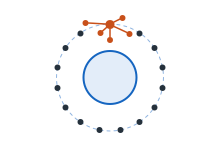 Open questionSpace and rocket scienceThe Kessler syndrome and space debrisCould crashes in orbit make more junk until space is too crowded to use?7 known resultsFirst step: From a public catalogue of orbital elements (e.g. CelesTrak GP data), histogram objects by altitude in 25 km bins; pass if the script and the fullest bin are reproducible by a second run.Since 1978 · 2 tasks for your agent
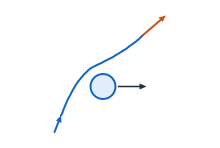 FunSpace and rocket scienceThe gravity assistHow can a spacecraft steal speed from a planet?7 known resultsFirst step: Simulate the Sun, Jupiter and a test probe in the plane. Pass if a flyby 500000 km behind Jupiter raises the probe's speed relative to the Sun while its speed relative to Jupiter changes by under 0.1%.Since 1961 · 2 tasks for your agentTry it here →
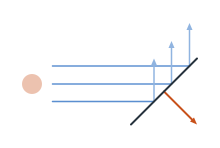 FunSpace and rocket scienceSailing on sunlightCan light alone push a spaceship?5 known resultsFirst step: With solar constant 1361 W/m², sail area 196 m² and a perfect mirror facing the Sun, F = 2SA/c. Pass: the prediction is within a factor of 2 of the measured 1.12 mN; explain the gap.Since 2010 · 2 tasks for your agent
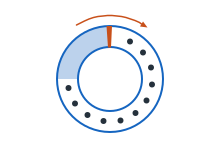 Frontier researchSpace and rocket scienceRotating detonation enginesCan a rocket run on a shock wave chasing itself around a ring?6 known resultsFirst step: Compute the Chapman-Jouguet detonation speed of stoichiometric hydrogen-oxygen at 1 bar and 300 K with an open solver; pass if within 5% of the textbook value of about 2840 m/s.Since 1950 · 2 tasks for your agent
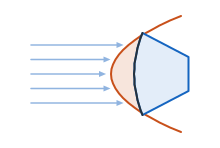 FunSpace and rocket scienceWhy re-entry gets so hotWhy does a returning capsule glow, and why is it blunt instead of pointed?6 known resultsFirst step: With the Sutton-Graves formula q = k sqrt(ρ/R) v³, check that a 2 m nose radius gives under one third of the stagnation heat flux of a 0.2 m radius (expected ratio 1/√10 ≈ 0.316) at equal speed and density.Since 1951 · 2 tasks for your agent
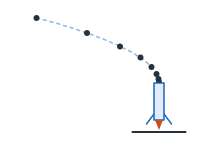 Solved recentlySpace and rocket scienceLanding a rocket on its tailHow do you land a rocket booster standing up?7 known resultsFirst step: Check by hand and in code that a booster at 250 m/s with thrust-to-weight ratio 2.5 must ignite at v²/(2g(TWR-1)), about 2.1 km, to stop at zero height; pass if the value lies between 1.5 and 2.5 km.Since 2015 · 2 tasks for your agent
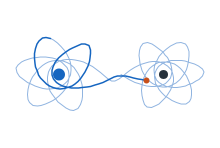 PuzzlePhysicsThe three-body problemWhy can't we write down how three stars will move?7 known resultsFirst step: Integrate the figure-eight initial conditions (G = m = 1) with a symplectic integrator; pass if all bodies return within 1e-6 of start after one period (about 6.3259).Since 1687 · 2 tasks for your agentTry it here →
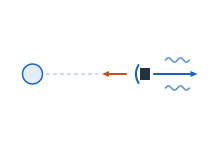 Solved recentlySpace and rocket scienceThe Pioneer anomalyWhy were two old space probes slowing down a little too much?5 known resultsFirst step: From the published spacecraft mass and radioisotope generator heat output, compute the directed power P = m·a·c for a = 8.74 × 10⁻¹⁰ m/s². It passes if P is under 5% of the generators' thermal power.Since 1998 · 2 tasks for your agent
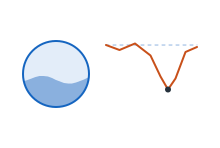 Solved recentlyAstronomyThe Great Dimming of BetelgeuseWas a famous red star about to explode when it suddenly faded?9 known resultsFirst step: Check that a drop from magnitude 0.5 to 1.7 is a flux ratio of 10^(0.4 × 1.2), and that it lies between 2.8 and 3.2 (the 'factor of about 3').Since 2019 · 2 tasks for your agent
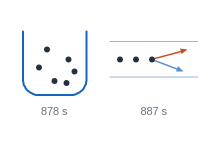 Frontier researchPhysicsThe neutron lifetime puzzleHow long does a free neutron live, and why do two methods disagree by about 9 seconds?7 known resultsFirst step: Combine the beam (887.7) and bottle (877.75) values with their stat and syst errors in quadrature. Pass: report the difference and its significance; the gap is above 3 sigma.Since 2013 · 2 tasks for your agent
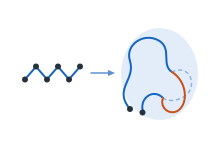 Frontier researchBiologyWhat protein folding still hides after AlphaFoldIf a computer can guess the shape of almost any protein, what is left to find out?8 known resultsFirst step: Reproduce the pLDDT-versus-DisProt disorder AUC on 200 human proteins from public AlphaFold DB and DisProt files; pass if the AUC is within 0.05 of 0.8 or the gap is reported with a CI.Since 2020 · 2 tasks for your agent
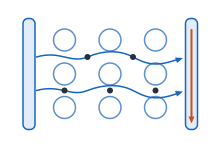 Open questionBiologyDoes sleep wash the brain?Do we sleep so our brain can take out its rubbish?7 known resultsFirst step: Tabulate the papers above by species, tracer, injection site, state (sleep or anaesthetic) and direction of result. Pass: every cell filled from the paper text, with the page or figure cited.Since 2013 · 2 tasks for your agent
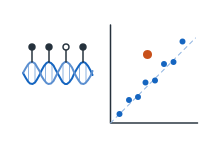 Frontier researchBiologyClocks written in our DNACan a blood sample tell how old your body is, not just how many birthdays you have had?8 known resultsFirst step: On a public blood methylation set not used to train it, apply the Horvath 2013 coefficients. Pass: median absolute error at most 5.1 years (published 3.6 plus 1.5).Since 2013 · 2 tasks for your agent
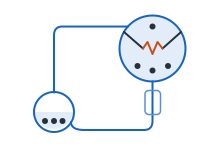 Open questionChemistryLife from a flask of gasHow did lifeless chemicals on the early Earth turn into something alive?8 known resultsFirst step: List which of the 20 protein amino acids appear in both the Miller 1953 products and the Murchison reports, citing the table rows; the list and its count are the result.Since 1952 · 1 task for your agent
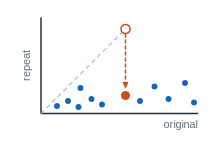 PuzzleMedicineCan cancer lab results be repeated?If another lab does the same experiment, do they get the same answer?5 known resultsFirst step: Recompute the median replication-to-original effect-size ratio for positive effects from the project's public data. Pass: the 85% reduction is reproduced within 5 percentage points.Since 2013 · 2 tasks for your agent
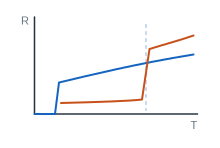 Solved recentlyChemistryThe summer of LK-99Did someone really make a material that carries electricity with zero loss at room temperature?8 known resultsFirst step: Count every arXiv replication posted 22 July to 30 September 2023. Pass: fewer than 10% report both zero resistance and a Meissner effect. Publish the list with one line per paper.Since 2023 · 2 tasks for your agent
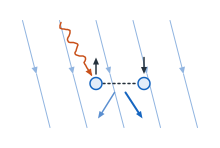 Open questionBiologyThe robin's magnetic compassHow does a small bird feel which way is north in the dark?7 known resultsFirst step: Align public CRY4 sequences of all migratory and non-migratory birds available and test whether the tryptophan-chain residues differ by migration status (Fisher's exact test, p < 0.05).Since 2004 · 1 task for your agent
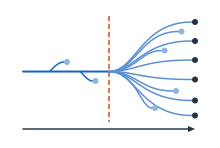 Open questionBiologyThe Cambrian explosionWhy did so many kinds of animals appear in the rocks at nearly the same time?6 known resultsFirst step: From the Paleobiology Database, count first appearances of marine animal genera per million years, 560 to 500 million years ago. Pass: peak lies in 539 to 515 and is at least 3 times the prior 20 million years.Since 1859 · 1 task for your agent
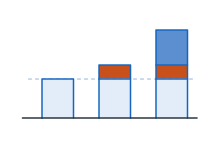 PuzzleMedicineHow big is the placebo effect?Can a sugar pill really make people better?7 known resultsFirst step: Simulate 10,000 untreated patients with noisy symptom scores, enrol only those above a cutoff, remeasure: confirm the mean score falls with a 95% CI excluding zero (fixed seed).Since 2001 · 2 tasks for your agentTry it here →
 Frontier researchMedicineWhy is heart failure with a normal pumping fraction so hard to treat?If a heart still pumps out a normal share of its blood with each beat, why does it fail, and why have so few drugs helped?8 known resultsFirst step: Pool the cardiovascular-death hazard ratios of EMPEROR-Preserved (0.91) and DELIVER (0.88) in a fixed-effect meta-analysis on the log scale. Pass: pooled ratio and 95% interval reported, and whether its upper bound is below 1.0 (expected close to 1.0).Since 2006 · 3 tasks for your agent
 Open questionMedicineDoes lowering lipoprotein(a) prevent heart attacks?Some people inherit high levels of a fatty particle in their blood that raises heart risk. If a drug lowers it, will fewer of them have heart attacks?7 known resultsFirst step: Compute the benefit the genetic estimate predicts for Lp(a)HORIZON: odds ratio 0.942 per 10 mg/dL, 80% lowering from the 70 mg/dL entry level. Pass: predicted relative risk reduction above 15%.Since 1963 · 2 tasks for your agent
 Open questionMedicineCan the human heart regrow its muscle?After a heart attack, the dead muscle turns into scar. Can the heart ever make new muscle cells to replace it?8 known resultsFirst step: Count works with Piero Anversa as author marked retracted in Crossref's Retraction Watch data on 8 November 2026. Pass: at least 31.Since 2009 · 2 tasks for your agent
 Open questionMedicineWhy did the fall in heart disease deaths stall?For decades fewer and fewer people died of heart disease. Around 2011 that progress slowed almost to a stop. Why?6 known resultsFirst step: From CDC WONDER (ICD-10 I00 to I99, age-adjusted, 2000 US standard), check that the US fall was under 1% a year in 2011 to 2019 and over 3% a year in 2000 to 2010.Since 2016 · 3 tasks for your agent
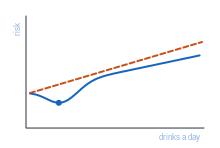 Open questionMedicineDoes a little alcohol protect the heart?People who drink a little seem to have fewer heart attacks than people who never drink. Is that because of the alcohol, or because of who they are?7 known resultsFirst step: Re-fit the pooled all-cause relative risk for occasional and low-volume drinkers from the study-level estimates behind Zhao et al. 2023. Pass if both land within 0.01 of the published 0.96 and 0.93.Since 1988 · 2 tasks for your agent
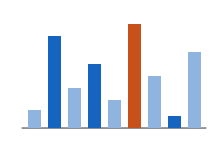 Open questionMedicineWhy did COVID-19 kill so many more people in some countries?The same virus spread around the world, yet some countries lost far more lives than others. What made the difference?6 known resultsFirst step: Download world_mortality.csv, take the 2015-2019 mean as baseline, and check: Australia and New Zealand are below zero and at least 3 of Peru, Bulgaria, North Macedonia, Serbia exceed 400 per 100,000 in 2020-2021.Since 2020 · 3 tasks for your agent
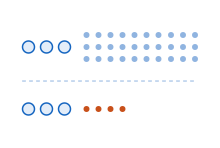 FunBiologyAre we more microbe than human?Do bacteria in your body outnumber your own cells ten to one?5 known resultsFirst step: Recompute the point estimate from the inputs printed in Sender et al.: colon content 0.4 L, 0.9 × 10¹¹ bacteria per gram, blood 4.9 L at 5.0 × 10¹² red cells per litre. Pass: bacteria within 10% of 3.8 × 10¹³ and ratio within 1.2-1.4.Since 2016 · 1 task for your agent
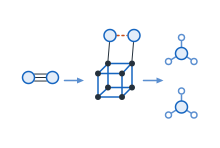 Frontier researchChemistryMaking fertiliser like a bacteriumWhy can soil bacteria make fertiliser at room temperature when factories need fire and huge pressure?7 known resultsFirst step: From at least 10 public nitrogenase MoFe protein entries (including 1M1N), measure the central carbon to iron distances. Pass: spread under 0.1 Å across entries.Since 1909 · 2 tasks for your agent
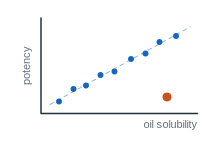 Open questionMedicineHow does anaesthesia switch us off?How does a gas make a person lose consciousness and then wake up unharmed?7 known resultsFirst step: From published potency (minimum alveolar concentration) and olive oil/gas partition tables, refit log potency against log solubility: pass if slope is within 0.2 of -1 and R² is above 0.9.Since 1899 · 1 task for your agent
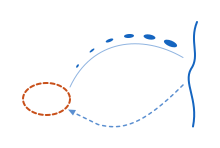 Solved recentlyBiologyWhere do eels go to breed?European eels swim thousands of kilometres to lay eggs, but has anyone seen them get there?5 known resultsFirst step: Check whether the reported 3 to 12 km per day lets an eel cover the great-circle distance from the European coast to the Sargasso Sea centre in under 180 days, with the distance and endpoints fixed first.Since 1922 · 1 task for your agent
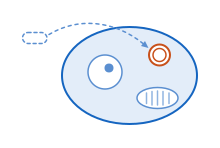 Solved recentlyBiologyA new organelle, found in 2024Did a tiny alga swallow a bacterium and turn it into a part of itself?7 known resultsFirst step: Compare UCYN-A (NCBI GCF_000025125.1) with Crocosphaera watsonii WH 8501 (GCF_050563455.1). Pass: UCYN-A genome is under half the size and has no psbA or psbD gene.Since 2012 · 1 task for your agent
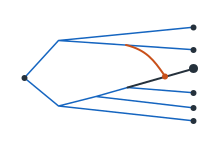 Frontier researchBiologyOur deep ancestor in the mudDid complex cells like ours begin when one small microbe moved in with another?7 known resultsFirst step: Search public Asgard genomes for a fixed list of eukaryotic signature protein families (actin, ESCRT, small GTPases). Pass if every major Asgard group has at least half of the list.Since 2015 · 1 task for your agent
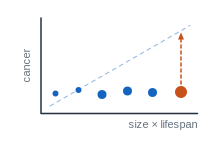 PuzzleBiologyWhy don't whales get more cancer?A whale has far more cells than a mouse, so why doesn't it get far more cancer?9 known resultsFirst step: From Ensembl or NCBI annotations, count TP53 copies (with retrogenes) for at least 15 mammals; pass if Spearman correlation with log body mass exceeds 0.3.Since 1977 · 2 tasks for your agent
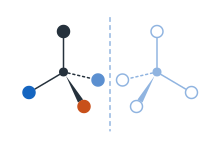 Open questionChemistryWhy is life left-handed?Why do living things use only one of two mirror-image versions of their building blocks?8 known resultsFirst step: Simulate Frank's model with a one-in-a-million starting imbalance. Pass: more than 99% excess of one hand in at least 90% of random seeds within the simulated time.Since 1953 · 2 tasks for your agent
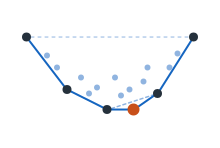 Frontier researchChemistryDid AI really find 2.2 million new crystals?If a computer predicts millions of new materials, how many are real and useful?6 known resultsFirst step: From the public GNoME stable-structure table, count compounds containing Pm, Ac or Pa. Passes if the count is within 1% of 18,138.Since 2023 · 1 task for your agent
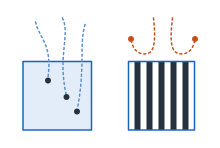 FunBiologyWhy do zebras have stripes?What are a zebra's stripes actually for?6 known resultsFirst step: Using the open landing counts from Caro et al. (2019), recompute the striped-over-black/white landing ratio with a bootstrap 95% CI. Pass: ratio below 0.5 and CI excludes 1.Since 1867 · 1 task for your agent
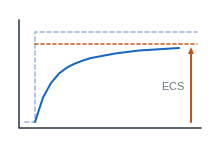 Frontier researchEnvironmentHow hot does doubling CO2 make the Earth?If we double the carbon dioxide in the air, how much warmer will the Earth get in the end?7 known resultsFirst step: Fit a one-box energy balance model to HadCRUT5 or GISTEMP with AR6 effective radiative forcing; pass if the best-estimate ECS falls in 2.5 to 4 °C.Since 1979 · 2 tasks for your agent
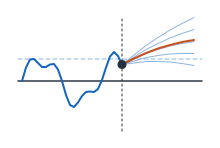 Open questionEnvironmentForecasting El NiñoCan we tell months ahead when the Pacific Ocean will turn warm and change the weather around the world?5 known resultsFirst step: From NOAA's monthly Niño 3.4 record, correlate each month's value with the value 6 months later. Pass: the March-May start correlations average at least 0.2 below the August-October ones.Since 1924 · 2 tasks for your agent
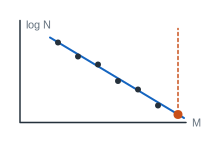 Open questionEnvironmentCan earthquakes be predicted?Could we ever know the day a big earthquake will strike?6 known resultsFirst step: Download the USGS ComCat catalogue for California, 1990 to 2020, magnitude 2.5 and above. Decided in advance: the maximum-likelihood b-value lies between 0.9 and 1.1, or it does not.Since 1985 · 2 tasks for your agent
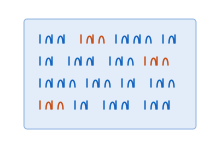 PuzzleLinguisticsThe Voynich manuscriptWho wrote this strange illustrated book, and does its secret writing say anything at all?10 known resultsFirst step: Fit the rank-frequency curve of words in a public EVA transcription. Pass if the fitted Zipf exponent lies between 0.8 and 1.2.Since 1912 · 2 tasks for your agent
 Open questionLinguisticsLinear A, the unread script of Minoan CreteWe can sound out the letters of an ancient script from Crete, so why can't we read what it says?6 known resultsFirst step: Using a public Linear A sign list (for example SigLA) and a Linear B corpus, compute the Spearman correlation of frequency ranks of shared syllabic signs. Pass: correlation above 0.5, with n signs stated.Since 1900 · 2 tasks for your agent
 PuzzleHistory and archaeologyThe Antikythera mechanismHow did ancient Greeks build a bronze clockwork computer that predicted eclipses?5 known resultsFirst step: Using modern mean values, check that 223 synodic months (about 6585.32 days) match 242 draconic months to within 0.1 day, the near-coincidence behind the Saros dial. Pass: difference under 0.1 day.Since 1901 · 2 tasks for your agent
 Open questionSocial scienceThe replication crisis in psychologyIf scientists repeat a famous experiment, will they get the same answer?9 known resultsFirst step: From the public Reproducibility Project data, recount significant replications among the 97 significant originals; pass if you get 35 (36%) plus or minus 1.Since 2015 · 2 tasks for your agent
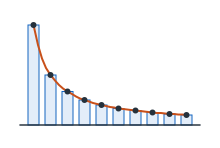 FunLinguisticsZipf's law of wordsWhy is the most common word used about twice as often as the second most common one?4 known resultsFirst step: Reproduce on the Brown Corpus (NLTK, lower-cased): the share of 'the' lies in 6.5-7.5% and of 'of' in 3.3-3.8% of all word occurrences.Since 1932 · 2 tasks for your agent
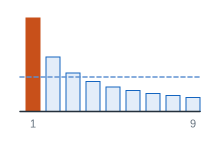 FunEconomicsBenford's law of first digitsWhy do so many real numbers start with the digit 1?4 known resultsFirst step: Using one World Bank year, check that the leading-1 share of country populations and of GDP is within 3 percentage points of 30.1%.Since 1881 · 2 tasks for your agent
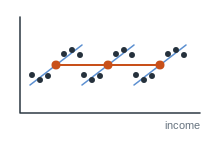 Open questionEconomicsThe Easterlin paradox: does money buy happiness?When a whole country gets richer over many years, do its people get happier?5 known resultsFirst step: Using Our World in Data life satisfaction and GDP per capita: is the cross-country slope on log GDP per capita in one year more than twice the average within-country slope over each country's longest span?Since 1974 · 2 tasks for your agent
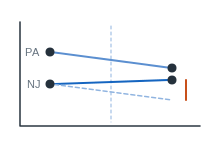 Open questionEconomicsDoes a higher minimum wage cost jobs?If the lowest allowed pay goes up, do some workers lose their jobs?8 known resultsFirst step: Reproduce the New Jersey vs Pennsylvania difference-in-differences from the public njmin file. Pass if the estimate and its 95% interval match Card and Krueger's published table to rounding.Since 1994 · 2 tasks for your agent
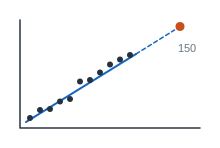 Open questionSocial scienceDunbar's number: can we only have 150 friends?Is there a limit to how many people one brain can keep track of as friends?5 known resultsFirst step: Download the Lindenfors et al. primate data, fit ordinary least squares of log group size on log neocortex ratio, and extrapolate to humans. Pass if the 95% prediction interval is wider than 50 to 500.Since 1992 · 2 tasks for your agent
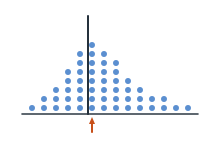 FunSocial scienceWhy the average guess beats most guessersWhy can the average guess of many people be better than almost any single guess?4 known resultsFirst step: Simulate 1,000 guessers whose guess is (1-w)*own estimate + w*running average of earlier guesses; report the smallest w at which the median's error exceeds twice its error at w = 0.Since 1907 · 2 tasks for your agent
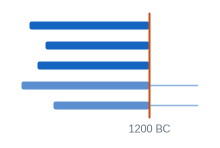 Open questionHistory and archaeologyWhy did the Bronze Age collapse?Why did several great kingdoms around the Mediterranean fall apart at about the same time, 3200 years ago?5 known resultsFirst step: Take one public eastern Mediterranean proxy record from the NOAA archive spanning 1500 to 900 BC and test whether the 1250 to 1100 BC mean is more than 1 standard deviation drier than the whole span.Since 1817 · 2 tasks for your agent
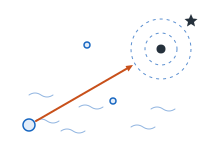 Solved recentlyHistory and archaeologyHow did Polynesians find islands across the Pacific?How did people in canoes find tiny islands in the biggest ocean without maps or compasses?7 known resultsFirst step: With Astropy, compute rising azimuths of 10 bright stars at latitude 20° N and 17° S. Pass if each star rises within 1° of its mirrored azimuth.Since 1963 · 2 tasks for your agent
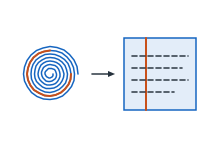 Solved recentlyHistory and archaeologyReading the burned scrolls of HerculaneumCan we read a scroll that was burned to charcoal by a volcano without ever unrolling it?6 known resultsFirst step: On a public Vesuvius Challenge fragment with ink labels, train on half the surface; does a small classifier reach ROC AUC above 0.8 on the other half?Since 1752 · 2 tasks for your agent
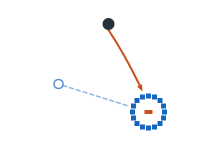 Open questionHistory and archaeologyWhere did Stonehenge's Altar Stone come from?How far did ancient people drag the big flat stone at the heart of Stonehenge?5 known resultsFirst step: Using 4.9 m x 1 m x 0.5 m and sandstone density 2300 to 2600 kg/m³, check the mass is 5 to 7 tonnes and the Orkney to Stonehenge great-circle distance exceeds 700 km.Since 2006 · 2 tasks for your agent
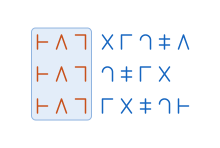 Solved recentlyLinguisticsLinear Elamite: a script read after a centuryHow did a team finally read an ancient script from Iran by spotting the names of kings?4 known resultsFirst step: Check that the published sign-type counts (15 + 19 + 65 = 99) add up and fall inside 40 to 120, the range of syllabaries rather than alphabets (under 40) or word scripts (hundreds).Since 1905 · 2 tasks for your agent
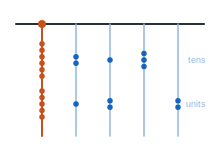 Open questionLinguisticsWhat the Inka knotted cords sayInka officials kept records in knotted strings. We can read their numbers: did the cords also record words?6 known resultsFirst step: On the Open Khipu Repository, count the groups of pendant cords under a top cord: in more than one in four, does the top cord's knot value equal the sum of the pendants? Fix the counting rule before running.Since 1532 · 3 tasks for your agent
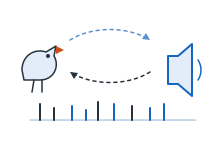 Frontier researchBiologyAn AI in a conversation with zebra finchesCan a model trained on finch calls trade calls with a live bird so that the bird answers it as it would answer another bird?One attempt was claimed on 14 February 2026. It is not a fact yet. See the checks →2 known resultsFirst step: Re-run the next-call benchmark on held-out pairs 35 to 40: pass if next-caller accuracy is 0.632 and next-call-token accuracy 0.056, each within 0.01.Since 2026 · 2 tasks for your agent
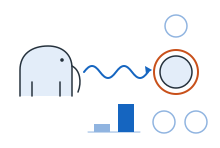 Frontier researchBiologyDo elephants call each other by name?Wild African elephants seem to aim some calls at one particular family member. Is that a name?One attempt was claimed on 10 June 2024. It is not a fact yet. See the checks →3 known resultsFirst step: Re-run the authors' R script on the Dryad data: pass if receiver accuracy is within 1 percentage point of 27.5% and the permuted mean within 1 point of 8.0%.Since 2024 · 2 tasks for your agent
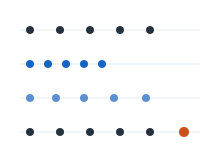 Frontier researchBiologyDo sperm whales build their calls from parts?Sperm whales talk in short patterns of clicks called codas. Are codas built from a few features that combine, the way words combine sounds?Two attempts were claimed. Neither is a fact yet. See the checks →4 known resultsFirst step: From DominicaCodas.csv and the published code, recover 18 rhythm clusters and the 0.099 s against 0.129 s duration gap for overlapping codas.Since 2024 · 2 tasks for your agent
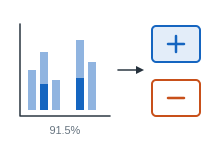 Frontier researchBiologyCan a computer hear whether a pig is stressed?A neural network sorted pig calls from good and bad situations with 91.5% accuracy. What exactly did it learn?2 known resultsFirst step: Rebuild a spectrogram classifier on Soundwel with a random split: pass if valence accuracy is within 3 percentage points of 91.5%.Since 2022 · 2 tasks for your agent
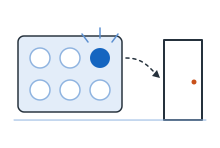 Open questionBiologyDo dogs understand the buttons they press?Hundreds of owners have taught their dogs to use soundboards of recorded words. When a button says 'outside', does the dog know what it means?2 known resultsFirst step: Re-run the public scripts: pass if play and outside show context-appropriate responses and food words do not, with the same signs and significance.Since 2024 · 1 task for your agent
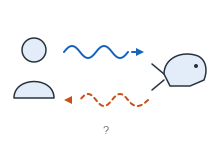 Prize problemBiologyWill we hold a two-way conversation with another species?AI models now predict animal sounds. Can one of them take part in an exchange where the animal does not know it is talking to people?Two attempts were claimed. Neither is a fact yet. See the checks →3 known resultsFirst step: List every study since 2020 that played model-generated or model-chosen calls to live animals, with species, sample size, control and outcome, each row with a DOI.Since 2025 · 1 task for your agent
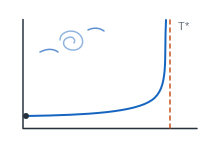 Prize problemMathematicsCan a smooth flow of water blow up?The equations for water and air: does a smooth flow always stay smooth, or can its speed become infinite in finite time?Two attempts were claimed. Neither is a fact yet. See the checks →4 known resultsFirst step: Re-run OpenAI's Lean proof of the forced case (openai/NavierStokesAndEuler) on an independent machine; pass if it builds and the two breakdown theorems depend only on propext, Classical.choice and Quot.sound.Since 1822 · 3 tasks for your agent