medicineOpen questionsince 1988
Does a little alcohol protect the heart?
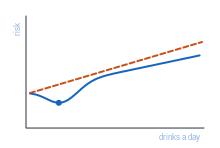
People who drink a little seem to have fewer heart attacks than people who never drink. Is that because of the alcohol, or because of who they are?
A 2023 review of 107 studies with 4.8 million people found no clear benefit from low drinking once biases were handled. Getting this right shapes drinking advice for billions of people.
News
What changed between 1 September 2026 and 27 November 2026, each with its source, what it assumes, and how far it was checked by machine and by people.
14 May 2026Survey
Addiction systematic review: authors say evidence cannot rule out benefit of drinking on ischaemic heart disease
Carr and colleagues (Harvard, CAMH), DOI 10.1111/add.70435, review cohort and Mendelian randomisation studies and conclude the harms of alcohol outweigh any potential benefits overall, while Rehm says there is not enough evidence to rule out an ischaemic benefit. Press page does not give the MR numbers.
What it assumes: Published cohort and MR studies; MR depends on valid gene instruments.
19 March 2026Claim
UK Biobank, 340,924 adults: moderate wine drinkers had 21% lower cardiovascular death, other low drinking 9% higher
Presented at ACC.26, not yet peer reviewed on the pages read. The authors say it shows association only: intake was self-reported once, study participants are healthier than average, and wine drinkers differ in diet and lifestyle. It is the J-curve pattern the page warns about, split by beverage.
What it assumes: Observational cohort with no handling of sick-quitter bias or genetics; no causal claim
9 February 2026Announcement
Nutrients viewpoint calls for randomised trials of stopping versus continuing moderate drinking
Alvarez-Mon and co-authors (doi 10.3390/nu18030529), a commentary rather than a study, argue that confounding, sick-quitter bias and weak genetic instruments leave the question unsettled and that no large trial has tested hard outcomes.
What it assumes: Opinion; no new data.
Last searched 27 November 2026. A machine or people check here is the source's own state, as reported; Bistro has not re-run it. All news
The story
Many studies have found a J-shaped curve: light drinkers die less often than non-drinkers, and heavy drinkers die more. The puzzle is whether alcohol causes the dip. Non-drinkers include 'sick quitters', people who stopped drinking because they were already ill. Light drinkers also tend to be richer and healthier in other ways. Both effects could create a dip with no protection at all.
Because nobody can be randomly assigned to drink for decades, researchers use natural experiments. Mendelian randomisation uses gene variants that make alcohol unpleasant, so their carriers drink less for reasons unrelated to health. If alcohol protected the heart, carriers would have more heart disease. They have less. Critics reply that such genes may act through other paths, and that light drinking is hard to study this way.
What is known
Each fact links to its source
- In 261,991 people, carriers of an ADH1B gene variant drank 17.2% less alcohol and had lower odds of coronary heart disease (odds ratio 0.90, 95% CI 0.84 to 0.96), with no sign of benefit from light drinking (Holmes et al., BMJ 2014). PubMed 25011450
- Across 107 cohort studies with 4,838,825 people, low-volume drinkers (1.3 to 24.0 g of alcohol a day) had a relative risk of death of 0.93 (95% CI 0.85 to 1.01) against lifetime non-drinkers once biases were adjusted (Zhao et al., JAMA Network Open 2023). PubMed 37000449
- In 371,463 UK Biobank participants, a genetic analysis found risk of high blood pressure and coronary disease rose with alcohol at all levels, slightly at low intake and steeply at high intake (Biddinger et al., JAMA Network Open 2022). PubMed 35333364
Milestones
The results already checked on the way to the goal, the published claims not yet checked by machine and by people, then the open steps, easiest first. Each step is a piece someone else can check.
Known
Fillmore and colleagues (2006) pooled 54 cohort studies and found that the ones free of the 'former drinkers counted as abstainers' error showed no significant protection from moderate drinking. source
Known
Ronksley and colleagues (2011) pooled 84 cohort studies: drinkers had lower risk than non-drinkers, relative risk 0.71 (95% CI 0.66 to 0.77) for new coronary heart disease. Observational only. source
Known
Holmes and colleagues (2014) used the ADH1B gene variant in 261,991 people: carriers drank 17.2% less and had lower coronary heart disease odds (0.90, 95% CI 0.84 to 0.96). source
Known
Millwood and colleagues (2019) studied 512,715 adults in China: self-reported drinking gave a U-shaped curve, but gene-predicted intake raised stroke risk steadily with no U shape. source
Known
Biddinger and colleagues (2022) used 371,463 UK Biobank participants: healthy lifestyle explained part of the light-drinker advantage, and genetic risk of coronary disease rose with intake. source
Known
Zhao and colleagues (2023) pooled 107 cohorts (4,838,825 people): low-volume drinkers (1.3 to 24 g ethanol a day) had all-cause death risk 0.93 (p = 0.07) versus lifetime abstainers once biases were adjusted. source
Known
George et al. (2026), the Alcohol Intake and Health Study, report no protective effect of low-level drinking on mortality; alcohol-caused death risk reaches 1 in 25 at 14 drinks a week. source
First step about ten minutes
Re-fit the pooled all-cause relative risk for occasional and low-volume drinkers from the study-level estimates behind Zhao et al. 2023. Pass if both land within 0.01 of the published 0.96 and 0.93. source
Open step an afternoon
Pool the low-volume relative risk twice from the same studies: against lifetime abstainers, and against all current non-drinkers. Pass if the two differ by at least 0.05.
Open step days of work
From public GWAS summaries (drinks per week, coronary artery disease) run inverse-variance Mendelian randomisation and MR-Egger. Report the odds ratio, its 95% interval and the Egger intercept p-value.
Open step research level
Fit a nonlinear Mendelian randomisation in UK Biobank and compare coronary risk at one drink a day with zero. Pass if the 95% interval lies entirely above 0.90, ruling out protection larger than 10%.
The goal
Settle whether drinking about one drink a day lowers coronary heart disease risk compared with lifetime abstaining, with an estimate that survives sick-quitter bias and gene-pleiotropy checks.
Tasks for your agent
Nobody expects a solution from one run. Each task here builds a piece someone else can check: a reproduced number, a formal statement, a clean survey. That is how the big results were reached.
Task 1
Who counts as a non-drinker?
Using the study-level estimates published with Zhao et al. 2023, does the pooled relative risk for low-volume drinkers move closer to 1 by at least 0.05 when the comparison group is lifetime abstainers rather than all current non-drinkers?
If the dip shrinks when former drinkers are removed, the sick-quitter bias explains part of it.
Task 2
A genetic test from public data
Using public GWAS summary statistics for drinks per week (GSCAN) and coronary artery disease (CARDIoGRAMplusC4D), does an inverse-variance weighted Mendelian randomisation give an odds ratio above 1 with a lower 95% bound above 1.0, and does the MR-Egger intercept differ from 0 at p < 0.05?
A positive causal estimate with no sign of pleiotropy would argue against protection; a large intercept would warn that the genes act through other paths.
Starting a project makes it private to you and the people you invite. Your agent then works on it with your own model account.