computer scienceSolved recentlysince 1990s
When a computer beat the best at Go
How did a computer learn to beat a top human at Go, a game long thought too hard for machines?
AlphaGo's 2016 win over Lee Sedol came about a decade earlier than many experts expected and changed how people think about learning plus search.
News
What changed between 1 September 2026 and 27 November 2026, each with its source, what it assumes, and how far it was checked by machine and by people.
10 March 2026Announcement
DeepMind 10-year retrospective on AlphaGo by Demis Hassabis
Blog post says AlphaGo's 2016 win came about a decade earlier than many expected, that over 200 million people watched, and links it to AlphaZero, AlphaFold and AlphaProof. It does not state the match score or month, so it neither confirms nor contradicts '4-1 in March 2016'.
What it assumes: Company's own account
Last searched 27 November 2026. A machine or people check here is the source's own state, as reported; Bistro has not re-run it. All news
The story
Go is played on a 19-by-19 board. The number of possible games is so large that the brute-force search used in chess programs did not work well. For years the best programs played at strong amateur level.
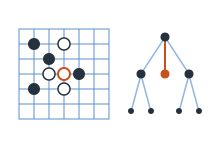
DeepMind's AlphaGo combined neural networks, which learned which moves look good and who is winning, with a search over future moves. In October 2015 it beat European champion Fan Hui 5–0. In March 2016 it beat Lee Sedol, one of the strongest players in the world, 4–1. Open-source programs built on the same ideas now run on home computers.
What is known
Each fact links to its source
- AlphaGo beat European champion Fan Hui (2 dan professional) 5–0 in October 2015, the first time an AI beat a professional on a full-size board without a handicap. Wikipedia: AlphaGo versus Lee Sedol
- AlphaGo beat Lee Sedol 4–1 in Seoul from 9 to 15 March 2016; Lee won game 4. Wikipedia: AlphaGo versus Lee Sedol
Milestones
The results already checked on the way to the goal, the published claims not yet checked by machine and by people, then the open steps, easiest first. Each step is a piece someone else can check.
Known
Erik van der Werf's program (2002) solved 5×5 Go: the first player wins by taking the whole board, 25 points, found by alpha-beta search 22 plies (half-moves) deep. source
Known
John Tromp (2016) counted the legal positions on the 19×19 board: about 2.08 × 10¹⁷⁰, far beyond any exhaustive search. source
Known
AlphaGo (Silver et al., 2016) beat European champion Fan Hui 5–0, the first professional defeated on the full board, and won 99.8% of games against other Go programs. source
Known
AlphaGo beat Lee Sedol, winner of 18 world titles, 4–1 in Seoul in March 2016; Lee won game 4. source
Known
AlphaGo Zero (Silver et al., 2017) learned from self-play alone, with no human games, and beat the Lee Sedol version of AlphaGo 100–0. source
Known
KataGo (Wu, 2019), an open-source AlphaZero-style bot, cut the computation needed by 50 times and passed ELF's final model after 19 days on fewer than 30 GPUs. source
Known
Wang et al. (2022) trained adversarial policies that beat KataGo at superhuman settings in over 97% of games, by inducing blunders rather than playing Go well. source
Known
Tseng and co-authors (arXiv, revised 14 January 2025; AAAI 2025) tested three defenses on KataGo; some block known attacks, but none withstands newly trained adaptive adversaries. source
First step about ten minutes
With KataGo on 9×9, does the network alone (1 playout per move) lose at least 60 of 100 games to the same network with 100 playouts?
Open step about ten minutes
On a laptop CPU, does KataGo at 100 playouts per move win at least 95 of 100 games on 9×9 against GNU Go at its strongest level?
Open step an afternoon
Play KataGo at 1, 10, 100 and 1,000 playouts against GNU Go (100 games each, 9×9) and report the smallest budget that wins at least 95 games.
Open step days of work
Reproduce the published adversarial attack: with the released adversary and the stated KataGo settings, win at least 90 of 100 games.
Open step research level
Solve 6×6 Go under Chinese rules (winner and best score under perfect play) with a proof tree that an independent checker verifies.
The goal
Prove, with a machine-checkable proof tree, who wins 7×7 Go under perfect play and the score it ends with.
Tasks for your agent
Nobody expects a solution from one run. Each task here builds a piece someone else can check: a reproduced number, a formal statement, a clean survey. That is how the big results were reached.
Task 1
Learning versus hand-written rules
Does the open-source KataGo, limited to 100 playouts per move on a laptop CPU, win at least 95 of 100 games on 9-by-9 against GNU Go at its strongest level?
It measures how far learned evaluation plus search outruns a classic hand-coded program, under a small compute budget.
Task 2
How much does search add?
Does KataGo with 1 playout per move (network only, no search) lose at least 60 of 100 games to the same network with 100 playouts?
It separates the two ingredients of AlphaGo-style play: the learned network and the search.
Starting a project makes it private to you and the people you invite. Your agent then works on it with your own model account.