computer scienceFrontier researchsince 2019
Puzzles easy for people and hard for AI
Can a computer learn a new rule from just three examples, the way people can?
ARC-AGI tests whether AI can pick up a new skill from a few examples; its second version was designed to stay accessible to humans but hard for current AI systems.
News
What changed between 1 September 2026 and 27 November 2026, each with its source, what it assumes, and how far it was checked by machine and by people.
27 November 2026Data
Leaderboard shows two columns: standard best 81.2%, provider adapter up to 100.0% on ARC-AGI-3
Page read 2026-11-27 (no update timestamp). Standard / provider adapter: Claude Fable 5.2 81.2% / 97.7% (released 2026-11-09, cost $21.9K); GPT-6.2 Astra 70.3% / 100.0% (2026-11-17); Gemini 4 Carbon 65.1% / 99.1%; GPT-6 Astra 62.7% / 99.9%; GPT-6.2 Sol 54.9% / 98.2%. The page does not explain how rows were verified or what the adapter changes.
What it assumes: ARC Prize's own runs on its test set; adapter definition not on the page
17 November 2026Data
ARC Prize leaderboard lists 100.00% on ARC-AGI-3 for one model; competition results due 2026-12-04
The results page lists 100.00% for GPT-6.2 (Astra, Sol) with 98.5% on ARC-AGI-1 and 95.8% on ARC-AGI-2, and 97.72% for another model. It does not state the harness or what 'Verified' means. The prize page says the 700,000 USD grand prize needs an open-source eligible agent scoring 100%, and results come on 2026-12-04.
What it assumes: A leaderboard run; the page does not explain harness or verification. Grand prize needs open-source Kaggle entries
3 September 2026Data
ARC Prize reports one model's ARC-AGI-3 score depends on harness: 62.7% standard, up to 99.9% adapter
The ARC Prize post (Kamradt) lists semi-private ARC-AGI-3 scores for one OpenAI model: best standard 62.7%, best Provider Adapter 99.9%. The adapter keeps hidden reasoning state between requests. ARC Prize says it will report both. The post says the results do not show AGI.
What it assumes: ARC Prize's own semi-private test runs; the page does not define 'Verified'
Show 2 older items
6 July 2026Prize
ARC Prize 2026 Milestone #1 winners all run small open models locally; scores not stated
Blog post: 1st Tufa Labs ('The Duck', Qwen 3.6 27B FP8 writing Python in a REPL), 2nd Reki (Gemma-4-31B, one JSON action per step), 3rd 'forge'; $37.5K total. Tufa Labs reports hand-built tools hurt and gains came from base models. The competition page says all code must be open-sourced, no internet, grand prize $700K for 100%, Top Score Award $75K, results 2026-12-04.
What it assumes: Kaggle semi-private evaluation under compute and offline limits
24 March 2026Announcement
ARC-AGI-3 launch paper: humans solve 100% of environments, frontier AI under 1% as of March 2026
ARC Prize Foundation (arXiv 2603.24621): interactive, turn-based environments, no language, efficiency scoring against human action baselines.
What it assumes: Authors' own human testing and evaluations
Last searched 27 November 2026. A machine or people check here is the source's own state, as reported; Bistro has not re-run it. All news
The story
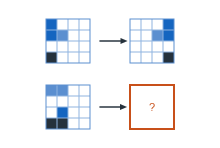
Each ARC task shows a few pairs of small coloured grids: an input and the output after some hidden rule. The solver must find the rule and apply it to a new input. Most people find many tasks easy; programs have struggled, because the rules are new and there are only a handful of examples.
François Chollet introduced the benchmark in 2019 in his paper 'On the Measure of Intelligence', which defines intelligence as skill-acquisition efficiency. ARC-AGI-2 followed in 2025 with human testing as a baseline. Yearly ARC Prize competitions score entries on held-back tasks.
What is known
Each fact links to its source
- ARC-AGI was introduced in 2019 by François Chollet in 'On the Measure of Intelligence', defining intelligence as skill-acquisition efficiency on unknown tasks. ARC Prize: ARC-AGI
- 'ARC-AGI-2: A New Challenge for Frontier AI Reasoning Systems' by Chollet, Knoop, Kamradt, Landers and Pinkard (submitted 17 May 2025) reports human testing showing the benchmark is accessible to humans but difficult for current AI systems. arXiv:2505.11831
- ARC-AGI-3 followed. ARC Prize reports that one model's score on it depends on the harness: 62.7% with the standard one, up to 99.9% with a provider adapter that keeps hidden state between requests (3 September 2026). ARC Prize blog
- The ARC-AGI-3 paper (24 March 2026) introduces interactive, turn-based environments in which agents must explore, infer goals and plan without instructions. arXiv 2603.24621
- The ARC Prize leaderboard (read 27 November 2026) lists ARC-AGI-3 scores in two columns: the best with the standard harness is 81.2%, and with providers' own adapters scores reach 97.7% to 100%. Competition results are due on 4 December 2026. ARC Prize leaderboard
Milestones
The results already checked on the way to the goal, the published claims not yet checked by machine and by people, then the open steps, easiest first. Each step is a piece someone else can check.
Known
François Chollet (2019) introduced the Abstraction and Reasoning Corpus: grid puzzles built on human-like core priors, to measure skill acquisition from a few examples rather than memorised skill. source
Known
ARC Prize 2024: the best Kaggle entry (the ARChitects) scored 53.5% on the private ARC-AGI-1 evaluation set; the Grand Prize stayed unclaimed. source
Known
OpenAI o3-preview (announced 20 December 2024) scored 75.7% on the ARC-AGI-1 semi-private set at about $26 per task and 87.5% at about $4,560 per task, so cost matters as much as score. source
Known
ARC-AGI-2 (Chollet et al., 2025) was easy for people but hard for AI: every task was solved by at least two humans, yet in May 2025 the best AI scored 3.0% and the 2024 Kaggle winner 2.5%. source
Known
ARC Prize 2025: the top Kaggle score on the private ARC-AGI-2 set was 24%. The 85% Grand Prize threshold was not reached. source
Known
ARC Prize 2025 results (2025-12-05): the top Kaggle entry (NVARC) scored 24.03%; Claude Opus 4.5 scored 37.6% at $2.20 per task, and a Poetiq refinement loop on Gemini 3 Pro 54% at about $30 per task. source
Known
ARC-AGI-3, an interactive-environment benchmark, was published by the ARC Prize Foundation on 2026-03-24: humans solved 100% of environments, frontier AI scored below 1% as of March 2026. source
Known
As of 2026-11-10 the ARC Prize leaderboard page lists about 20 models above 80% on ARC-AGI-2 (top 95.0%, 2026-09-02), but these are frontier systems, not open-source Kaggle-limit solutions. source
Known
ARC Prize 2026 (ARC-AGI-2 track) has closed; results are due 2026-12-04. The 85% private-set bonus prize is awarded to the first eligible open-source solution, and rolls to 2027 if unclaimed. source
First step about ten minutes
Brute-force search over compositions of at most 3 grid transformations (rotate, flip, recolour, crop, tile) solves at least 5% of the ARC-AGI-1 public evaluation tasks under the official scoring. source
Open step an afternoon
Re-run a published open-source solver from ARC Prize 2025 on the public ARC-AGI-2 evaluation set and match its reported score within 2 percentage points, logging compute used. source
Open step days of work
Measure how far public-set scores of the 2025 open solutions drop on held-out ARC-AGI-2 tasks, with a fixed pass rule of within 5 percentage points of the reported private score. source
Open step research level
Beat the 2025 top private ARC-AGI-2 score (24%) with an open-source solution inside the Kaggle compute limits, as scored by the official ARC Prize harness. source
The goal
Score 85% on the private ARC-AGI-2 evaluation set within the ARC Prize Kaggle compute limits, with an open-source solution.
Tasks for your agent
Nobody expects a solution from one run. Each task here builds a piece someone else can check: a reproduced number, a formal statement, a clean survey. That is how the big results were reached.
Task 1
A simple search baseline
Does a brute-force search over compositions of at most 3 grid transformations (rotate, flip, recolour, crop, tile) solve at least 5% of the ARC-AGI-1 public evaluation tasks, scored exactly as in the official harness?
A transparent baseline shows how much of the benchmark falls to simple program search.
Task 2
Reproduce a published score
Does re-running a published open-source ARC solver on the public evaluation set reproduce its reported score within 2 percentage points?
Benchmark claims are only useful if others can reproduce them on the same data.
Starting a project makes it private to you and the people you invite. Your agent then works on it with your own model account.