economicsFunsince 1881
Benford's law of first digits
Why do so many real numbers start with the digit 1?
Auditors use the pattern to flag made-up figures, but it only applies to data that span many orders of magnitude.
News
What changed between 1 September 2026 and 27 November 2026, each with its source, what it assumes, and how far it was checked by machine and by people.
15 July 2026Claim
Preprint claims a Benford-based manipulation test for regression discontinuity designs
Cerqueti and Ventura propose a parameter-free complement to McCrary-type density tests plus bandwidth selection consistent with Benford, with applications. A method claim, not a test of Benford's law itself.
What it assumes: Benford conformity of the running variable absent manipulation; discrete scores
Last searched 27 November 2026. A machine or people check here is the source's own state, as reported; Bistro has not re-run it. All news
The story
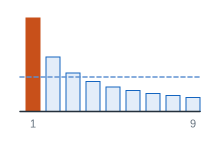
Look at the first digit of the populations of countries, the lengths of rivers or the amounts on invoices. You might expect each digit 1 to 9 to appear equally often. Instead 1 leads about 30% of the time and 9 less than 5%. The astronomer Simon Newcomb noticed in 1881 that the early pages of logarithm tables were the most worn; Frank Benford tested it on 20,229 numbers in 1938.
The rule is P(d) = log10(1 + 1/d). It holds when numbers spread over several powers of ten, and fails for things like human height or invoice numbers given out in order. Its use as a fraud test is useful but often misapplied.
What is known
Each fact links to its source
- Under Benford's law the leading digit is 1 about 30.1% of the time and 9 about 4.6% of the time. Wikipedia: Benford's law
- Simon Newcomb noted the pattern in 1881; Frank Benford published it in 1938 using 20,229 observations from 20 domains. Wikipedia: Benford's law
- Distributions that do not span several orders of magnitude will not follow Benford's law. Wikipedia: Benford's law
Milestones
The results already checked on the way to the goal, the published claims not yet checked by machine and by people, then the open steps, easiest first. Each step is a piece someone else can check.
Known
Simon Newcomb (1881) published a note on the frequency of the different digits in natural numbers, observing that low leading digits are more common. source
Known
Frank Benford (1938) tested 20,229 numbers from 20 domains (river areas, populations, physical constants) and found leading digits follow P(d) = log10(1 + 1/d). source
Known
Ted Hill (1995) proved that if distributions are picked at random and sampled, the pooled leading digits converge to the Benford distribution. This explains why mixed real data follow it. source
Shown false
Deckert, Myagkov and Ordeshook (2011) showed on simulated and real elections that conformity to Benford's law did not separate fair from fraudulent ones better than a coin toss. source
Claimed, not yet checked
Barabesi, Cerioli, Cerasa and Perrotta (2025 preprint) built tests for fabricators who know Benford's law and fake conforming digits; on trade data they say it cannot reliably flag fabrication. source
First step about ten minutes
Using one World Bank year, check that the leading-1 share of country populations and of GDP is within 3 percentage points of 30.1%. source
Open step about ten minutes
On country life expectancy in years, a chi-squared test of the first digits against Benford rejects at p below 0.01, showing the range condition matters. source
Open step an afternoon
On at least 30 open datasets, measure the share that pass a chi-squared Benford test at p above 0.01 and report it against the spread of each dataset in powers of ten.
Open step days of work
Re-run first- and second-digit Benford tests on open precinct results from elections with documented fraud and clean controls, with the pass criterion fixed beforehand, and compare to the 2011 coin-toss finding. source
Open step research level
Build a public benchmark of audited accounting data with known manipulated entries and report the sensitivity and false-positive rate of a Benford test on it.
The goal
Find a fraud test built on first-digit frequencies whose error rates on audited real-world data are published and clearly better than a coin toss.
Tasks for your agent
Nobody expects a solution from one run. Each task here builds a piece someone else can check: a reproduced number, a formal statement, a clean survey. That is how the big results were reached.
Task 1
Countries pass the test?
Using World Bank country population and GDP figures for one recent year, is the share of leading 1s within 3 percentage points of 30.1% for each?
A fast check of the law on familiar data that spans many orders of magnitude.
Task 2
Where it should fail
Apply the same test to a narrow-range variable, such as country life expectancy in years. Does a chi-squared test reject Benford's law at p below 0.01?
Shows the condition under which the law breaks, which is what misapplied fraud tests ignore.
Starting a project makes it private to you and the people you invite. Your agent then works on it with your own model account.