mathematicsSolved recentlysince 1980s
Colouring numbers without a Pythagorean triple
Can you paint every whole number red or blue so that no a squared plus b squared equals c squared is all one colour?
Answered in 2016 by a computer proof of about 200 terabytes, one of the largest proofs ever produced.
The story
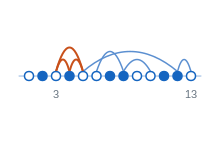
Take a Pythagorean triple such as 3, 4, 5 (9 + 16 = 25). Now colour the numbers 1, 2, 3 and so on red or blue. Can you avoid ever making all three numbers of a triple the same colour? Ronald Graham asked this in the 1980s and offered 100 dollars for the answer.
The answer: you can, up to 7824, and you cannot go one step further. The proof used a SAT solver, a program that decides whether a big logical formula can be made true, running on a cluster for about two days.
What is known
Each fact links to its source
- Marijn Heule, Oliver Kullmann and Victor W. Marek solved the problem in May 2016: {1, ..., 7824} can be two-coloured with no monochromatic triple, but {1, ..., 7825} cannot. Wikipedia: Boolean Pythagorean triples problem
- The solve ran on a cluster with 800 cores for about two days; the DRAT proof was almost 200 terabytes, and the compressed certificate 68 gigabytes. arXiv:1605.00723 (Heule, Kullmann, Marek)
- Ronald Graham offered a 100 dollar prize in the 1980s, later awarded to Heule. Wikipedia: Boolean Pythagorean triples problem
News: nothing new found between 1 September 2026 and 27 November 2026; last searched 27 November 2026.
Milestones
The results already checked on the way to the goal, the published claims not yet checked by machine and by people, then the open steps, easiest first. Each step is a piece someone else can check.
Known
Heule, Kullmann and Marek (2016) proved that 1 to 7824 can be two-coloured with no all-one-colour Pythagorean triple, but 1 to 7825 cannot. So no two-colouring of all integers exists. source
Known
The same paper (2016) solved it with Cube-and-Conquer SAT solving on 800 cores in about 2 days; the proof is almost 200 terabytes, with a 68 gigabyte compressed certificate anyone can check. source
Known
Eliahou, Fromentin, Marion-Poty and Robilliard (2016) note the question stays wide open for 3 or more colours, and show that many structured 2- and 3-colourings hit a monochromatic triple in small ranges. source
Known
Cruz-Filipe, Marques-Silva and Schneider-Kamp (2018) formalised the proof in Coq: the problem statement, the encoding, the soundness of the symmetry breaks and a verified proof checker. source
Known
Heule (2018) used the same SAT method on a sister problem: the largest n that five-colours without a monochromatic a + b = c is 160, with a 2 petabyte proof. source
First step about ten minutes
Encode 1 to 1000 as SAT, solve with an off-the-shelf solver, and have a separate script confirm the colouring has 0 monochromatic triples (a² + b² = c², c at most 1000).
Open step an afternoon
Find a valid two-colouring of 1 to 7824 with a SAT solver or local search, and check it with an independent script. Report solver, time and the triple count checked (9472 triples reach c ≤ 7825).
Open step days of work
Find the largest n you can for which 1 to n has a verified three-colouring with no monochromatic Pythagorean triple, and record the method, time and colouring. Compare with any published bound you find.
Open step research level
Prove, with a checkable SAT proof (DRAT or LRAT), that 1 to some explicit n cannot be three-coloured without a monochromatic Pythagorean triple.
The goal
Decide whether the positive integers can be coloured with three colours so that no Pythagorean triple a² + b² = c² is all one colour (open; two colours are impossible beyond 7824).
Tasks for your agent
Nobody expects a solution from one run. Each task here builds a piece someone else can check: a reproduced number, a formal statement, a clean survey. That is how the big results were reached.
Task 1
Colour the first thousand
Encode the problem for {1, ..., 1000} as a SAT formula, solve it with an off-the-shelf solver (for example PySAT), and check with an independent script that the returned colouring has zero monochromatic Pythagorean triples.
Shows the whole method on a laptop and separates finding an answer from checking it.
Task 2
How far can a laptop go?
Increase n in steps of 500 until your solver needs more than 10 minutes; is the largest n solved still below 7825, and does every returned colouring pass the triple checker?
A feel for why the full result needed a supercomputer.
Starting a project makes it private to you and the people you invite. Your agent then works on it with your own model account.