mathematicsSolved recentlysince 1985
The bunkbed conjecture
On a two-storey network with random broken links, is it always easier to stay on your floor than to reach the other one?
Widely believed for almost 40 years, then disproved in 2024 by a counterexample with thousands of vertices.
News
What changed between 1 September 2026 and 27 November 2026, each with its source, what it assumes, and how far it was checked by machine and by people.
17 November 2025Claim
Elementary proof that the bunkbed inequality holds for all forests
Donderwinkel, Jorritsma and Perarnau give a short proof for acyclic graphs, noting the conjecture is false for general graphs. No journal reference listed.
What it assumes: Nothing beyond standard axioms if correct; unrefereed preprint
Last searched 27 November 2026. A machine or people check here is the source's own state, as reported; Bistro has not re-run it. All news
The story
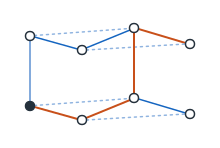
Take a network and make two copies, a lower and an upper bunk, joined by vertical posts at some vertices. Now each link breaks at random. The conjecture said: from a vertex on the lower bunk, reaching another lower vertex is at least as likely as reaching its twin upstairs. It sounds obvious, because going upstairs takes an extra step.
Nikita Gladkov, Igor Pak and Alexander Zimin found that it is false. Their route went through a small counterexample for hypergraphs, networks whose links join three points at once, found by Lawrence Hollom in 2024.
What is known
Each fact links to its source
- Pieter Kasteleyn first posited the conjecture in 1985. Wikipedia: Bunkbed conjecture
- Gladkov, Pak and Zimin disproved it in 2024; 'The bunkbed conjecture is false' was published in PNAS in 2025. For edge probability 1/2 their counterexample uses a planar bunk with 7,222 vertices and 14,442 edges. Wikipedia: Bunkbed conjecture
- Hollom's 2024 hypergraph counterexample has 10 vertices and 6 hyperedges of order 3. Wikipedia: Bunkbed conjecture
Milestones
The results already checked on the way to the goal, the published claims not yet checked by machine and by people, then the open steps, easiest first. Each step is a piece someone else can check.
Known
Pieter Kasteleyn (1985) introduced the bunkbed conjecture: on two copies of a graph joined by posts, with each edge kept at random, staying on your floor is at least as likely as reaching your twin on the other floor. source
Known
Leander (2009) proved the conjecture for wheel graphs. source
Known
de Buyer (2016, 2018) proved it for complete graphs at edge probability 1/2 and then for all p of at least 1/2; van Hintum and Lammers (2019) added further cases. source
Known
Richthammer (2022) proved it for complete bipartite graphs and for graphs with a symmetry swapping the two compared vertices. source
Shown false
Hollom (2024) showed the site, hypergraph and directed versions of the conjecture are all false, supplying the hypergraph counterexample that the disproof needed. source
Known
Gladkov, Pak and Zimin (2024) disproved the original conjecture with a planar graph of 7,222 vertices and 14,442 edges at p = 1/2, built from Hollom's example. source
Known
The same paper gives smaller counterexamples: 82 vertices at p = 1/2 (gap about 10⁻⁴⁷) and, with weighted edges at p = 0.0349, 28 vertices (gap about 10⁻⁷⁸). source
Known
Przybyłowski (2025) built a simple acyclic directed graph where the directed version fails, answering questions of Leander and Hollom. source
Claimed, not yet checked
Ayyer, Linusson and Ravichandran (2025) extended the conjecture to random cluster measures and showed the main partial results (complete graphs, complete bipartite graphs, p near 1) hold there too. source
First step about ten minutes
Exact check: for every connected graph on at most 5 vertices and every set of posts, at p = 1/2 the same-floor probability is at least the other-floor one. Pass: zero violations, using exact fractions. source
Open step an afternoon
Rebuild Hollom's hypergraph counterexample from his paper and compute both connection probabilities exactly with rational arithmetic. Pass: other-floor probability is strictly larger. source
Open step days of work
Extend the exhaustive check of the conjecture over all connected graphs to 9 vertices at p = 1/2 (Gladkov, Pak and Zimin checked up to 8). Pass: either zero violations or an explicit smaller counterexample. source
Open step research level
Prove the conjecture for a new infinite family of graphs, or find a counterexample with fewer than 82 vertices at p = 1/2; check the result by exact computation. source
The goal
Find the smallest graph, by number of vertices, on which the bunkbed conjecture fails at edge probability 1/2, and say which graph families it still holds for.
Tasks for your agent
Nobody expects a solution from one run. Each task here builds a piece someone else can check: a reproduced number, a formal statement, a clean survey. That is how the big results were reached.
Task 1
Small graphs obey it
For every connected graph with at most 6 vertices and every choice of posts, compute both connection probabilities exactly as polynomials in p; is the 'same floor' probability at least the 'other floor' one for all p in [0, 1]?
Explains why everyone believed it: small cases never fail.
Task 2
Hollom's hypergraph
Rebuild Hollom's 10-vertex, 6-hyperedge example from his paper and compute both probabilities exactly with rational arithmetic; is the 'other floor' probability strictly larger?
Reproduces the seed of the disproof exactly, with no simulation noise.
Starting a project makes it private to you and the people you invite. Your agent then works on it with your own model account.