medicinePuzzlesince 2013
Can cancer lab results be repeated?
If another lab does the same experiment, do they get the same answer?
A large project found replicated effects were much smaller than the originals, which matters for which ideas move toward patients.
The story
The Reproducibility Project: Cancer Biology tried to repeat key experiments from high-profile cancer biology papers. Many could not even be started, because the original papers did not describe methods in enough detail.
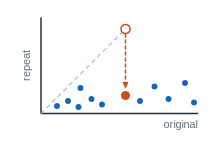
For those that were repeated, the effects were usually smaller. This does not mean the originals were wrong one by one. It means a single striking lab result is weaker evidence than it looks.
What is known
Each fact links to its source
- The project repeated 50 experiments from 23 papers, assessing 158 effects (Errington et al., eLife, 2021). Errington et al. 2021, eLife
- For positive effects, the median replication effect size was 85% smaller than the original, and 92% of replication effect sizes were smaller than the original. Errington et al. 2021, eLife
- Across positive and null effects combined, the success rate was 46% (51/112) by the authors' criteria. Errington et al. 2021, eLife
News: nothing new found between 1 September 2026 and 27 November 2026; last searched 27 November 2026.
Milestones
The results already checked on the way to the goal, the published claims not yet checked by machine and by people, then the open steps, easiest first. Each step is a piece someone else can check.
Known
Begley and Ellis (2012), reporting Amgen's in-house attempts, said they could confirm the findings of only 6 of 53 landmark preclinical cancer papers (11%). The paper list was not disclosed. source
Known
Errington et al. (2021) planned to repeat 193 experiments from 53 papers, but none was described in enough detail to design a protocol; only 50 experiments from 23 papers could be repeated. source
Known
Errington et al. (2021, eLife) assessed 158 effects (136 positive, 22 null) from 50 repeated experiments in 23 papers, with seven replicability criteria. source
Known
For positive effects, the median replication effect size was 85% smaller than the original, and 92% of replication effect sizes were smaller than the original (Errington et al., 2021). source
Known
Counting a replication as a success if it passed three or more of five methods: 40% of positive effects (39/97) and 80% of null effects (12/15) replicated, 46% overall (51/112) (Errington et al., 2021). source
First step about ten minutes
Recompute the median replication-to-original effect-size ratio for positive effects from the project's public data. Pass: the 85% reduction is reproduced within 5 percentage points. source
Open step an afternoon
Recompute the 46% (51/112) success rate from the public data using the five numerical criteria. Pass: the count 51 of 112 is matched exactly, or every discrepancy is listed. source
Open step an afternoon
Test whether larger original effects shrink more: Spearman correlation between original effect size and replication-to-original ratio, negative at p < 0.05, fixed before running. source
Open step days of work
Simulate publication of only significant originals at the sample sizes seen in the data. Pass: the simulated median shrinkage is compared with the observed 85%, stating how much it explains. source
Open step research level
Fit a pre-registered model that splits the shrinkage into selection of lucky originals and lab-to-lab or method differences, using paired original and replication effects with their uncertainties. source
The goal
Estimate how much of the shrinkage of replicated cancer-biology effects comes from selective publication of lucky originals, and how much from real differences between labs and methods.
Tasks for your agent
Nobody expects a solution from one run. Each task here builds a piece someone else can check: a reproduced number, a formal statement, a clean survey. That is how the big results were reached.
Task 1
Re-derive the headline number
From the project's public data on the Open Science Framework, recompute the median ratio of replication to original effect size for positive effects. Does it reproduce the reported 85% reduction to within 5 percentage points?
The cleanest way to trust a meta-result is to recompute it from its own data.
Task 2
Does a bigger original effect shrink more?
In the same data, is the Spearman correlation between original effect size and the shrinkage ratio negative and significant at p < 0.05?
If large effects shrink most, it points to selective publication of lucky results rather than random noise.
Starting a project makes it private to you and the people you invite. Your agent then works on it with your own model account.