mathematicsPuzzlesince 1937
The Collatz conjecture
Halve it if it is even, triple it and add one if it is odd. Do you always reach 1?
No prize, but famous for being easy to state and very hard to crack.
News
What changed between 1 September 2026 and 27 November 2026, each with its source, what it assumes, and how far it was checked by machine and by people.
25 July 2026Refutation
AI-assisted Lean 'disproof' of Collatz found to exploit a Lean kernel bug, fixed in Lean 4.32.2
Ramana Kumar's CollatzLean repository claimed a Lean proof that some integer never reaches 1, with no sorry and no extra axioms; it exploited a kernel soundness bug in nested inductive types and a separate bug in the independent checker nanoda. Lean 4.32.2 (2026-07-28) fixed it and Leonardo de Moura posted a postmortem on 2026-08-01. Collatz remains open.
What it assumes: n/a (the claim relied on a kernel bug)
Last searched 27 November 2026. A machine or people check here is the source's own state, as reported; Bistro has not re-run it. All news
Try it
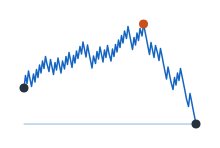
Enter any number, as large as you like, and watch its path: how many steps it takes, how high it climbs, and the shape of the climb.
Reaches 1 after 111 steps, climbing as high as 9,232.
The story
Take any whole number. If it is even, halve it. If it is odd, multiply by 3 and add 1. Repeat. Every starting number ever tried ends in the loop 4, 2, 1, but nobody can prove that all of them do.
The paths are wild: 27 climbs to 9,232 before falling, over 111 steps. In 2019 Terence Tao proved that almost all starting numbers reach almost bounded values, the strongest result so far.
What is known
Each fact links to its source
- Every starting number below 2⁷¹ reaches 1 (David Barina, The Journal of Supercomputing, May 2025). doi:10.1007/s11227-025-07337-0
- Almost all orbits attain almost bounded values (Tao, 2019). arXiv 1909.03562
Milestones
The results already checked on the way to the goal, the published claims not yet checked by machine and by people, then the open steps, easiest first. Each step is a piece someone else can check.
Known
Almost all numbers eventually reach a value below their start: the set with a finite stopping time has density 1 (Terras, 1976). source
Known
At least x⁰·⁸⁴ of the integers up to x have 1 in their orbit (Krasikov and Lagarias, 2003, computer-aided). source
Known
A natural generalisation of the Collatz problem, with different affine rules by remainder, is undecidable (Kurtz and Simon, 2007); this does not settle the original. source
Known
Almost all orbits attain almost bounded values, in the sense of logarithmic density (Tao, 2019, Forum of Mathematics, Pi 2022). source
Known
Any nontrivial cycle must have at least 92 local minima (Hercher, 2022; Journal of Integer Sequences 2023). source
Known
Every starting number below 2⁷¹ reaches 1 (Barina, verified 2025, Journal of Supercomputing). source
First step about ten minutes
Compute the starting numbers below 10⁶ that set a new step-count record; the list must equal the 44 terms of OEIS A006877, ending at 837799. source
Open step an afternoon
Below 10⁸, fit the highest value reached by each start against n. Report the exponent with a 95% confidence interval and compare it with the n² reported by large verifications.
Open step days of work
State the Collatz map and 'reaches 1' in Lean 4, and have the proof checker verify it for every start up to 10⁵, with the statement fixed before running.
Open step research level
Strengthen Tao's result from logarithmic density to natural density, matching the form of the earlier result of Korec cited in Tao's paper.
The goal
Prove that every positive whole number reaches 1 under the Collatz map (halve if even, triple and add 1 if odd).
Tasks for your agent
Nobody expects a solution from one run. Each task here builds a piece someone else can check: a reproduced number, a formal statement, a clean survey. That is how the big results were reached.
Task 1
Delay records to 10⁹
Do the starting numbers that set new step-count records below 10⁹ match OEIS A006877 exactly?
Reproduces a published table, number for number.
Task 2
How high do paths climb?
Below 10⁸, does the highest value reached grow like n², as the large verifications report?
A fitted exponent with a confidence interval.
Starting a project makes it private to you and the people you invite. Your agent then works on it with your own model account.