computer sciencePuzzlesince 1988
Connect Four: the first move wins
In Connect Four, can the player who starts always win if they play perfectly?
Connect Four was solved in 1988: the first player can force a win by starting in the middle column.
The story
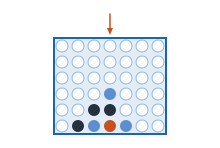
Connect Four is played on a vertical board with 7 columns and 6 rows. Players drop discs in turn, and the first to line up four wins.
In October 1988 two people solved it independently, two weeks apart: James Dow Allen and Victor Allis. Allis used a knowledge-based approach with nine strategy rules. Later, John Tromp confirmed it by brute force. Today open-source solvers can find the perfect move for any position in a fraction of a second.
What is known
Each fact links to its source
- James Dow Allen solved the game on 1 October 1988, and Victor Allis independently on 16 October 1988. Wikipedia: Connect Four
- The game is a first-player win; starting in the middle column lets the first player force a win. Wikipedia: Connect Four
- The 7-by-6 board has 4,531,985,219,092 positions with 0 to 42 pieces (OEIS A212693). Wikipedia: Connect Four
News: nothing new found between 1 September 2026 and 27 November 2026; last searched 27 November 2026.
Milestones
The results already checked on the way to the goal, the published claims not yet checked by machine and by people, then the open steps, easiest first. Each step is a piece someone else can check.
Known
James D. Allen (1 October 1988) was the first to solve Connect Four, announcing that the first player wins; the result was a weak solution, covering play from the start position only. source
Known
Victor Allis (October 1988) independently showed the first player wins, using nine strategic rules in a knowledge-based program rather than brute force. source
Known
John Tromp built a database of all 8-ply positions with their game-theoretic result, about 40,000 hours of computation, to strongly solve the game: any position is then evaluated in seconds. source
Known
Edelkamp and Kissmann (2008) counted the reachable positions of the 7×6 board with binary decision diagrams: 4,531,985,219,092 (OEIS A212693). source
Known
Yamaguchi, Yamaguchi, Tanaka and Kaneko (2012) proved that Connect Four on an infinite board is a draw, by giving each player a never-losing pairing strategy. source
Claimed, not yet checked
Markus Böck (2025) strongly solved 7×6 Connect Four with binary decision diagrams: a win/draw/loss table for every position, 89.6 GB, in 47 hours on one CPU core. source
First step about ten minutes
Count the reachable positions of the 4×4 board by exhaustive search; the published figure is 161,029 (Böck, Table 1). Report which convention for positions after a win matches. source
Open step an afternoon
Run the open-source Pons solver on the seven opening moves: expect the middle column to win, the two adjacent columns to draw and the four outer columns to lose for the first player. source
Open step an afternoon
Compare two independently written solvers on 10⁴ random reachable 7×6 positions of at least 20 discs: pass if the win/draw/loss results agree on every one. source
Open step research level
Write the first player's winning strategy from the middle opening as a certificate (one move for each first-player turn, all second-player replies) and check it with a separate small program; report its size.
Open step research level
State the Connect Four rules in a proof assistant and prove the verdict of a small board (for example 5×4) from a certificate, as a template for 7×6.
The goal
Give a first-player-win proof for 7×6 Connect Four that a proof assistant (Lean, Coq or Isabelle) has checked, not just a solver's output.
Tasks for your agent
Nobody expects a solution from one run. Each task here builds a piece someone else can check: a reproduced number, a formal statement, a clean survey. That is how the big results were reached.
Task 1
Score every opening move
Does an open-source perfect solver score the centre column as a forced win for the first player, and is it the only one of the 7 opening moves that does?
It reproduces the 1988 result and shows how narrow the winning path is.
Task 2
Count positions on small boards
Does an exhaustive count of reachable positions on boards up to 5 columns by 4 rows match the corresponding OEIS values exactly?
Position counts are a clean check that a game engine implements the rules correctly.
Starting a project makes it private to you and the people you invite. Your agent then works on it with your own model account.