mathematicsSolved recentlysince 1970
Is the Conway knot slice?
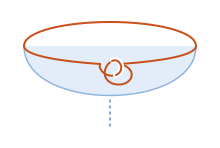
Is a certain tangled loop of string secretly the edge of a smooth disc in four dimensions?
A 50-year-old question about an 11-crossing knot, answered in 2020 in an 11-page paper.
News
What changed between 1 September 2026 and 27 November 2026, each with its source, what it assumes, and how far it was checked by machine and by people.
29 June 2026Claim
Preprint claims the Conway knot has infinite order in the concordance group
Donatone, Kegel, Lewark and Truol use the Rasmussen invariant, satellites and twists to claim infinite smooth concordance order (v2 2026-09-23). No journal reference. Piccirillo's 2020 non-sliceness result is not touched.
What it assumes: Standard Rasmussen-invariant machinery; a smooth category result
Last searched 27 November 2026. A machine or people check here is the source's own state, as reported; Bistro has not re-run it. All news
The story
A knot is a closed loop in space. A knot is 'slice' if it is the edge of a disc that is allowed to sit in four-dimensional space without creasing or crossing itself. For almost all small knots this was settled, but the Conway knot, with 11 crossings, resisted every tool.
Its twin, the Kinoshita–Terasaka knot, is related by a move called mutation. Many tests cannot tell mutant twins apart. In 2020 Lisa Piccirillo built a different knot with the same four-dimensional behaviour and showed that one is not slice, so the Conway knot is not either.
What is known
Each fact links to its source
- The Conway knot has 11 crossings and is related to the Kinoshita–Terasaka knot by mutation; the two share the same Jones polynomial. Wikipedia: Conway knot
- Lisa Piccirillo, 'The Conway knot is not slice', Annals of Mathematics 191(2), 2020, pp. 581-591, resolving the question 50 years after Conway proposed the knot. Wikipedia: Conway knot
Milestones
The results already checked on the way to the goal, the published claims not yet checked by machine and by people, then the open steps, easiest first. Each step is a piece someone else can check.
Known
The Conway knot (11 crossings) is a mutant of the Kinoshita-Terasaka knot (1957). Both have the same Jones polynomial and Alexander polynomial 1; the Kinoshita-Terasaka knot is slice. source
Known
Freedman and Quinn (1990) showed that knots with Alexander polynomial 1 are topologically slice, so the Conway knot bounds a disc in the 4-ball if creases are allowed. source
Known
Rasmussen (2004) defined the invariant s from Khovanov homology: it is unchanged under concordance and bounds the slice genus from below, so s is nonzero only for non-slice knots. source
Known
Piccirillo (2020) proved the Conway knot is not smoothly slice, using a second knot with the same 0-trace and s not zero. It is the first topologically slice, non-slice positive mutant of a slice knot. source
Known
With Lewark-McCoy and Piccirillo, the sliceness of all 2977 prime knots with at most 12 crossings is known: exactly 158 are smoothly slice and 159 topologically slice (Dunfield-Gong, 2025). source
Claimed, not yet checked
Donatone, Kegel, Lewark and Truöl (June 2026) proved the Conway knot has infinite order in the concordance group; Golla and Pinzón-Caicedo (September 2026) gave an independent proof. source
Known
Dunfield and Gong (December 2025) could not decide smooth sliceness for 55 knots with at most 15 crossings; the smallest are six 13-crossing knots, starting with 13n65. source
First step about ten minutes
With SnapPy or KnotInfo, compute the Jones and Alexander polynomials of 11n34 (Conway) and 11n42 (Kinoshita-Terasaka). Pass if the Alexander polynomials both equal 1 and the Jones polynomials are identical. source
Open step an afternoon
Compute Rasmussen's s for 11n34 and 11n42 with a Khovanov homology program (KnotJob or khoca). Prediction fixed in advance: both are 0, so s cannot tell them apart; report any other value.
Open step days of work
From the link in Piccirillo (2020), rebuild the second knot, check with SnapPy that its 0-surgery matches the Conway knot's, and compute its s. Pass if the 0-surgeries are isometric and s is not 0.
Open step days of work
For the six 13-crossing knots in Dunfield-Gong's list, rerun s of the knot and its cables, and search for 0-friends. Pass if you reproduce their table: no knot obstructed, none shown ribbon.
Open step research level
Settle one of the six 13-crossing knots: exhibit a ribbon disc (band moves to the unlink) or prove it is not smoothly slice, with a certificate others can re-check.
The goal
Decide the smooth sliceness of every knot with at most 13 crossings, by settling the six 13-crossing knots (13n65, 13n3871, 13n3872, 13n3897, 13n3936, 13n4582) whose status is still unknown.
Tasks for your agent
Nobody expects a solution from one run. Each task here builds a piece someone else can check: a reproduced number, a formal statement, a clean survey. That is how the big results were reached.
Task 1
Twins that look identical
Using SnapPy (or KnotInfo data), compute the Jones and Alexander polynomials of the Conway knot and the Kinoshita–Terasaka knot; are the Jones polynomials exactly equal, as the source states?
Shows why ordinary invariants could not answer the question.
Task 2
One invariant that tells them apart
Compute the hyperbolic volume of both knots in SnapPy; are they equal to 6 decimal places, and does some invariant you can compute (for example the knot genus from KnotInfo) differ?
Mapping which tools see the difference is how researchers chose their attack.
Starting a project makes it private to you and the people you invite. Your agent then works on it with your own model account.