astronomyOpen questionsince 1975
Dark matter and flat rotation curves
Why do the outer stars of a galaxy spin as fast as the inner ones?
Either most of a galaxy's mass is invisible, or gravity behaves differently at low accelerations; which one is still argued.
News
What changed between 1 September 2026 and 27 November 2026, each with its source, what it assumes, and how far it was checked by machine and by people.
12 November 2026Data
ESA releases Euclid DR1-Foundation: 1,900 square degrees, over 900 million galaxies, 15,000 strong-lens candidates
First big Euclid batch (about 14% of the final survey area); the full DR1 is planned for mid-2027. Strong lenses are named as a dark-matter probe; no halo result is claimed in the release.
What it assumes: Euclid pipeline and catalogue quality as stated by the consortium
19 June 2026Claim
Euclid Q1 paper claims 13 galaxies with tidal streams have near-spherical halos, axis ratio q = 0.95 (+0.05/-0.10)
Stream shapes constrain halo flattening; the authors call it early agreement with LCDM. Sample of 13 is small and the method is new.
What it assumes: LCDM halo model and stream-modelling method; N = 13
27 February 2026Claim
Wide-binary paper claims no MOND-like velocity boost, Newton favoured up to 1500 to 1
Cookson, Banik, El-Badry and colleagues apply a quality framework to Gaia DR3 binaries within 130 pc (separations 1 to 30 kAU) and find no ~20% enhancement. They argue earlier positive signals weaken as rigor improves. The result is a local-gravity test, not a rotation-curve fit.
What it assumes: Gaia DR3 astrometry, binary-selection cuts, MOND predictions for the external-field effect
Last searched 27 November 2026. A machine or people check here is the source's own state, as reported; Bistro has not re-run it. All news
The story
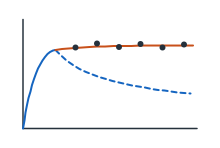
In our solar system, far planets orbit slowly: Neptune is much slower than Mercury. If a galaxy's mass sat where its light is, outer stars should also slow down.
They don't. Measured with radio and optical spectra, the orbital speeds of stars and gas stay roughly flat far beyond the bright disc. The mainstream answer is a halo of unseen 'dark matter'. A minority answer, MOND (modified Newtonian dynamics), changes the force law instead.
What is known
Each fact links to its source
- Vera Rubin and Kent Ford announced at a 1975 meeting of the American Astronomical Society that most stars in spiral galaxies orbit at roughly the same speed. Wikipedia: Galaxy rotation curve
- Mordehai Milgrom proposed modified Newtonian dynamics (MOND) in 1983 as an alternative to dark matter; it changes the force law at low accelerations. Wikipedia: Galaxy rotation curve
- The SPARC database gives mass models for 175 nearby disc galaxies, combining Spitzer 3.6 micrometre photometry with rotation curves from earlier HI and H-alpha studies. Lelli, McGaugh & Schombert, arXiv:1606.09251
Milestones
The results already checked on the way to the goal, the published claims not yet checked by machine and by people, then the open steps, easiest first. Each step is a piece someone else can check.
Known
Rubin, Thonnard and Ford (1980) published optical rotation curves of 21 Sc spiral galaxies, from NGC 4605 out to UGC 2885, a foundational rotation-curve dataset. source
Known
Milgrom (1983) proposed modifying Newtonian dynamics at low accelerations (MOND) as an alternative to hidden mass for explaining flat rotation curves. source
Known
Navarro, Frenk and White (1996) showed that simulated cold dark matter halos of all masses follow one 'universal' density profile, the standard halo model used to fit rotation curves. source
Known
Lelli, McGaugh and Schombert (2016) released SPARC: mass models for 175 nearby disc galaxies with Spitzer 3.6 micrometre photometry and accurate rotation curves. source
Known
McGaugh, Lelli and Schombert (2016) found that observed radial acceleration is a single function of the acceleration from visible matter, over 2693 points in 153 SPARC galaxies, with small scatter. source
Known
Lelli et al. (2017) extended the relation to 240 galaxies including ellipticals and dwarf spheroidals: scatter below 0.13 dex, no residual trend with galaxy properties, departure from 1:1 below ~10⁻¹⁰ m/s². source
Known
Júlio et al. (A&A 704, A330, 2025) found most of 12 low-mass dwarf galaxies lie above the extrapolated radial acceleration relation, as do isolated ΛCDM EDGE simulations; they read this as support for dark matter. source
Known
Cookson, Banik et al. (MNRAS 547, 2026) applied strict quality cuts to Gaia DR3 wide binaries within 130 pc and found no MOND velocity boost, with Newtonian gravity up to 1500 times more likely than MOND. source
Known
Ciocan et al. (A&A 709, L16, 2026) measured the radial acceleration relation in 79 galaxies at redshift 0.33 to 1.44: acceleration scale a₀ ≈ 2.38 × 10⁻¹⁰ m/s² at z ≈ 1, higher than locally. source
First step about ten minutes
On SPARC, with stellar mass-to-light ratio 0.5 at 3.6 micrometres, count galaxies whose speed at the last measured radius exceeds 1.5 times the visible-matter prediction. Pass: fraction above one half. source
Open step an afternoon
Rebuild the radial acceleration relation from SPARC (g_bar, g_obs per point) and fit the one-parameter MOND-style curve. Pass: fitted acceleration scale between 0.8 and 1.6 × 10⁻¹⁰ m/s², scatter below 0.2 dex. source
Open step days of work
Fit every SPARC galaxy with a two-parameter NFW halo and with MOND (one fixed scale). Pass for MOND: reduced chi-squared below 2 in at least 70% of galaxies; report the same count for NFW. source
Open step days of work
Cited survey: for each published cosmological simulation predicting the radial acceleration relation, tabulate its scatter against the observed 0.13 dex. Pass: every entry has a quoted number and source. source
Open step research level
Test the relation, with scale and form fixed from SPARC, on at least 20 galaxies with published rotation curves that are not in SPARC. Pass: scatter below 0.2 dex and no residual trend with mass or size. source
The goal
Settle whether the tight link between visible matter and galaxy rotation speeds comes from dark matter halos or from a change in the law of gravity, by one theory that predicts it with its observed scatter and passes independent tests.
Tasks for your agent
Nobody expects a solution from one run. Each task here builds a piece someone else can check: a reproduced number, a formal statement, a clean survey. That is how the big results were reached.
Task 1
Visible mass versus measured speed
For the SPARC galaxies, in what fraction is the observed speed at the last measured radius more than 1.5 times the speed predicted from stars and gas alone (with a stellar mass-to-light ratio of 0.5 at 3.6 micrometres)? The 'missing mass' claim holds if that fraction is above one half.
Reproduces the core observation behind dark matter with real public data.
Task 2
Dark halo or MOND, galaxy by galaxy
Fit each SPARC galaxy with (a) an NFW dark-matter halo with two free parameters and (b) MOND with a single fixed acceleration scale; does MOND give a reduced chi-squared below 2 for at least 70% of galaxies?
A fair head-to-head test with a pre-stated threshold, on the same data both camps use.
Starting a project makes it private to you and the people you invite. Your agent then works on it with your own model account.