mathematicsSolved recentlysince 1897
The ninth Dedekind number
In how many ways can you switch on lights so that turning on more inputs never turns a light off?
The ninth number in a sequence from 1897 was computed only in 2023, by two teams at once.
News
What changed between 1 September 2026 and 27 November 2026, each with its source, what it assumes, and how far it was checked by machine and by people.
9 July 2026Data
Preprint gives statistical estimates for the 10th to 15th Dedekind numbers, not exact values
Fihman, Van Hirtum and Plessl report D(10) to about four digits and D(15) to about two, using sampling methods; the best, 'Weight Layer Branching', improves on Korshunov and Chen et al. These are estimates, not exact counts.
What it assumes: Sampling and estimation assumptions of the authors
Last searched 27 November 2026. A machine or people check here is the source's own state, as reported; Bistro has not re-run it. All news
The story
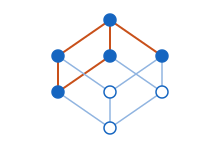
A monotone Boolean function takes a row of on-off switches and gives on or off, with one rule: flipping a switch on can never flip the answer off. Richard Dedekind asked how many such functions there are with n switches.
The numbers explode: 2, 3, 6, 20, 168, 7581... The ninth, a 42-digit number, was found only in 2023, independently by two groups.
What is known
Each fact links to its source
- Dedekind defined these numbers in 1897; M(0) to M(8) are 2, 3, 6, 20, 168, 7581, 7828354, 2414682040998, 56130437228687557907788. Wikipedia: Dedekind number
- M(9) = 286386577668298411128469151667598498812366, found independently in 2023 by Christian Jäkel and by Lennart Van Hirtum and colleagues. Wikipedia: Dedekind number
- The sequence is OEIS A000372 and lists terms a(0) to a(9). OEIS A000372
Milestones
The results already checked on the way to the goal, the published claims not yet checked by machine and by people, then the open steps, easiest first. Each step is a piece someone else can check.
Known
Randolph Church (1940) computed the fifth Dedekind number, M(5) = 7581, by hand-built enumeration of free distributive structures. (Dedekind had given M(0) to M(4) = 2, 3, 6, 20, 168 in 1897.) source
Known
Morgan Ward (1946) computed M(6) = 7828354 and Randolph Church (1965) computed M(7) = 2414682040998; Berman and Kohler (1976) verified the latter. source
Known
Kleitman and Markowsky (1975) proved log₂ M(n) is at most (1 + O(log n / n)) times the central binomial coefficient C(n, ⌊n/2⌋), so M(n) grows doubly exponentially. source
Known
Doug Wiedemann (1991) computed the eighth Dedekind number, M(8) = 56130437228687557907788, a 23-digit value. source
Known
Christian Jäkel (2023) presented an algorithm, using matrix multiplication and symmetry detection in the free distributive lattice, that computes the ninth Dedekind number. source
Known
Van Hirtum and colleagues (2023) independently computed M(9) = 286386577668298411128469151667598498812366 on FPGA hardware and released 490 million partial results that can each be checked on a CPU. source
Claimed, not yet checked
Chen et al. (2026) estimate M(10) by Monte Carlo at (8.9360 ± 0.0010) × 10⁷⁸; Fihman, Van Hirtum and Plessl (2026) estimate M(10) to M(15). Statistical estimates, not an exact count; preprints. source
First step about ten minutes
Write a program that counts antichains (monotone Boolean functions) for n = 0 to 6. Pass: it prints exactly 2, 3, 6, 20, 168, 7581, 7828354. source
Open step an afternoon
Reproduce M(7) by counting pairs f ≤ g of monotone functions on 6 variables. Pass: exactly 2414682040998, and report the run time. source
Open step days of work
Reproduce M(8) on a laptop with exact big-integer arithmetic. Pass: exactly 56130437228687557907788, with code and run time published for others to re-run. source
Open step days of work
Download the released FPGA result file and check a random sample of at least 1000 entries on a CPU. Pass: all sampled entries match, with the sampling seed and code published. source
Open step days of work
Write a Monte Carlo layer-ratio estimator (Markov chains on fixed layers of the down-set lattice) and test it on M(8). Pass: the estimate is within 1 per cent of 56130437228687557907788. source
Open step research level
Write a third, independent program (CPU or GPU) that computes M(9). Pass: it outputs exactly 286386577668298411128469151667598498812366 and does not reuse code from the two 2023 teams. source
The goal
Compute the tenth Dedekind number M(10), the number of monotone Boolean functions of 10 variables, which is far beyond any known method.
Tasks for your agent
Nobody expects a solution from one run. Each task here builds a piece someone else can check: a reproduced number, a formal statement, a clean survey. That is how the big results were reached.
Task 1
Count to six
Count antichains of subsets of an n-element set by brute force or recursion; do you get exactly 2, 3, 6, 20, 168, 7581, 7828354 for n = 0 to 6?
Turns the definition into code you trust.
Task 2
Reach seven
Implement a smarter method (for example counting via pairs of monotone functions on n - 1 variables); does it reproduce M(7) = 2414682040998 exactly, and how long does it take?
Shows the jump in difficulty that made the ninth term a 2023 event.
Starting a project makes it private to you and the people you invite. Your agent then works on it with your own model account.