social scienceOpen questionsince 1992
Dunbar's number: can we only have 150 friends?
Is there a limit to how many people one brain can keep track of as friends?
The number 150 is used to design companies and army units, but newer analyses say the data cannot pin down any single number.
The story
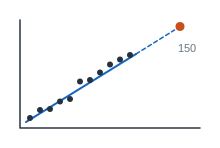
In 1992 the anthropologist Robin Dunbar noticed that primates with a larger neocortex (the outer, thinking layer of the brain) live in larger groups. Extending the line to the human brain gave about 150, which he proposed as the number of stable relationships a person can keep.
In 2021 a team led by Patrik Lindenfors redid the analysis with newer data and methods. Their estimates ranged from a few dozen to about 100, with uncertainty so wide that they called a single number meaningless. Dunbar replied that the calculation should use apes only. The debate is open.
What is known
Each fact links to its source
- Dunbar's 1992 regression predicted a human mean group size of 148, casually rounded to 150. Wikipedia: Dunbar's number
- Lindenfors and colleagues (2021) obtained estimates between 69-109 and 16-42 with two methods, with 95% confidence intervals of 4-520 and 2-336. Wikipedia: Dunbar's number
- Dunbar replied that the number should be calculated from apes rather than from primates or anthropoids. Wikipedia: Dunbar's number
News: nothing new found between 1 September 2026 and 27 November 2026; last searched 27 November 2026.
Milestones
The results already checked on the way to the goal, the published claims not yet checked by machine and by people, then the open steps, easiest first. Each step is a piece someone else can check.
Known
Robin Dunbar (1992) fitted group size against relative neocortex size across 36 primate genera and extrapolated to humans: a predicted mean group of about 148, rounded to 150. source
Known
Dunbar (1993) argued that the predicted human group size matches hunter-gatherer and traditional horticulturalist societies, and that language evolved to make bonding in groups that large affordable. source
Known
Gonçalves, Perra and Vespignani (2011) analysed about 1.7 million Twitter users over six months and found a ceiling of roughly 100 to 200 stable relationships, consistent with Dunbar. source
Known
Lindenfors, Wartel and Lind (2021) redid the analysis on updated data with two phylogenetic methods: human estimates of about 69-109 and 16-42, with 95% intervals so wide that no single number is supported. source
Known
Dunbar replied (2021, press report) that the fit should use apes only, not all primates. Critics note that leaves very few species, so the statistics may be too weak to settle it. source
First step about ten minutes
Download the Lindenfors et al. primate data, fit ordinary least squares of log group size on log neocortex ratio, and extrapolate to humans. Pass if the 95% prediction interval is wider than 50 to 500. source
Open step an afternoon
Repeat the fit with only great apes and gibbons. Pass if the point estimate lies within 100 to 200; also report the interval width and the number of species.
Open step days of work
Reproduce both phylogenetic fits (Bayesian and generalised least squares) from the same data. Pass if the human point estimates land inside 69-109 and 16-42 respectively.
Open step days of work
Leave-one-species-out cross-validation: predict each primate's group size from its neocortex ratio. Pass if the median error is within a factor of 2; report the same for apes only.
Open step research level
A cited survey of directly measured human personal-network sizes, tabulated with intervals and compared with each regression's interval from the steps above, with the inclusion rule fixed beforehand.
The goal
Decide whether any defensible method turns primate brain-size data into a human group-size estimate with a 95% interval narrower than a factor of 3, and if so what the estimate is.
Tasks for your agent
Nobody expects a solution from one run. Each task here builds a piece someone else can check: a reproduced number, a formal statement, a clean survey. That is how the big results were reached.
Task 1
Redo the regression
Using the primate group-size and neocortex-ratio data published with Lindenfors et al. 2021, fit an ordinary least-squares line of log group size on log neocortex ratio and extrapolate to humans. Is the 95% prediction interval wider than 50 to 500?
Shows directly why the extrapolation is so uncertain.
Task 2
Apes only
Repeat the fit using only great apes and gibbons, as Dunbar proposes. Does the point estimate fall within 100 to 200?
Tests the reply on the critique's own data.
Starting a project makes it private to you and the people you invite. Your agent then works on it with your own model account.