environmentOpen questionsince 1985
Can earthquakes be predicted?
Could we ever know the day a big earthquake will strike?
We can say how often quakes of each size happen in a region, but no one has shown a reliable way to say when the next big one will come.
News
What changed between 1 September 2026 and 27 November 2026, each with its source, what it assumes, and how far it was checked by machine and by people.
12 June 2026Claim
Nature Communications: unsupervised learning flags catalog changes before 3 of 5 large earthquakes, retrospectively
Karimpouli and colleagues report changes weeks to months before the 2023 Kahramanmaras, 2014 Iquique and 2009 L'Aquila quakes, and none before the 2016 Amatrice or 2024 Noto ones. The authors call it a monitoring tool, not deterministic prediction, and the validation was retrospective with no skill scores.
What it assumes: Retrospective analysis of five chosen sequences with catalog features
3 March 2026Claim
arXiv: b-value deep-learning forecast has small but consistently positive skill; 5.88% of events captured at 1%…
Kohler, Li, Faber, Rumpker, Srivastava report Brier skill scores positive against a spatial base-rate model, absolute skill small. Unrefereed on the page read.
What it assumes: Catalogue b-value patterns; skill measured against a spatial base-rate model.
25 November 2025Claim
BGS and partners: machine-learning aftershock forecasts in seconds, similar to ETAS
Earth, Planets and Space paper trained on catalogues from California, New Zealand, Italy, Japan and Greece; performance reported as similar to ETAS, not better.
What it assumes: Five regional catalogues; ETAS comparison.
Machine: not yetPeople: passedBritish Geological Survey news (secondary to Earth, Planets and Space)
Last searched 27 November 2026. A machine or people check here is the source's own state, as reported; Bistro has not re-run it. All news
The story
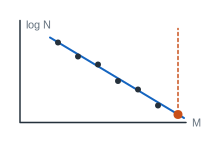
Seismologists distinguish forecasting (how likely a quake is somewhere over years) from prediction (a time, place and size). Forecasting works: the number of quakes falls off with magnitude in a steady pattern called the Gutenberg-Richter law. Prediction has a long record of failure.
The most famous test was at Parkfield, California. Scientists expected the next one by 1993 at the latest. It came in 2004. Today most scientists are pessimistic, and some argue prediction is impossible in principle, while others pursue machine learning on laboratory and real fault data.
What is known
Each fact links to its source
- Parkfield forecasters expected the next quake around 1988, or 1993 at the latest; an M 6.0 quake arrived on 28 September 2004, a decade late. Wikipedia: Earthquake prediction
- Demonstrably successful predictions of large earthquakes have not occurred, and the few claims of success are controversial. Wikipedia: Earthquake prediction
- In the Gutenberg-Richter law, log10 N = a - bM, the constant b is commonly close to 1.0 in seismically active regions. Wikipedia: Gutenberg–Richter law
Milestones
The results already checked on the way to the goal, the published claims not yet checked by machine and by people, then the open steps, easiest first. Each step is a piece someone else can check.
Known
Geller, Jackson, Kagan and Mulargia (1997) argued that earthquakes cannot be predicted reliably, since any small quake may cascade into a large one, and that predictions are rarely stated as testable hypotheses. source
Known
Bakun and 18 co-authors (2005): the M 6.0 Parkfield quake of 28 September 2004 had no obvious precursors, so reliable short-term prediction is still not achievable; the 1985 forecast of the quake before 1993 had missed by about 11 years. source
Known
Rouet-Leduc and co-authors (2017) showed that machine learning on the acoustic signal of a laboratory fault predicts the time remaining before it fails, using only the instantaneous signal. source
Known
Schorlemmer and co-authors (2018) review a decade of the CSEP, a global infrastructure that tests earthquake forecasts and prediction algorithms against new data at four centres since 2007. source
Known
Mignan and Broccardo (2019) showed a logistic regression with 2 free parameters matches a 13,451-parameter deep network at predicting aftershock locations (AUC 0.85, against 0.58 for Coulomb stress). source
Known
Bayona and colleagues (Nature Communications, October 2026) checked 27 CSEP models' 50,000+ prospective next-day California forecasts against almost 600 quakes of M 3.95 or larger: select models were consistent. source
First step about ten minutes
Download the USGS ComCat catalogue for California, 1990 to 2020, magnitude 2.5 and above. Decided in advance: the maximum-likelihood b-value lies between 0.9 and 1.1, or it does not. source
Open step an afternoon
Same catalogue, aftershocks removed with a standard window method: the coefficient of variation of waiting times between M 4 or larger events is below 1 (more regular than random), or it is not. source
Open step days of work
Rerun the one-neuron versus deep-network aftershock comparison on the published data; pass if a 2-parameter logistic regression reaches an AUC within 0.02 of 0.85 on the held-out set. source
Open step research level
Register, before the period starts, a machine-learning forecast of M 5 or larger events for one region over a fixed period, and score it against a Poisson baseline under CSEP-style rules; pass if the log-likelihood beats the baseline. source
The goal
Show, in a prospective test with the rules fixed in advance, a method that predicts the time, place and size of large earthquakes better than a random-occurrence baseline.
Tasks for your agent
Nobody expects a solution from one run. Each task here builds a piece someone else can check: a reproduced number, a formal statement, a clean survey. That is how the big results were reached.
Task 1
Measure the b-value
Download the USGS ComCat catalogue for California, 1990 to 2020, magnitude 2.5 and above. Is the maximum-likelihood b-value between 0.9 and 1.1?
Reproduces the one statistical law of earthquakes that does hold.
Task 2
Do quakes come on a schedule?
For the same catalogue, after removing aftershocks with a standard window method, is the coefficient of variation of waiting times between M 4 or larger events below 1 (more regular than random) or not?
A coefficient near 1 means quakes behave like a random process, which is why scheduled prediction fails.
Starting a project makes it private to you and the people you invite. Your agent then works on it with your own model account.