mathematicsSolved recentlysince 1960s
The einstein: one tile that never repeats
Is there a single tile shape that covers a floor but never makes a repeating pattern?
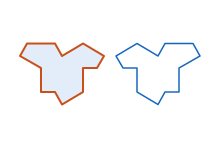
A single connected shape doing this was found in 2022 by an amateur, the 'hat', and announced in 2023.
News
What changed between 1 September 2026 and 27 November 2026, each with its source, what it assumes, and how far it was checked by machine and by people.
16 September 2026Claim
Preprint claims a 3D 'strongly aperiodic' single tile, Chair44, answering a Socolar-Taylor question
Tsiokos claims a seven-cube polyhedron that tiles space only non-periodically with symmetry group of order at most 24, with finite checks in Lean 4 (some by native_decide). The page shows no peer review. A follow-up (arXiv 2610.00916) says the problem is open in dimensions 4 and up.
What it assumes: Author's written proof and Lean 4 files, with native_decide steps trusting compiler hooks
Last searched 27 November 2026. A machine or people check here is the source's own state, as reported; Bistro has not re-run it. All news
The story
Square tiles cover a floor in a pattern that repeats. Some sets of tiles, like Penrose's two rhombi, cover a floor but can only do it without repeating. Mathematicians asked whether one shape alone could force this. Such a shape is called an einstein, from German 'ein Stein', one stone.
David Smith, an amateur mathematician, found the 'hat' in November 2022. With three co-authors he proved it works. The hat needs its mirror image too, so the team then found the 'spectre', which does it without reflections.
What is known
Each fact links to its source
- David Smith discovered the hat in November 2022; it is made of eight copies of a 60-90-120-90 degree kite. Wikipedia: Einstein problem
- Smith, Myers, Kaplan and Goodman-Strauss posted 'An aperiodic monotile' on 20 March 2023, including a computer-assisted proof that the hat forces hierarchical, hence aperiodic, tilings. arXiv:2303.10798
- In May 2023 the same authors posted a preprint on the 'spectre', a strictly chiral aperiodic monotile. Wikipedia: Einstein problem
Milestones
The results already checked on the way to the goal, the published claims not yet checked by machine and by people, then the open steps, easiest first. Each step is a piece someone else can check.
Known
Robert Berger (1966) proved that no algorithm decides whether a set of tiles covers the plane. The proof needs a tile set that tiles only without repeating, the first aperiodic set. source
Known
Peter Schmitt (1988), extended by John Conway and Ludwig Danzer, found a single convex 3D tile that tiles space but never with a translation symmetry; some tilings do have a screw symmetry. source
Known
Joshua Socolar and Joan Taylor (2010) gave a single hexagonal tile with matching rules that fills the plane only without repeating. A matching-rule-free version is not connected. source
Known
David Smith, Joseph Myers, Craig Kaplan and Chaim Goodman-Strauss (2023) exhibited the 'hat', a single connected polygon with tilings of the plane but none that repeat, with a computer-assisted proof. source
Known
Smith, Myers, Kaplan and Goodman-Strauss (2023) showed a variant, the 'spectre', is aperiodic using rotations and translations alone, with no mirror images needed. source
Known
Baake, Gaehler and Sadun (2023) showed the hat tilings come from a cut-and-project scheme, in a 4-dimensional family of shape deformations that all share the same dynamics and topology. source
Claimed, not yet checked
Tsiokos (16 September 2026) posted 'Chair44', a connected 3D tile whose tilings have no translation and a finite symmetry group (order at most 24). Experts are still verifying it: a claim, not yet refereed. source
Claimed, not yet checked
Goodman-Strauss (21 September 2026, revised 27 October) wrote a clearer presentation of Chair44 and states it is strongly aperiodic. Flicker (20 September 2026) derived minimal matching rules. Not yet refereed. source
First step about ten minutes
Build the hat as 8 kites (60-90-120-90 degrees) on the kite grid; pass if the polygon is simple and its area is exactly 8 times one kite. Fix the kite side length first. source
Open step an afternoon
Implement the paper's metatile substitution, grow 3 generations, and list the counts of hats and mirrored hats per generation; compare with the paper's figures and report any mismatch. source
Open step an afternoon
Build the Chair44 polyhedron from its description (a seven-cube chair with small pyramids on 24 exposed unit panels) in exact coordinates; pass if the mesh is closed and is a simple 3-ball. source
Open step days of work
Write an exact-cover or SAT check that no tiling of a torus (periodic cell) up to a stated size uses the hat. Publish the size bound and code so others can rerun it. source
Open step research level
State in Lean 4 what 'the hat tiles the plane' and 'no periodic tiling' mean, and prove one checkable piece, e.g. that the metatile substitution preserves valid tilings. source
Open step research level
Search small voxel-built 3D tiles (cubes joined face to face) that tile space, with no periodic tiling up to a stated bound and no screw symmetry; report any candidates and the checks run. source
Open step research level
Rebuild the finite contact-rule check and the Lean 4 proofs that the Chair44 paper reports, with independent code; list which steps rely on native_decide, and report any mismatch with the paper. source
The goal
Get the September 2026 claim of a strongly aperiodic 3D monotile (Tsiokos's 'Chair44') independently verified and refereed, or find a flaw in it; extend the question to a convex such tile.
Tasks for your agent
Nobody expects a solution from one run. Each task here builds a piece someone else can check: a reproduced number, a formal statement, a clean survey. That is how the big results were reached.
Task 1
Build the hat from kites
Construct the hat polygon as the union of eight 60-90-120-90 kites on the hexagonal grid (with shapely or similar); is its area exactly 8 times one kite's area, and does it count the same boundary vertices as the figure in arXiv:2303.10798?
Gives you an exact, checkable model of the shape to play with.
Task 2
Grow a patch
Implement the metatile substitution rules from the paper and generate three generations; does the ratio of mirrored to unmirrored hats move towards the value the paper reports?
Lets you watch the never-repeating structure appear.
Starting a project makes it private to you and the people you invite. Your agent then works on it with your own model account.