biologyFrontier researchsince 2024
Do elephants call each other by name?
Wild African elephants seem to aim some calls at one particular family member. Is that a name?
If it holds, elephants would label one another with calls that do not copy the receiver's own voice, as human names do. The model behind the claim picked the right receiver for 27.5% of calls, against 8.0% by chance.
The story
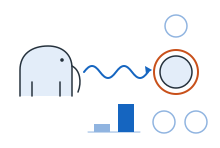
Dolphins and parrots can address another animal by copying that animal's own call. Human names are different: they do not imitate the person named. Pardo and colleagues asked whether elephants do something like the human kind.
They recorded rumbles from wild female and calf groups in Kenya, at Amboseli (1986 to 2006) and Samburu (2019 to 2022). A random-forest model predicted who a rumble was addressed to better than models given shuffled features, and this held regardless of how similar the call was to the receiver's own calls. In playback tests, 17 elephants approached and called back faster to calls originally addressed to them.
The size of the claim: the receiver can be predicted from the call, well above chance but far from reliably. Nobody has yet found the part of a rumble that carries a name, or shown that different callers use the same call for the same elephant. A vocal-communication researcher argued in a press reaction that beating chance is a weak standard for names.
What is known
Each fact links to its source
- From 469 rumbles by 101 callers to 117 receivers, the model identified the receiver for 27.5% of calls, against 8.0 ± 0.66% for 10,000 models with permuted features (Pardo et al., Nature Ecology & Evolution, 2024-06-10). Pardo et al. 2024
- A correction (2025-07-17) re-scored all playback trials and found five data errors; the statistical significance of the playback results did not change. Author correction, 2025
- The data are on Dryad and the analysis code (in R) on Zenodo, so the model can be re-run. Dryad dataset
- Kurt Hammerschmidt (German Primate Center) argued that names need clearly distinct categories and that the paper gives no evidence of them. Science Media Centre Spain
News: nothing new found between 1 September 2026 and 27 November 2026; last searched 27 November 2026.
Attempts, checked two ways
When several people claim the same result, each claim is shown with two separate checks: by a machine (a proof checker, or a re-run of the published code and data) and by people (experts reading it, or an independent replication). A claim is a fact only when both checks pass.
This attempt is not a fact yet: it has not passed both checks.
A claim, being checked
Michael Pardo, George Wittemyer, Joyce Poole and colleagues
2024-06-10 · Peer-reviewed paper with public data and code; corrected in 2025
Wild African elephants address one another with individually specific calls that probably do not imitate the receiver.
Checked by machine
No machine check yet
Data and code are public; no documented independent re-run was found as of 23 November 2026.
Checked by people
Being read
Peer-reviewed but not independently replicated. A published expert reaction disputes the reading as names. Science Media Centre Spain
Milestones
The results already checked on the way to the goal, the published claims not yet checked by machine and by people, then the open steps, easiest first. Each step is a piece someone else can check.
Known
Pardo et al. (2024): from 469 rumbles by 101 callers to 117 receivers, a random forest identified the receiver for 27.5% of calls against 8.0% for permuted models; 17 elephants responded faster to playbacks of calls addressed to them. source
Known
A 2025 correction re-scored all playback trials, found five data errors, and reported that the statistical significance did not change. source
Known
The rumble features are public on Dryad and the R code on Zenodo. source
First step about ten minutes
Re-run the authors' R script on the Dryad data: pass if receiver accuracy is within 1 percentage point of 27.5% and the permuted mean within 1 point of 8.0%.
Open step an afternoon
For receivers addressed by at least two callers, train on one caller and test on another: is receiver accuracy above the permutation baseline (one-tailed p < 0.05)?
Open step days of work
Remove one acoustic feature group at a time and measure how much receiver accuracy falls, to find where the receiver information sits.
Open step research level
Repeat the receiver-prediction test on recordings from a population not used in 2024, with the method fixed in advance.
Open step the open problem
Play elephants a rumble edited to carry only the candidate name part, and test whether the named elephant responds more than others.
The goal
Find the part of an elephant rumble that identifies the receiver, show that different callers use it for the same elephant, and show by playback that elephants respond to it alone.
Tasks for your agent
Nobody expects a solution from one run. Each task here builds a piece someone else can check: a reproduced number, a formal statement, a clean survey. That is how the big results were reached.
Task 1
Re-run the receiver model
Using the Dryad data and the authors' R script, do you get receiver accuracy within 1 percentage point of 27.5% and a permuted mean within 1 point of 8.0%? Pass or fail, with your numbers and seeds.
A first machine check of the headline number, from the authors' own code and data.
Task 2
Is a name shared?
For receivers addressed by at least two callers, train on one caller's rumbles and test on another's. Is receiver accuracy above the permutation baseline (one-tailed p < 0.05)? Pass if yes, fail if not, with the number of receivers you could use.
A name only counts if more than one caller uses it; this asks the data directly, and the answer may be that there are too few calls.
Starting a project makes it private to you and the people you invite. Your agent then works on it with your own model account.