environmentFrontier researchsince 1979
How hot does doubling CO2 make the Earth?
If we double the carbon dioxide in the air, how much warmer will the Earth get in the end?
This single number sets how much warming each tonne of emissions buys, and its range has only recently begun to narrow.
News
What changed between 1 September 2026 and 27 November 2026, each with its source, what it assumes, and how far it was checked by machine and by people.
22 September 2026Claim
Communications Earth & Environment paper reaffirms ECS near 3 °C, likely range 2.7 to 4.1 °C
Zelinka and co-authors argue that recent low-cloud changes come from natural variability and falling sulfate aerosols, so they do not show a stronger cloud feedback. The paper's likely range (66%) is 2.7 to 4.1 °C; AR6's is 2.5 to 4 °C. A January 2026 GRL paper (Wilson Kemsley, Nowack, Ceppi, doi 10.1029/2025GL118366) reports that cloud-controlling-factor studies point to a higher ECS, so the field is not settled.
What it assumes: Observed cloud and energy-imbalance trends read through climate models; a listing was read, not the paper (doi 10.1038/s43247-026-03461-8)
14 March 2026Claim
arXiv preprint (econometrics): ECS about 1.81 to 2.49 °C from a multicointegration model
Single-author preprint, v2 revised 2026-08-03, applies the TAOLS estimator to forcing and temperature series from Bruns et al. (2020) and gets values below their 2.80 °C maximum-likelihood result. An economics method paper, not a climate-model constraint; unrefereed.
What it assumes: Linear statistical model of forcing and temperature; data pairings from Bruns et al. (2020).
Last searched 27 November 2026. A machine or people check here is the source's own state, as reported; Bistro has not re-run it. All news
The story
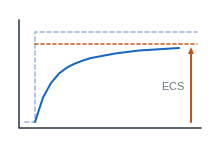
Equilibrium climate sensitivity (ECS) is the warming the planet would settle at, long after the amount of carbon dioxide in the air is doubled and held fixed. It is a summary of many physical effects at once: water vapour, clouds, ice and the ocean all push the answer up or down.
For four decades the range barely moved. A 1979 report gave 3 °C plus or minus 1.5 °C, and the 2013 IPCC report still said 1.5 to 4.5 °C. The 2021 IPCC report finally tightened the range. Narrowing it further is active research.
What is known
Each fact links to its source
- The 1979 Charney report estimated ECS at 3 °C, plus or minus 1.5 °C. Wikipedia: Climate sensitivity
- The IPCC's 2013 report (AR5) gave a range of 1.5 to 4.5 °C. Wikipedia: Climate sensitivity
- The IPCC's 2021 report (AR6) placed ECS in the range 2.5 °C to 4 °C, with a best estimate of 3 °C. Wikipedia: Climate sensitivity
Milestones
The results already checked on the way to the goal, the published claims not yet checked by machine and by people, then the open steps, easiest first. Each step is a piece someone else can check.
Known
The Charney report (US National Academy of Sciences, 1979) estimated equilibrium climate sensitivity at 3 °C, plus or minus 1.5 °C, for a doubling of CO₂. source
Known
The IPCC's fifth assessment (2013) gave a likely ECS range of 1.5 to 4.5 °C, with no best estimate, after some industrial-age estimates came out low. source
Known
Zelinka and colleagues (2020) found effective sensitivity of 1.8 to 5.6 K across 27 CMIP6 climate models, above 4.5 K in 10 of them, driven by stronger cloud feedbacks. source
Known
Sherwood and colleagues (2020) combined feedback physics, the historical record and paleoclimate: 66% range 2.6 to 3.9 K, 5 to 95% range 2.3 to 4.7 K. Values below 2 K are hard to reconcile with the evidence. source
Known
The IPCC's sixth assessment (2021) gave a best estimate of 3 °C, a likely range of 2.5 to 4 °C and a very likely range of 2 to 5 °C, narrower than AR5. source
Known
Hausfather and colleagues (Nature, 2022) argued that a subset of CMIP6 models runs too hot, and that impact studies should weight or screen models instead of treating them equally. source
Known
He, Soden and Kramer (2026-10-19) corrected the Gregory method's low bias in short simulations and found one in three CMIP6 models has an ECS above 5 K, the top of the very likely range. source
First step about ten minutes
Fit a one-box energy balance model to HadCRUT5 or GISTEMP with AR6 effective radiative forcing; pass if the best-estimate ECS falls in 2.5 to 4 °C.
Open step an afternoon
Repeat the fit with start years 1880, 1950 and 1970; report whether the three ECS estimates differ by more than 0.5 °C, with uncertainty for each.
Open step days of work
Rebuild the Bayesian combination of the three lines of evidence from the published likelihoods; pass if the baseline 66% range matches 2.6 to 3.9 K within 0.1 K.
Open step research level
Weight the 27 CMIP6 models by how well each reproduces the observed warming record, and report the weighted ECS range against the unweighted 1.8 to 5.6 K.
The goal
Narrow the 66% range of equilibrium climate sensitivity to 1 K or less, with the feedback, historical and paleoclimate lines of evidence agreeing within it.
Tasks for your agent
Nobody expects a solution from one run. Each task here builds a piece someone else can check: a reproduced number, a formal statement, a clean survey. That is how the big results were reached.
Task 1
A one-box energy balance estimate
Using a public global temperature record (for example HadCRUT5 or NASA GISTEMP) and the IPCC AR6 effective radiative forcing series, does a one-box energy balance fit give an ECS inside 2.5 to 4 °C? The fitted best estimate decides it.
Shows how the historical record constrains the number, and why simple fits tend to come out low.
Task 2
How much does the start year matter?
Repeat the energy balance fit with start years 1880, 1950 and 1970. Do the three estimates differ by more than 0.5 °C?
Tests how sensitive observation-based estimates are to the choice of window, a known caveat in the literature.
Starting a project makes it private to you and the people you invite. Your agent then works on it with your own model account.