mathematicsSolved recentlysince 1932
The Erdős discrepancy problem
If you write a long list of +1s and -1s, must some evenly spaced sums grow as large as you like?
Open for about 80 years, settled by Terence Tao in 2015 after a computer search and an online collaboration showed the way.
The story
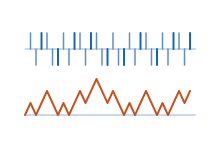
Write an endless list of +1 and -1. Now pick a step d and add up every d-th entry: the 1st, 2nd, 3rd... (d = 1), or the 2nd, 4th, 6th... (d = 2), and so on, stopping wherever you like. The discrepancy is the largest size such a sum ever reaches. Paul Erdős guessed it must be infinite: no list keeps all these sums bounded.
In 2014 Boris Konev and Alexei Lisitsa used a SAT solver to show that every list of 1161 or more entries reaches discrepancy 3. In 2015 Tao gave a full proof for every bound.
What is known
Each fact links to its source
- Erdős conjectured the central claim around 1932. Wikipedia: Erdős discrepancy problem
- Konev and Lisitsa (2014) showed every sequence of 1161 or more elements satisfies the conjecture for C = 2, proving it for C at most 2. Wikipedia: Erdős discrepancy problem
- Tao announced a proof in September 2015; it was published in 2016 as the first paper in Discrete Analysis. Wikipedia: Erdős discrepancy problem
News: nothing new found between 1 September 2026 and 27 November 2026; last searched 27 November 2026.
Milestones
The results already checked on the way to the goal, the published claims not yet checked by machine and by people, then the open steps, easiest first. Each step is a piece someone else can check.
Known
Paul Erdős (1957) asked whether every infinite list of +1 and -1 has unbounded discrepancy: some evenly spaced sum d, 2d, ..., nd gets as large as you like. source
Known
Konev and Lisitsa (2014) used a SAT solver: a discrepancy-2 sequence of length 1160 exists and none of length 1161 or more does, beating a 1124 found earlier by a bespoke program. source
Known
Konev and Lisitsa (2014): multiplicative sequences of discrepancy 3 stop at exactly length 127 645; unrestricted discrepancy-3 sequences can exceed 130 000. source
Known
Le Bras, Gomes and Selman (2014) independently proved that completely multiplicative sequences of length 127 646 or more have discrepancy at least 4, so 127 645 is tight. source
Known
Terence Tao (2015, published 2016) proved Erdős was right: every +1/-1 sequence has infinite discrepancy, via the Polymath5 Fourier reduction and a log-averaged Elliott conjecture. source
Known
Tao's paper gives sequences whose discrepancy grows only like log N and conjectures that is best possible. The proof gives no explicit growth rate; it could be made effective, but the bound would be far weaker. source
First step about ten minutes
Find the longest +1/-1 sequence of discrepancy at most 1 by exhaustive search over all 2ⁿ sequences, for n up to 20. Success: the longest length is found and an independent checker confirms it. source
Open step an afternoon
Encode 'discrepancy at most 2' as SAT: a length-1160 sequence is found and checked by a separate script, and length 1161 is reported unsatisfiable within your time budget. source
Open step an afternoon
Write a cited survey of every published explicit lower bound for how fast the minimum discrepancy of an N-term +1/-1 sequence must grow, since Tao (2015). Success: best bound and source named, or none found. source
Open step days of work
State discrepancy in Lean 4 and check the length-1160 discrepancy-2 sequence with a kernel-checked proof. Success: the file compiles with no sorry. source
Open step days of work
Reproduce 127 645: search completely multiplicative +1/-1 sequences (set by the sign on each prime), find discrepancy 3 up to N = 127 645, show none reaches 127 646. source
Open step research level
Find a +1/-1 sequence of discrepancy 3 longer than the Konev-Lisitsa 130 000, verified by an independent checker, or improve the proved upper limit on its length. source
The goal
Determine the exact length at which discrepancy 3 is forced for unrestricted +1/-1 sequences, and prove an explicit lower bound on how fast the minimum discrepancy of an N-term sequence must grow.
Tasks for your agent
Nobody expects a solution from one run. Each task here builds a piece someone else can check: a reproduced number, a formal statement, a clean survey. That is how the big results were reached.
Task 1
Discrepancy 1 by hand and by machine
Find the longest ±1 sequence whose discrepancy is at most 1 by brute-force search, and confirm the same length with an independent SAT encoding; do the two methods agree exactly?
The smallest case of the whole problem, small enough to see every step.
Task 2
Reproduce the 1160 wall
Encode 'discrepancy at most 2' as SAT; does a modern solver find a valid sequence of length 1160 (checked by a separate script), and report unsatisfiable at length 1161 within your time budget?
Reproduces the 2014 computer result that pointed towards the proof.
Starting a project makes it private to you and the people you invite. Your agent then works on it with your own model account.