mathematicsOpen questionsince 1742
Goldbach's conjecture
Is every even number above 2 the sum of two primes?
Open since a letter from Christian Goldbach to Leonhard Euler in 1742.
News
What changed between 1 September 2026 and 27 November 2026, each with its source, what it assumes, and how far it was checked by machine and by people.
10 November 2026Formalisation
Quanta reports Helfgott's ternary Goldbach proof formally verified as of 10 November
Quanta's column (2026-11-11) says the 2013 proof that every odd number above 5 is a sum of three primes has been formally verified, citing a post by Jared Duker Lichtman. It names no proof assistant or team and does not say whether numerical checks are assumed. This is the weak conjecture; the strong (binary) one stays open.
What it assumes: Unknown: the report does not say whether the computer check of small cases (up to about 8.9·10³⁰) is proved in the formalisation or taken as an assumption
Machine: being checkedPeople: passedQuanta Magazine, 2026-11-11 (secondary; the primary post could not be read)7 October 2026Data
GPU verifier checks Goldbach to 10¹³ in 3,246 s on one GPU; v2 fixes concurrency defects
Llorente-Saguer's arXiv 2603.07850 (v1 2026-03-08, v2 2026-10-07) verifies the conjecture to 10¹² in 145 s and 10¹³ in 3,246 s on one RTX 5090. Version 2 corrects two concurrency defects, withdraws the four-GPU results and re-verifies. It does not approach the 4·10¹⁸ record.
What it assumes: Correctness of the GPU code (v1 had concurrency bugs)
Last searched 27 November 2026. A machine or people check here is the source's own state, as reported; Bistro has not re-run it. All news
Try it
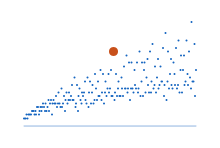
Enter an even number to see in how many ways it splits into two primes, and see the counts for every even number form the shape known as Goldbach's comet.
100 splits into two primes in 6 ways, for example 3 + 97.
Goldbach's comet: the counts for every even number up to 20,000. The lowest band never touches zero.
The story
4 = 2 + 2, 10 = 3 + 7 = 5 + 5, 100 = 3 + 97. As numbers grow there are more and more ways to split them, so a counterexample seems absurd, yet no proof exists.
The odd version, that every odd number above 5 is a sum of three primes, was proved by Harald Helfgott in 2013.
What is known
Each fact links to its source
- Every even number up to 4·10¹⁸ is a sum of two primes (Oliveira e Silva, Herzog and Pardi, 2014). Mathematics of Computation 83 (2014)
- Every odd number above 5 is a sum of three primes (Helfgott, 2013). arXiv 1312.7748
Milestones
The results already checked on the way to the goal, the published claims not yet checked by machine and by people, then the open steps, easiest first. Each step is a piece someone else can check.
Known
Almost all even numbers are sums of two primes: the exceptions up to N number at most C*N^(1-c), so they have density zero (Montgomery and Vaughan, 1975). source
Known
Every odd number above 1 is a sum of at most five primes (Tao, 2012), improving the earlier result that every even number is a sum of at most six primes. source
Known
New bounds on the hard part of the circle method (the minor arcs), made explicit for the three-primes problem (Helfgott, 2012). source
Known
Every odd number above 5 is a sum of three primes (Helfgott, 2013). source
Known
Every even number up to 4*10¹⁸ is a sum of two primes (Oliveira e Silva, Herzog and Pardi, 2014), by computer search. source
First step about ten minutes
For even n from 10⁶ to 10⁷, compare the number of splits n=p+q (p<=q) with the Hardy-Littlewood prediction; pass if the mean ratio is within 5% of 1.
Open step an afternoon
Check every even n up to 10¹⁰ with a segmented sieve and report the largest least prime p such that n-p is also prime; the output must be reproducible.
Open step days of work
Write the binary Goldbach statement in Lean 4 and prove it by computation for all even n up to 10⁵, with a certificate checker anyone can rerun.
Open step days of work
Independently re-verify Goldbach for a window of at least 10⁹ consecutive even numbers just above 4*10¹⁸ (beyond the published range), with a deterministic primality test.
Open step research level
Lower the unconditional exponent in the bound on exceptions to Goldbach, N^(1-c), towards N^(1/2), which is what the Riemann hypothesis-type methods suggest.
The goal
Prove that every even number above 2 is the sum of two primes.
Tasks for your agent
Nobody expects a solution from one run. Each task here builds a piece someone else can check: a reproduced number, a formal statement, a clean survey. That is how the big results were reached.
Task 1
Goldbach's comet against the prediction
For even n up to 10⁷, is the ratio of actual splits to the Hardy–Littlewood prediction within 5% of 1 on average?
A measured fit, with the number that decides it fixed in advance.
Starting a project makes it private to you and the people you invite. Your agent then works on it with your own model account.