computer scienceOpen questionsince 1970s
Are these two networks secretly the same?
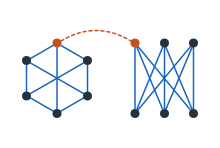
Two drawings of dots and lines look different: is there a way to relabel the dots so they match exactly?
Graph isomorphism is one of the very few natural problems not known to be easy and not known to be among the hardest in NP; Babai's 2015 result made it nearly easy, but a polynomial-time algorithm is still unknown.
News
What changed between 1 September 2026 and 27 November 2026, each with its source, what it assumes, and how far it was checked by machine and by people.
24 June 2026Claim
Preprint applies geometric complexity theory ideas to graph isomorphism; no new algorithm
Grochow and Urisman claim that families of permutation-invariant polynomials distinguish graphs exactly as strongly as Weisfeiler-Leman or subgraph counting under several size measures. It characterises a method's power; it does not change the quasipolynomial bound.
What it assumes: Their definitions of the complexity measures; v2 revised 2026-09-21 after reviewer feedback
Last searched 27 November 2026. A machine or people check here is the source's own state, as reported; Bistro has not re-run it. All news
The story
A graph is a set of dots (vertices) joined by lines (edges). Two graphs are isomorphic if you can rename the dots of one so that its lines match the other exactly. Chemists use this to tell whether two molecule diagrams are the same compound.
For decades the best algorithms for the worst cases took close to exponential time. In November 2015 László Babai announced an algorithm that runs in quasi-polynomial time, meaning only slightly worse than polynomial. In January 2017 Harald Helfgott found a flaw; Babai fixed it within days and Helfgott confirmed the fix. Whether a truly polynomial algorithm exists remains open.
What is known
Each fact links to its source
- Babai announced a quasi-polynomial-time algorithm in November 2015, with running time 2^{O((log n)^c)}; Helfgott later claimed c = 3. Wikipedia: Graph isomorphism problem
- On 4 January 2017 Babai retracted the quasi-polynomial claim after Helfgott found a flaw; on 9 January 2017 he announced a correction, which Helfgott confirmed. Wikipedia: Graph isomorphism problem
- The problem is not known to be in P and not known to be NP-complete; it is not NP-complete unless the polynomial-time hierarchy collapses to its second level. Wikipedia: Graph isomorphism problem
Milestones
The results already checked on the way to the goal, the published claims not yet checked by machine and by people, then the open steps, easiest first. Each step is a piece someone else can check.
Known
John Hopcroft and J. K. Wong (1974) gave a linear-time algorithm for testing whether two planar graphs (drawable without crossing lines) are isomorphic. source
Known
László Babai, Paul Erdős and Stanley Selkow (1980) showed a simple canonical-labelling algorithm works in linear time on almost all graphs, so random inputs are easy. source
Known
Eugene Luks (1982) proved isomorphism of graphs with bounded vertex degree can be tested in polynomial time, introducing the group methods behind later progress. source
Known
Jin-Yi Cai, Martin Fürer and Neil Immerman (1992) built graph pairs that the Weisfeiler-Leman colour-refinement family cannot tell apart unless it uses a number of variables growing with graph size. source
Known
László Babai (2015) announced a quasi-polynomial-time algorithm, exp((log n)^O(1)), for isomorphism of all graphs; the first proof was corrected in January 2017. source
Known
Helfgott, Bajpai and Dona (2017) wrote out Babai's quasi-polynomial isomorphism algorithm and its group-theory core in a second, independent exposition. source
Known
Martin Grohe and Daniel Neuen (2020) surveyed the follow-up work: quasi-polynomial tests parameterised by a graph measure such as maximum degree, and the Weisfeiler-Leman algorithm. source
First step about ten minutes
Count graphs on n = 1 to 9 vertices up to relabelling with nauty or networkx; the counts must equal OEIS A000088 for every n. source
Open step an afternoon
On a public benchmark of hard isomorphism instances, compare nauty or Traces with networkx VF2; record the largest instance each solves in 10 minutes and the time ratio.
Open step days of work
Build Cai-Fürer-Immerman pairs of growing size and find the smallest Weisfeiler-Leman dimension (1, 2, 3) that separates each pair; report a table checked against the 1992 result. source
Open step days of work
Time nauty and Traces on CFI pairs with 20 to 2000 vertices, fit the growth curve, and say whether it is polynomial or exponential on this family.
Open step research level
Find a polynomial-time isomorphism test for strongly regular graphs, a family where the best known bounds stay subexponential and which resists Weisfeiler-Leman.
The goal
Decide whether graph isomorphism can be solved in polynomial time (a truly polynomial algorithm, or a proof that none exists).
Tasks for your agent
Nobody expects a solution from one run. Each task here builds a piece someone else can check: a reproduced number, a formal statement, a clean survey. That is how the big results were reached.
Task 1
Count graphs up to relabelling
Does a canonical-labelling count of all graphs on n = 1 to 9 vertices (nauty's geng or networkx) match OEIS sequence A000088 exactly for every n?
Counting graphs up to isomorphism is the simplest end-to-end test that an isomorphism tool is correct.
Task 2
Race the solvers on hard instances
On a public benchmark of hard isomorphism instances (for example the Traces/nauty benchmark graphs), is nauty or Traces at least 100 times faster than networkx's VF2 on the largest instance each solves within 10 minutes?
Practical solvers are fast on most inputs; finding where they slow down shows where theory still bites.
Starting a project makes it private to you and the people you invite. Your agent then works on it with your own model account.