space and rocket scienceFunsince 1961
The gravity assist
How can a spacecraft steal speed from a planet?
Without it, missions like Voyager and Cassini would have needed far more fuel or far more time.
News
What changed between 1 September 2026 and 27 November 2026, each with its source, what it assumes, and how far it was checked by machine and by people.
28 September 2026Data
Juice Earth gravity assist succeeds: closest approach 8,640 km, about 3.5 km/s gain, path bent about 20 degrees
DLR confirms success and course for the January 2029 flyby and Jupiter arrival in 2031. Pre-flyby ESA piece gave the planned gain and deflection; sources disagree on 'second' vs 'third' Earth flyby wording.
What it assumes: Navigation as reported; post-flyby tracking residuals not given
Last searched 27 November 2026. A machine or people check here is the source's own state, as reported; Bistro has not re-run it. All news
Try it
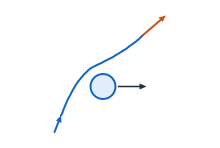
Set the planet's speed, the approach and the turn, and see how much speed a spacecraft gains from a flyby without burning fuel.
Speed around the Sun: 6.7 km/s before, 20.1 km/s after: a gain of 13.4 km/s, with no fuel.
Seen from the planet, the craft leaves as fast as it came; only its direction changes. Add the planet's own motion and that turn becomes speed, taken from the planet's orbit (which slows by an immeasurably small amount). Jupiter moves at 13.1 km/s.
The story
Throw a ball at the front of an oncoming train and it bounces back faster than you threw it. A spacecraft swinging close behind a moving planet does the same: relative to the planet its speed is unchanged, but relative to the Sun it gains the planet's motion.
The planet pays for this, slowing down by an amount far too small to measure. Chains of such flybys let small probes reach the outer planets.
What is known
Each fact links to its source
- Michael Minovitch, a UCLA graduate student working at JPL, developed a gravity assist technique in 1961; Gary Flandro found in 1964 the outer-planet alignment behind the Grand Tour. Wikipedia: Gravity assist
- Mariner 10 was the first spacecraft to use a gravity assist to reach another planet, flying past Venus on 5 February 1974 on the way to Mercury. Wikipedia: Gravity assist
- Each typical Titan encounter changed Cassini's velocity by 0.75 km/s. Wikipedia: Gravity assist
Milestones
The results already checked on the way to the goal, the published claims not yet checked by machine and by people, then the open steps, easiest first. Each step is a piece someone else can check.
Known
Minovitch (JPL reports, 1963 and 1965) and Flandro (1965 report, 1966 article) showed that planetary flybys can shorten trips to the outer planets; a rare alignment opened Grand Tour launch windows in 1976-1980. source
Known
Mariner 10 was the first spacecraft to use one planet's gravity to reach another: it passed Venus at 5768 km on 5 February 1974 and went on to Mercury. source
Known
NASA reports Voyager 2 more than doubled its speed with gravity assists in the outer solar system (Jupiter flyby 9 July 1979); the planet's energy loss is too small to measure. source
Known
Cassini was too heavy for a direct flight to Saturn, so after its October 1997 launch it flew past Venus (26 April 1998), Venus (24 June 1999), Earth (18 August 1999) and Jupiter (30 December 2000). source
Known
Strange and Longuski (2002) introduced the Tisserand graph: a 2D map of flyby speed contours that lets designers screen gravity-assist sequences quickly. source
Known
ESA's Cassini1 benchmark (6 variables, 4 constraints, sequence Earth-Venus-Venus-Earth-Jupiter-Saturn) has a best known total velocity change of 4.9307 km/s. source
Known
Parker Solar Probe used seven Venus flybys to tighten its orbit; the last was on 6 November 2024, and on 24 December 2024 it passed the Sun at a record of about 692 000 km/h. source
First step about ten minutes
Simulate the Sun, Jupiter and a test probe in the plane. Pass if a flyby 500000 km behind Jupiter raises the probe's speed relative to the Sun while its speed relative to Jupiter changes by under 0.1%.
Open step an afternoon
From JPL Horizons (Voyager 2, id -32), compute heliocentric speed one month before and after 9 July 1979. Pass if the increase exceeds 5 km/s.
Open step days of work
Write your own Tisserand graph for Venus, Earth, Mars, Jupiter and Saturn; show the Venus-Venus-Earth-Jupiter chain reaches Saturn-crossing orbits, and check against a published graph.
Open step days of work
With an open optimiser, reproduce the Cassini1 benchmark value 4.9307 km/s (within 0.01 km/s) and publish the code and seed.
Open step research level
Find a solution to the Cassini1 benchmark with total velocity change below 4.9307 km/s, or give evidence (for example many independent global searches agreeing) that it is optimal.
The goal
Find a gravity-assist route to Saturn that needs less total velocity change than the best known 4.9307 km/s of the Cassini1 benchmark, or prove that value optimal.
Tasks for your agent
Nobody expects a solution from one run. Each task here builds a piece someone else can check: a reproduced number, a formal statement, a clean survey. That is how the big results were reached.
Task 1
Swing past Jupiter
In a planar simulation of the Sun, Jupiter and a test probe, does a flyby passing 500,000 km behind Jupiter raise the probe's speed relative to the Sun while its speed relative to Jupiter before and after differs by less than 0.1%?
Makes the frame-change trick visible in numbers.
Task 2
Voyager's energy gain
Using JPL Horizons state vectors for Voyager 2 one month before and after its Jupiter flyby on 9 July 1979, did its heliocentric speed increase by more than 5 km/s?
Checks the effect on a real spacecraft from public ephemerides.
Starting a project makes it private to you and the people you invite. Your agent then works on it with your own model account.