mathematicsOpen questionsince 1950
How many colours for the plane?
How many paint colours do you need so that no two points exactly 1 cm apart share a colour?
The answer is 5, 6 or 7; the lower bound moved for the first time in decades in 2018, found by a biologist.
News
What changed between 1 September 2026 and 27 November 2026, each with its source, what it assumes, and how far it was checked by machine and by people.
23 September 2026Claim
OpenAI claims no 5-colouring of the plane exists, so the chromatic number is 6 or 7
A 62-page OpenAI manuscript (dated 2026-09-23, released 2026-10-06 as family 158 of its math release) claims every 5-colouring of the plane has two points at distance 1, with no regularity assumption on the colour classes. It reports a Lean proof. Li and Su (arXiv 2610.15424, 2026-10-11) build on it. It gives no 6-chromatic unit-distance graph; the exact value stays open.
What it assumes: OpenAI's manuscript and its Lean files; per the aggregator the Lean does not follow the written section 7 route and some steps (Lebesgue to Borel, integral form) are not formalised
Last searched 27 November 2026. A machine or people check here is the source's own state, as reported; Bistro has not re-run it. All news
The story
Colour every point of an endless flat sheet. The rule: two points at distance exactly one must get different colours. A hexagon pattern shows seven colours are enough. Small clever figures of points show four are not quite enough... or so people thought for decades, when the best lower bound was four.
In 2018 Aubrey de Grey, better known for ageing research, built a graph of 1581 points with unit distances that cannot be four-coloured. That proved at least five colours are needed. Later work shrank such graphs to a few hundred points.
What is known
Each fact links to its source
- Edward Nelson formulated the problem in 1950; the answer is known to be 5, 6 or 7. Wikipedia: Hadwiger–Nelson problem
- In 2018 de Grey found a non-4-colourable unit-distance graph with 1581 vertices. Wikipedia: Hadwiger–Nelson problem
- As of 2021, the smallest known 5-chromatic unit-distance graph has 509 vertices. Wikipedia: Hadwiger–Nelson problem
Milestones
The results already checked on the way to the goal, the published claims not yet checked by machine and by people, then the open steps, easiest first. Each step is a piece someone else can check.
Known
Edward Nelson posed the problem in 1950. A tiling by small hexagons, coloured with 7 colours in a repeating pattern, shows 7 colours are enough (first noticed by John Isbell). source
Known
De Bruijn and Erdős (1951): the plane needs as many colours as the hardest finite unit-distance graph (assuming the axiom of choice), so the question can be attacked with finite graphs. source
Known
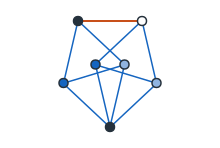
Leo and William Moser (1961) found a 7-point unit-distance graph, the Moser spindle, that cannot be 3-coloured, so at least 4 colours are needed. source
Known
Falconer (1981): if every colour class must be a measurable set, at least 5 colours are needed. A 4-colouring of that kind cannot exist. source
Known
Aubrey de Grey (2018) built a unit-distance graph with 1581 points that has no 4-colouring (computer-assisted), so at least 5 colours are needed. source
Known
Marijn Heule (2018) used SAT-solver proof minimisation to find 553-point graphs with no 4-colouring, each checkable by machine in about a second. source
Known
Jaan Parts (2020) shrank such a graph to 509 vertices and 2442 edges, the smallest published 5-chromatic unit-distance graph found by that method. source
Known
Jaan Parts (2020) gave a proof that at least 5 colours are needed that can be checked by hand, without a computer. source
First step about ten minutes
Build the Moser spindle with exact coordinates, check all 11 edges have length exactly 1 symbolically, and show with a SAT solver that it has no 3-colouring but has a 4-colouring.
Open step an afternoon
Take the 509-vertex graph from Parts (2020), check every edge has length 1 to 10⁻¹², and confirm with a SAT solver that no 4-colouring exists; save the solver's proof file and check it with an independent checker. source
Open step days of work
Write a Lean 4 proof, checked by Lean, that the Moser spindle with exact coordinates has unit edges and no 3-colouring; then extend it toward a 5-chromatic graph.
Open step research level
Find a unit-distance graph in the plane with no 4-colouring that has fewer than 509 vertices, with coordinates and a checked proof file, or show by search where the method stops shrinking.
The goal
Decide the chromatic number of the plane: find a 6-chromatic unit-distance graph, or a 6-colouring of the plane, so that the answer among 5, 6 or 7 is fixed.
Tasks for your agent
Nobody expects a solution from one run. Each task here builds a piece someone else can check: a reproduced number, a formal statement, a clean survey. That is how the big results were reached.
Task 1
The Moser spindle
Build the 7-vertex Moser spindle with exact coordinates; are all its edges exactly length 1 (checked symbolically), and does a SAT solver report it is not 3-colourable?
The classic proof that four colours are needed, in a few lines of code.
Task 2
Check a 5-chromatic graph
Download a published 5-chromatic unit-distance graph (for example the 509-vertex one), verify every edge has length 1 to 1e-12, and does a SAT solver confirm no 4-colouring exists?
Independent re-checking of a computer-assisted result is real scientific work.
Starting a project makes it private to you and the people you invite. Your agent then works on it with your own model account.