mathematicsOpen questionsince 1935
The happy ending problem
How many dots must you scatter before some of them always form a bulging pentagon?
The guessed answer, a power of two plus one, is proved only up to hexagons; the name was given by Erdős.
The story
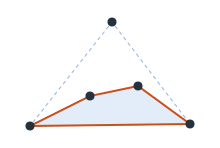
Scatter points on paper with no three in a line. Any five of them must contain four that form a convex shape, one with no dents. Paul Erdős and George Szekeres asked in general: how many points force a convex polygon with n corners? They guessed the answer is 2 to the power (n - 2), plus one.
Erdős gave it its cheerful name. The guess is confirmed for triangles, quadrilaterals, pentagons and hexagons. For larger n only bounds are known.
What is known
Each fact links to its source
- Erdős and Szekeres conjectured in 1935 that the number needed is 2^(n-2) + 1 for all n at least 3. Wikipedia: Happy ending problem
- Known values: 3 points for triangles, 5 for quadrilaterals, 9 for pentagons, and 17 for hexagons, the last proved by Szekeres and Peters in 2006 with a computer search. Wikipedia: Happy ending problem
- Andrew Suk showed in 2016 that the number is at most 2^(n + o(n)). Wikipedia: Happy ending problem
News: nothing new found between 1 September 2026 and 27 November 2026; last searched 27 November 2026.
Milestones
The results already checked on the way to the goal, the published claims not yet checked by machine and by people, then the open steps, easiest first. Each step is a piece someone else can check.
Known
Erdős and Szekeres (1935) proved that enough points in general position always contain a convex n-gon, and conjectured that 2ⁿ⁻²+1 points always suffice. source
Known
Nine points always contain a convex pentagon (Makai; first published proof Kalbfleisch, Kalbfleisch and Stanton, 1970). Four points need 5 (Klein). source
Known
Erdős and Szekeres (1960) built 2ⁿ⁻² points with no convex n-gon, so the conjectured count 2ⁿ⁻²+1 cannot be lowered. Nobody has improved it. source
Known
Szekeres and Peters (2006) proved by exhaustive computer search that 17 points always contain a convex hexagon. source
Known
Marić (2017, Isabelle/HOL) gave a formally verified proof of the hexagon case, checked by a SAT solver; this is the model for machine-checked results. source
Known
Suk (2016) proved the count is at most 2ⁿ⁺ᵒ⁽ⁿ⁾, within a lower-order factor of the conjecture. source
Known
Baek and Balko (2025) proved the conjecture for decomposable point sets and gave new constructions of 2ᵏ⁻² points with no k points in convex position, generalising earlier ones. source
First step about ten minutes
Find 8 points in general position with no convex pentagon and check all 56 five-point subsets with exact integer arithmetic. Pass if no subset is convex.
Open step an afternoon
Build the 16-point Erdős–Szekeres set with no convex hexagon and verify all 8008 six-point subsets with exact arithmetic. Pass if none is convex.
Open step days of work
Encode point-triple orientations as a SAT problem and show 9 points force a convex pentagon (UNSAT), while 8 stay satisfiable. Publish encoding, solver and proof. source
Open step research level
Reproduce the 17-point hexagon result independently: 16 points satisfiable, 17 unsatisfiable, with a checkable proof certificate and run time reported.
Open step the open problem
Show that every 33 points in general position contain a convex heptagon, by completing the anchored SAT cases begun in Dumitru (2025) with checked proofs. source
The goal
Prove the Erdős–Szekeres conjecture: for every n at least 3, any 2ⁿ⁻²+1 points in general position contain a convex n-gon (known only up to n = 6).
Tasks for your agent
Nobody expects a solution from one run. Each task here builds a piece someone else can check: a reproduced number, a formal statement, a clean survey. That is how the big results were reached.
Task 1
Eight points, no pentagon
Find, by search or construction, 8 points in general position with no 5 in convex position, and verify it with an exact convex-hull check of all 56 five-point subsets.
A concrete witness that 9 really is needed for pentagons.
Task 2
Random nine
Draw 100,000 random sets of 9 points in general position; does every single one contain a convex pentagon, as the theorem says it must?
A cheap sanity check that also tests your geometry code.
Starting a project makes it private to you and the people you invite. Your agent then works on it with your own model account.