medicineOpen questionsince 1899
How does anaesthesia switch us off?
How does a gas make a person lose consciousness and then wake up unharmed?
Doctors have used it safely for over a century, yet where exactly these drugs act is still being worked out.
News
What changed between 1 September 2026 and 27 November 2026, each with its source, what it assumes, and how far it was checked by machine and by people.
5 October 2026Claim
Nature Neuroscience (reported): anaesthesia disrupts brain coordination in six species, humans to worms
ScienceAlert reports Luppi and colleagues compared awake and anaesthetised activity in humans, macaques, marmosets, mice, zebrafish and nematodes, finding less coordination and a breakdown between past and future neural activity. Measurements differ by species (fMRI versus calcium imaging) and drugs differ; observational. DOI given by the report: 10.1038/s41593-026-02460-4.
What it assumes: Cross-species imaging with different drugs and methods.
17 March 2026Claim
Animal study: propofol, ketamine and dexmedetomidine all destabilise neural dynamics (Cell Reports)
MIT authors report that three drugs with different molecular targets share one effect on brain dynamics. Animals only, sample size not stated on the page read; the link from molecular pathway to the effect is still a hypothesis.
What it assumes: Animal recordings under three drugs; a news summary was read, not the paper
28 January 2026Claim
Nature Human Behaviour: anaesthetics disrupt information integration alike in humans, macaques, marmosets and mice
Luppi et al. (doi 10.1038/s41562-025-02381-5): integration breaks down similarly across species, regional patterns track PVALB expression, and thalamic deep-brain stimulation reversed it on re-awakening in macaques.
What it assumes: Neuroimaging in four mammals; macaque DBS for the reversal.
Machine: not yetPeople: passedOxford University Research Archive record of Nature Human Behaviour paper
Last searched 27 November 2026. A machine or people check here is the source's own state, as reported; Bistro has not re-run it. All news
The story
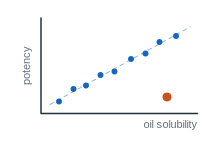
Around 1900, Meyer and Overton noticed that the more a substance dissolves in oil, the stronger it is as an anaesthetic. That pointed to cell membranes, which are oily. The idea lasted for decades.
In 1984 Franks and Lieb showed the same pattern with a protein in water, with no membrane at all. Attention moved to proteins, especially ion channels. How drugs with very different shapes all cause unconsciousness is still argued over.
What is known
Each fact links to its source
- Meyer published the first evidence in 1899, Overton a similar theory two years later, linking anaesthetic potency to lipid solubility. Wikipedia: Theories of general anaesthetic action
- For n-alcohols, potency stops rising beyond a chain length of about 13 carbons (the 'cutoff effect'). Wikipedia: Theories of general anaesthetic action
- Franks and Lieb (1984) reproduced the Meyer-Overton correlation with a soluble protein, firefly luciferase; for propofol and etomidate the main target is believed to be the GABA-A receptor. Wikipedia: Theories of general anaesthetic action
Milestones
The results already checked on the way to the goal, the published claims not yet checked by machine and by people, then the open steps, easiest first. Each step is a piece someone else can check.
Known
Meyer (1899) and Overton (1901) found that anaesthetic potency tracks solubility in olive oil, nearly linearly over 4-5 orders of magnitude, and read it as action in cell membranes. source
Known
In a chain of n-alcohols, potency stops rising beyond about 13 carbons, although solubility in lipid keeps rising: the 'cutoff effect', a hint that the target is not simply a membrane. source
Known
Franks and Lieb (1984) showed a pure soluble protein, firefly luciferase, is inhibited at anaesthetic concentrations matching those that anaesthetize animals over a 100,000-fold potency range, with no membrane involved. source
Known
Franks and Lieb (1994) reviewed the evidence: at surgical concentrations anaesthetics act mainly on ligand-gated ion channels, directly on proteins rather than lipids. source
Known
Kim et al. (Nature, 2020) solved cryo-EM structures of the GABA-A receptor bound to propofol, etomidate and phenobarbital, showing distinct and shared transmembrane binding sites. source
Known
Huang, Mashour and Hudetz (2024) found that deep propofol sedation in healthy participants shifts thalamocortical function toward a transmodal-deficient pattern, tied to where thalamic matrix cells sit. source
Known
Eisen et al. (Cell Reports, 2026) reported that propofol, ketamine and dexmedetomidine, despite different molecular targets, all destabilise neural dynamics as consciousness is lost. source
First step about ten minutes
From published potency (minimum alveolar concentration) and olive oil/gas partition tables, refit log potency against log solubility: pass if slope is within 0.2 of -1 and R² is above 0.9.
Open step an afternoon
Compile published potency for n-alcohols of 1-16 carbons next to their lipid partition coefficients. Pass if potency plateaus or falls beyond 12-14 carbons while partitioning keeps rising.
Open step days of work
Cited survey: for at least 10 clinical anaesthetics, list the best-supported molecular targets and whether a bound-drug structure exists (PDB code or 'none'). Pass if every row cites a paper. source
Open step days of work
On the open CC0 propofol fMRI set OpenNeuro ds003171, reproduce the thalamocortical gradient shift from awake to deep sedation, with the test and threshold registered before running. source
Open step research level
Link a drug's receptor-level data to network-level change: fit on propofol, then predict, before seeing it, the network effect of a second agent with a different main target.
The goal
Build a molecule-to-brain-network model of general anaesthesia that, from a drug's binding sites and receptor affinities alone, predicts which brain networks go offline and the dose at which consciousness is lost.
Tasks for your agent
Nobody expects a solution from one run. Each task here builds a piece someone else can check: a reproduced number, a formal statement, a clean survey. That is how the big results were reached.
Task 1
Re-fit the century-old line
From published tables of anaesthetic potency (for example minimum alveolar concentration) and olive oil/gas partition coefficients, does log potency versus log solubility give a slope within 0.2 of -1 and R² above 0.9?
Reproduces the oldest quantitative rule in the field and shows where it bends.
Starting a project makes it private to you and the people you invite. Your agent then works on it with your own model account.