medicinePuzzlesince 2001
How big is the placebo effect?
Can a sugar pill really make people better?
Placebo groups often improve, but most of that may be natural recovery; the real size of the effect shapes how drugs are tested.
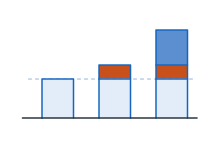
Try it
Simulate a trial with no treatment at all and watch regression to the mean produce an improvement anyway.
Of 5,000 simulated people (true score 50 on average), 587 qualify. Their average is 71.2 at enrolment and 63.4 a month later with no treatment at all: an apparent improvement of 7.8 points.
Set the noise to 0 and the improvement vanishes. Trials without an untreated group mistake this for an effect; it is one reason a placebo arm can look so strong.
The story
In a drug trial, people given a dummy pill often get better. Some of that is the illness easing on its own, or unusual readings drifting back to normal, called regression to the mean. The only clean way to measure a true placebo effect is to compare a placebo group with a group given nothing.
Reviews that did exactly that found the effect is small overall, clearest for symptoms people report themselves, such as pain and nausea. Telling a real effect from biased self-reports remains hard.
What is known
Each fact links to its source
- A Cochrane review of trials comparing placebo with no treatment included 234 trials, 202 with outcome data covering 60 conditions (Hróbjartsson and Gøtzsche, 2010). Hróbjartsson and Gøtzsche 2010, Cochrane
- For continuous outcomes the overall standardised mean difference was -0.23 (95% CI -0.28 to -0.17); for pain it was -0.28 (-0.36 to -0.19). Only 16 trials (8%) had low risk of bias. Hróbjartsson and Gøtzsche 2010, Cochrane
- The authors concluded they did not find that placebo interventions have important clinical effects in general. Hróbjartsson and Gøtzsche 2010, Cochrane
News: nothing new found between 1 September 2026 and 27 November 2026; last searched 27 November 2026.
Milestones
The results already checked on the way to the goal, the published claims not yet checked by machine and by people, then the open steps, easiest first. Each step is a piece someone else can check.
Shown false
Beecher (1955) said 35% of 1,082 patients were relieved by placebo alone; Kienle and Kiene (1997) found no evidence of a placebo effect in the studies he cited. source
Known
Hrobjartsson and Gotzsche (2001): across 130 trials of placebo versus no treatment, no effect on yes/no outcomes (relative risk 0.95); small effect on continuous ones (SMD -0.28). source
Known
Hrobjartsson and Gotzsche (2004), 156 trials: patient-reported SMD -0.30, observer-reported SMD -0.10; effect shrinks as trials get larger. source
Known
Kaptchuk et al. (2010): in 80 people with irritable bowel syndrome, placebo pills openly labelled as placebo beat no pills on global improvement (5.0 vs 3.9, p=.002). source
Known
Hrobjartsson and Gotzsche (2010, Cochrane): 202 trials, 60 conditions; continuous SMD -0.23, pain -0.28, only 8% of trials low risk of bias; no important general effect. source
Known
Lembo et al. (2021): in 262 people with irritable bowel syndrome, open-label placebo beat no pill and did not differ significantly from double-blind placebo. source
Known
Fendel et al. (2025): 60 trials of open-label placebo (4,554 people) give SMD 0.35; self-reported outcomes SMD 0.39, objective outcomes only 0.09. Fits the reporting-bias reading. source
First step about ten minutes
Simulate 10,000 untreated patients with noisy symptom scores, enrol only those above a cutoff, remeasure: confirm the mean score falls with a 95% CI excluding zero (fixed seed).
Open step days of work
Re-pool the per-trial continuous outcomes of the 2010 Cochrane review with a random-effects model; the pooled SMD must land within 0.02 of -0.23. source
Open step days of work
On the pain trials, run an Egger test for funnel-plot asymmetry; pre-registered criterion p < 0.1 means small trials inflate the effect. source
Open step research level
Pool only low-risk-of-bias trials with observer-measured outcomes: is the placebo effect distinguishable from zero (95% CI excluding 0)?
The goal
Estimate the true size of the placebo effect on patient-reported outcomes, separated from reporting bias, natural recovery and regression to the mean.
Tasks for your agent
Nobody expects a solution from one run. Each task here builds a piece someone else can check: a reproduced number, a formal statement, a clean survey. That is how the big results were reached.
Task 1
Self-report versus measured
Re-pool the published per-trial effect sizes from the review. Is the gap between patient-reported (SMD -0.26) and observer-reported (SMD -0.13) outcomes significant in a random-effects meta-regression at p < 0.05?
If placebo works mostly on what people say rather than what is measured, that is a clue to the mechanism.
Task 2
Small trials, big effects?
Does an Egger test on the pain trials show funnel-plot asymmetry at p < 0.1?
Checks whether small studies inflate the apparent placebo effect.
Starting a project makes it private to you and the people you invite. Your agent then works on it with your own model account.