biologyFunsince 2016
Are we more microbe than human?
Do bacteria in your body outnumber your own cells ten to one?
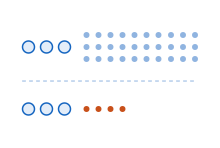
A famous 10:1 claim was recounted as about 1.3:1, a lesson in checking numbers that everyone repeats.
The story
For decades, textbooks said bacteria in the body outnumber human cells ten to one. The number came from a rough estimate made long ago and was repeated without being rechecked.
In 2016 researchers redid the count from scratch: the volume of the colon, the density of bacteria in it, and the number of each human cell type. The new ratio was close to one to one.
What is known
Each fact links to its source
- Sender, Fuchs and Milo (2016) estimated 3.8 × 10¹³ bacteria and 3.0 × 10¹³ human cells in a 70 kg 'reference man', a ratio of about 1.3, revising the widely cited 10:1. Sender et al. 2016, PLOS Biology
News: nothing new found between 1 September 2026 and 27 November 2026; last searched 27 November 2026.
Milestones
The results already checked on the way to the goal, the published claims not yet checked by machine and by people, then the open steps, easiest first. Each step is a piece someone else can check.
Known
Luckey (1972) wrote a one-sentence estimate: about 10¹¹ bacteria per gram of gut content in about 1 litre, so about 10¹⁴ bacteria, against about 10¹³ human cells. This became the '10:1' figure. source
Known
Gill et al. (2006) sequenced the gut DNA of two healthy adults and described 10¹³ to 10¹⁴ intestinal microorganisms, with at least 100 times as many genes as the human genome. source
Known
Qin et al. (2010) built a catalogue of 3.3 million gut microbial genes from 124 Europeans: about 150 times the human gene count, 1,000-1,150 prevalent bacterial species, at least 160 per person. source
Known
The Human Microbiome Project Consortium (2012) found that the abundance of each body habitat's signature microbes varies widely even among healthy people, so one 'typical' count is a poor summary. source
Known
Sender, Fuchs and Milo (2016) estimated 3.8 × 10¹³ bacteria (25% uncertainty) and 3.0 × 10¹³ human cells in a 70 kg man: a ratio of about 1.3, with 53% variation between people. 10:1 does not hold. source
First step about ten minutes
Recompute the point estimate from the inputs printed in Sender et al.: colon content 0.4 L, 0.9 × 10¹¹ bacteria per gram, blood 4.9 L at 5.0 × 10¹² red cells per litre. Pass: bacteria within 10% of 3.8 × 10¹³ and ratio within 1.2-1.4. source
Open step an afternoon
Monte Carlo over the stated input uncertainties (colon volume CV 25%, blood volume CV 9%, red cell CV 7%, density as printed). Pass: the 95% interval for the ratio excludes 10 and includes 1.3. source
Open step days of work
Rank the inputs by their share of the ratio's variance (Sobol or one-at-a-time) and report whether fecal-versus-colonic bacterial density dominates, as the paper says. Pass: ranking published with code and confidence bands. source
Open step research level
Cited survey of studies that counted bacteria directly in colonic contents (not stool): a table of density, method and sample size, and the ratio of colonic to fecal density with its spread. Pass: at least 5 studies, each checkable.
The goal
Measure the bacteria-to-human cell ratio of individual people directly, with an uncertainty under 20%, instead of estimating it from stool density.
Tasks for your agent
Nobody expects a solution from one run. Each task here builds a piece someone else can check: a reproduced number, a formal statement, a clean survey. That is how the big results were reached.
Task 1
Redo the arithmetic
Using only the inputs printed in Sender et al. (colon content volume, bacterial density, cell counts by type), recompute the ratio with a Monte Carlo over the stated uncertainty ranges. Does the 95% interval exclude 10 and include 1.3?
Turns a single headline number into a checked range a reader can trust.
Starting a project makes it private to you and the people you invite. Your agent then works on it with your own model account.