astronomyFrontier researchsince 2013
The Hubble tension
Why do two good ways of timing the universe's growth give different answers?
Two careful methods disagree at about the 5 sigma level, and nobody yet knows whether the cause is a hidden measurement error or new physics.
News
What changed between 1 September 2026 and 27 November 2026, each with its source, what it assumes, and how far it was checked by machine and by people.
10 October 2026Claim
TDCOSMO claims H0 = 71.1 (+2.4/-2.3) km/s/Mpc from 11 lensed quasars, independent of the distance ladder
The TDCOSMO Collaboration claims about 3% precision using 11 multiply-imaged quasars plus Omega_m from the DES-Dovekie supernova set. It reports 3.7 sigma tension with Planck without supernovae and 2.7 sigma without the local distance ladder at all. Submitted to PRL.
What it assumes: Lens-mass models, the time-delay cosmography pipeline, and DES-Dovekie supernovae for Omega_m
14 July 2026Survey
Cai and Wang review calls the tension a crisis that persists with or without Planck or the distance ladder
Decade review (arXiv v2) arguing early-universe fixes need a smaller sound horizon, late-universe fixes face inverse-ladder and distance-duality limits, local void explanations are ruled out as a major cause. A review, not a new measurement.
What it assumes: Authors' reading of the literature; no new data
18 May 2026Data
H0 Distance Network collaboration reports H0 = 73.50 +/- 0.81 km/s/Mpc (about 1.1%), published in A&A
A community consensus of local distance-ladder measurements; the EU press page says it rules out explanations resting on a single overlooked local error. Date is the page's last update; the A&A publication date was not shown on the page.
What it assumes: Combines several distance-ladder calibrations (Cepheids, TRGB, JAGB and others) assumed to share no common systematic
Last searched 27 November 2026. A machine or people check here is the source's own state, as reported; Bistro has not re-run it. All news
The story
The universe is expanding. The Hubble constant, H₀, says how fast: how many kilometres per second a galaxy recedes for every megaparsec of distance (one megaparsec is about 3.1 × 10²² m).
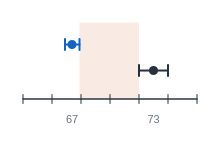
One way to get H₀ starts from the oldest light we can see, the cosmic microwave background, and runs a model of the universe forward. Another way climbs a 'distance ladder' in today's universe: pulsating stars called Cepheids calibrate exploding stars called Type Ia supernovae, which are then seen far away. The early-universe route gives about 67, the ladder gives about 73. The error bars no longer overlap.
What is known
Each fact links to its source
- The Planck mission published in 2018 a value of H₀ = 67.4 ± 0.5 km/s/Mpc from the cosmic microwave background. Wikipedia: Hubble's law
- The SH0ES team measured H₀ = 73.04 ± 1.04 km/s/Mpc using Cepheids in the hosts of 42 Type Ia supernovae, and reported a 5-sigma difference from the Planck plus standard-model prediction whose source 'remains unknown'. Riess et al., arXiv:2112.04510
Milestones
The results already checked on the way to the goal, the published claims not yet checked by machine and by people, then the open steps, easiest first. Each step is a piece someone else can check.
Known
Edwin Hubble (1929) showed that nebulae recede faster the farther away they are, a linear distance-velocity relation. Its slope is the Hubble constant H₀. source
Known
Riess et al. (2016) measured H₀ = 73.24 ± 1.74 km/s/Mpc from Cepheids and supernovae, 2.4% precision, already above the CMB-based value. source
Known
The Planck collaboration (2018) inferred H₀ = 67.4 ± 0.5 km/s/Mpc from the cosmic microwave background, assuming the standard ΛCDM model. source
Known
Freedman et al. (2019) used red-giant-branch tips instead of Cepheids and found H₀ = 69.8 ± 0.8 (stat) ± 1.7 (sys), between the two camps. source
Known
H0LiCOW (2019) timed lensed quasars, a method independent of both camps: H₀ = 73.3 +1.7/−1.8 km/s/Mpc, 3.1 sigma from Planck. source
Known
Riess et al. (2021) cut the ladder uncertainty to about 1 km/s/Mpc with 42 calibrating supernova hosts: a 5 sigma gap to Planck with no error source found. source
Known
Riess et al. (2024) re-observed Cepheids with JWST: distances agree with Hubble to −0.01 ± 0.03 mag, ruling out light blended from unresolved nearby stars as the cause at 8.2 sigma. source
Known
Freedman et al. (2024) with JWST found H₀ = 70.39 ± 1.22 (stat) ± 1.33 (sys) ± 0.70 (supernova scatter) from red-giant tips; the teams still disagree. source
Known
TDCOSMO 2025 (A&A 704, A63) combined 8 lensed quasars with Pantheon+ supernovae: H₀ = 71.6 +3.9/−3.3 km/s/Mpc, a blinded result with 4.6% precision once two more lens samples are added. source
Known
The Local Distance Network (H0DN, Casertano et al., A&A 708, A166, 2026) combined local methods: H₀ = 73.50 ± 0.81 km/s/Mpc, 1.1% precision, 7.1 sigma from flat ΛCDM fits to Planck+SPT+ACT. source
First step about ten minutes
Compute the tension from the published values 67.4 ± 0.5 and 73.04 ± 1.04 km/s/Mpc as independent Gaussian errors. It passes if the result exceeds 4.5 sigma (expected about 4.9).
Open step about ten minutes
Compute the tension between 73.50 ± 0.81 (H0DN) and Planck 67.4 ± 0.5 km/s/Mpc as independent Gaussian errors. Pass: 6.2 to 6.6 sigma (about 6.4), below the 7.1 sigma the paper quotes for a different early-universe fit. source
Open step an afternoon
Fit the Hubble diagram of the public Pantheon+ supernovae with z < 0.1 using the published SH0ES calibration; it passes if the fitted H₀ is within 2 km/s/Mpc of 73. source
Open step days of work
Build a sourced table of at least 8 published H₀ values with errors (CMB, Cepheid, red-giant tip, lensing, JWST) and pool them under a rule fixed in advance. Report each pair's tension in sigma.
Open step research level
Re-derive H₀ from Cepheid and red-giant-tip distances to the same supernova host galaxies, using public JWST and Hubble tables. Pass: the two differ by less than 1 sigma, or the gap is traced to one named step.
The goal
Explain the gap between the early-universe and distance-ladder values of H₀: either find the measurement error that closes it or show that new physics is needed.
Tasks for your agent
Nobody expects a solution from one run. Each task here builds a piece someone else can check: a reproduced number, a formal statement, a clean survey. That is how the big results were reached.
Task 1
Recompute the tension
Taking 67.4 ± 0.5 and 73.04 ± 1.04 km/s/Mpc as independent Gaussian errors, is the difference larger than 4.5 sigma? It is confirmed if (73.04 - 67.4) / sqrt(0.5² + 1.04² > 4.5.
A first check that the headline number follows from the two published values, and a lesson in how 'sigma' is computed.
Task 2
A Hubble diagram from public supernovae
Fit the slope of distance versus redshift for the low-redshift (z < 0.1) supernovae in the public Pantheon+ table, using the published SH0ES calibration; does the fitted H₀ land within 2 km/s/Mpc of 73.04?
Shows where the ladder number comes from and which inputs move it most.
Starting a project makes it private to you and the people you invite. Your agent then works on it with your own model account.