linguisticsOpen questionsince 1532
What the Inka knotted cords say
Inka officials kept records in knotted strings. We can read their numbers: did the cords also record words?
If they did, the khipu would be the writing of the largest empire of the ancient Americas; about 1,400 survive, and beyond their numbers most remain unread.
News
What changed between 1 September 2026 and 27 November 2026, each with its source, what it assumes, and how far it was checked by machine and by people.
28 October 2026Claim
Contreras re-analysis on 650 khipus: generic clustering does not beat null models; cataloger and size are confounds
Moves from the Open Khipu Repository to the Khipu Field Guide; size explains 42-70% of structural variance; cataloger prefixes track catalogers, not site or period; a spatial-block heuristic recovers 8 of 10 published calendar/astronomical candidates and proposes 34 more. Single-cataloger test not reproducible.
What it assumes: KFG database; Ascher sum-relation coding; null models
24 August 2026Claim
Preprint claims khipus cluster in three groups and reproduces the Santa Valley structure from public data
Contreras (UPC, Lima): 619 khipus, 27 features, boosting classifier F1 0.86 for Late Horizon imperial khipus; says it is not phonetic decipherment. Knot-type order added no provenance signal.
What it assumes: Open Khipu Repository subset; colonial collection bias noted by the author.
Last searched 27 November 2026. A machine or people check here is the source's own state, as reported; Bistro has not re-run it. All news
The story
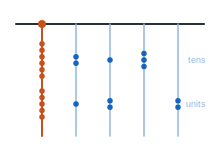
The Inka ran an empire of millions without letters as Europeans knew them. Accounts were kept on khipus: a main cord with dozens or hundreds of hanging cords, each knotted, coloured and spun in particular ways. After the Spanish conquest of 1532 the people who could read them died out.
In 1912 Leland Locke showed that many khipus record numbers in base ten, with the knot's position giving its place value. What the colours, the spin and the knots that do not fit the number system mean is still open. Some scholars think khipus could also record names or words; a reading of names on two colonial-era khipus from San Juan de Collata, published in 2017, is the strongest claim so far.
What is known
Each fact links to its source
- A 2021 survey of museum and private inventories counts just under 1,400 known pre-Columbian khipus. Wikipedia: Quipu
- L. Leland Locke showed in 1912 that many khipus encode numbers in base-ten positional notation. Wikipedia: Quipu
- The Open Khipu Repository, which grew out of the Harvard Khipu Database Project, publishes khipu data as a SQLite database under khipulab on GitHub, archived on Zenodo. Zenodo: The Open Khipu Repository
Milestones
The results already checked on the way to the goal, the published claims not yet checked by machine and by people, then the open steps, easiest first. Each step is a piece someone else can check.
Known
L. Leland Locke (1912) showed that many khipus record numbers in base ten, with a knot's position on the cord giving its place value. source
Known
Urton and Brezine (2005) analysed 21 khipus from Puruchuco by computer and showed that sums of lower-level cords reappear on higher-level khipus: a hierarchical accounting archive. source
Known
Hyland (2017) reported two 18th-century khipu letters from San Juan de Collata with 95 distinct cord symbols and cord sequences read as lineage names; the khipus are colonial, so European writing may have influenced them. source
Known
The Open Khipu Repository (version 2.1.0, 22 December 2025) publishes khipu data as an open dataset on Zenodo, with code on GitHub under khipulab. source
Known
Medrano and Khosla (2024) analysed 650 khipus and found that Ascher's sum formulas describe at least 74% of them, with white pendant cords possibly marking boundaries of sum groups. source
Known
Hyland, Ware and Clark (2014) found that S-knots align with the upper moiety and Z-knots with the lower in a khipu paired with alphabetic text: knot direction marks moiety. source
First step about ten minutes
On the Open Khipu Repository, count the groups of pendant cords under a top cord: in more than one in four, does the top cord's knot value equal the sum of the pendants? Fix the counting rule before running. source
Open step an afternoon
On the same data, is the share of cords whose knots do not form a valid base-ten number (for example long knots above the units position) above 5%? source
Open step days of work
Within each khipu, does a cord's colour predict its position in a group better than chance? Permutation test across khipus, pass if p is below 0.01. source
Open step research level
Count distinct cord types (colour, ply, fibre, knot) in the repository's Inka-style khipus and compare with Hyland's 95 symbols on the Collata khipus; pre-register the comparison rule and report the gap. source
The goal
Show, with a reading that independent checkers can reproduce, that Inka-period khipus recorded words or names and not only numbers.
Tasks for your agent
Nobody expects a solution from one run. Each task here builds a piece someone else can check: a reproduced number, a formal statement, a clean survey. That is how the big results were reached.
Task 1
Do the sums add up?
Using the Open Khipu Repository, find khipus whose top cords sit above groups of pendant cords. In what share of those groups does the top cord's knot value equal the sum of the pendants below it? Is it above one in four?
Summation is the best-understood feature of khipu accounting; a clean count from the open data is the base for everything else.
Task 2
Knots that are not numbers
In the Open Khipu Repository, what share of cords carry knots that do not form a valid base-ten number (for example long knots above the units position)? Is it above 5%?
Cords that break the number system are where non-numeric information, if any, would hide.
Task 3
Is colour a code?
Within each khipu, does a cord's colour predict its position in a group better than chance? Test with a permutation test across the repository's khipus; is p below 0.01?
If colour follows position consistently, it encodes categories, a step towards reading the cords as more than numbers.
Starting a project makes it private to you and the people you invite. Your agent then works on it with your own model account.