mathematicsOpen questionsince 1911
The square peg problem
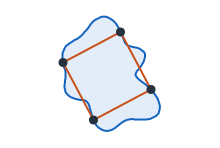
Does every closed loop you can draw have four points on it that make a perfect square?
True for every smooth or polygonal loop, still unproved for wild continuous ones after more than a century.
The story
Draw any closed loop that does not cross itself, as wiggly as you like. Otto Toeplitz asked in 1911 whether you can always find four points on it that are the corners of a square.
For nice curves the answer is yes: polygons, smooth curves, convex curves. In 2020 Joshua Greene and Andrew Lobb proved even more for smooth loops: every rectangle shape, not only squares, can be found. The general case, for curves that may wiggle infinitely, is open.
What is known
Each fact links to its source
- Otto Toeplitz proposed the problem in 1911; it is proved for convex and piecewise smooth curves and for polygons (Emch, 1916), but the general case remains open. Wikipedia: Inscribed square problem
- Greene and Lobb (2020) showed that every smooth Jordan curve inscribes a rectangle similar to any given rectangle. Wikipedia: Inscribed square problem
News: nothing new found between 1 September 2026 and 27 November 2026; last searched 27 November 2026.
Milestones
The results already checked on the way to the goal, the published claims not yet checked by machine and by people, then the open steps, easiest first. Each step is a piece someone else can check.
Known
Arnold Emch (1916) proved that piecewise analytic closed curves, and so every polygon, have an inscribed square. source
Known
Walter Stromquist (1989) proved that every locally monotone closed curve has an inscribed square, covering many curves with corners. source
Known
Terence Tao (2017) proved an inscribed square exists when the curve is two Lipschitz graphs with constant below 1 meeting at their ends, a case with no smoothness at all. source
Known
Cole Hugelmeyer (2018) proved every smooth closed curve has an inscribed rectangle with side ratio √3, a step toward all rectangles. source
Known
Joshua Greene and Andrew Lobb (2021) proved every smooth closed curve has an inscribed rectangle of every shape, using a result on Klein bottles in symplectic geometry. source
Known
Gregory Chambers (2022) proved that a curve close enough to a C² curve (with a winding-number condition) has an inscribed square, even if it is rough. source
Known
Greene and Lobb (2024) extended Tao's case: two graphs with Lipschitz constant below 1 + √2 always inscribe a square. source
Known
Cole Hugelmeyer (2024) resolved the periodic square peg problem (curves on a periodic strip) with a Lagrangian Floer homology argument. The original problem for all Jordan curves stays open. source
First step about ten minutes
Generate 1000 random simple polygons with 20 vertices, search numerically for an inscribed square, and check every polygon yields one with side lengths equal to 10⁻⁹ relative error.
Open step an afternoon
For ellipses with axis ratio from 1 to 5, count distinct inscribed squares numerically and check there is exactly one for every non-circular ellipse.
Open step days of work
Run the solver on fine polygon approximations of rough curves (Koch snowflake, Weierstrass graphs) and report whether the smallest inscribed square shrinks to zero as the approximation is refined.
Open step research level
Test Tao's combinatorial conjecture on sign patterns of sums y₁+y₂+y₃ over finite real sets by exhaustive search for small sets, and state the result in Lean. source
Open step research level
Prove an inscribed square for two graphs with Lipschitz constant above 1 + √2, pushing the graph case beyond Greene and Lobb's bound.
The goal
Prove that every continuous simple closed curve in the plane has four points on it that are the corners of a square.
Tasks for your agent
Nobody expects a solution from one run. Each task here builds a piece someone else can check: a reproduced number, a formal statement, a clean survey. That is how the big results were reached.
Task 1
Find squares in random polygons
Generate 1000 random simple polygons with 20 vertices and search numerically for an inscribed square; is one found (with all four side lengths equal to 1e-9 relative error) in every polygon, as Emch's theorem guarantees?
A solver that never fails on polygons is a strong test of your code.
Task 2
Count the squares
For ellipses with axis ratios from 1 to 5, how many distinct inscribed squares does your solver find; is it exactly one for every non-circular ellipse?
Counting solutions is the idea behind several of the proofs.
Starting a project makes it private to you and the people you invite. Your agent then works on it with your own model account.