mathematicsSolved recentlysince 1930
Keller's conjecture on cube tilings
If you fill space with equal cubes, must two of them always share a whole face?
True up to 6 dimensions, false from 8 upwards; the last case, dimension 7, fell to a computer proof in 2019.
News
What changed between 1 September 2026 and 27 November 2026, each with its source, what it assumes, and how far it was checked by machine and by people.
16 July 2026Formalisation
Lean 4 end-to-end verification of Keller's conjecture in all dimensions published at ITP 2026
Gallicchio, Codel, Avigad and Heule verify in Lean 4 the reduction to clique problems, an improved SAT encoding, and the symmetry reasoning; part was split with a checkable proof system because Lean alone could not handle the symmetry reasoning. Result is the known one: true up to dimension 7, false from 8.
What it assumes: Lean kernel plus an externally checked SAT proof for part of the symmetry reasoning
Last searched 27 November 2026. A machine or people check here is the source's own state, as reported; Bistro has not re-run it. All news
The story
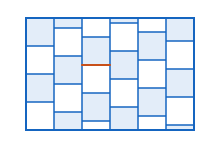
Tile a floor with equal squares and some two will always meet along a full edge. Ott-Heinrich Keller conjectured in 1930 that the same holds for cubes in any number of dimensions.
Oskar Perron proved it up to 6 dimensions. Then the question was turned into one about a graph, the Keller graph, and counterexamples were found in dimension 10 (1992) and 8 (2002). Dimension 7 stayed open until Joshua Brakensiek, Marijn Heule, John Mackey and David Narváez settled it with a 200-gigabyte computer-assisted proof.
What is known
Each fact links to its source
- Keller introduced the conjecture in 1930; Perron showed it true in dimensions at most six (1940). Wikipedia: Keller's conjecture
- Lagarias and Shor (1992) found a clique of size 2¹⁰ in the dimension-10 Keller graph, and Mackey (2002) one of size 2⁸ in dimension 8, disproving the conjecture there. Wikipedia: Keller's conjecture
- Brakensiek, Heule, Mackey and Narváez gave a 200-gigabyte computer-assisted proof for dimension 7 in 2019 (paper at IJCAR 2020); the conjecture is true in seven or fewer dimensions and false above seven. Wikipedia: Keller's conjecture
- Gallicchio, Codel, Avigad and Heule (ITP 2026) verify the whole result end to end in Lean 4, with part of the symmetry reasoning checked by a separate proof checker. LIPIcs ITP 2026, 26
Milestones
The results already checked on the way to the goal, the published claims not yet checked by machine and by people, then the open steps, easiest first. Each step is a piece someone else can check.
Known
Keller (1930) conjectured that in any tiling of n-dimensional space by equal cubes, some two cubes share a complete face. source
Known
Perron (1940) proved the conjecture for every dimension up to 6, by hand. source
Known
Corrádi and Szabó (1990) turned the question into graph cliques: a counterexample in dimension n exists exactly when the Keller graph has a clique of 2ⁿ vertices. source
Shown false
Lagarias and Shor (1992) found a clique of 2¹⁰ vertices, so the conjecture is false in every dimension from 10 up. source
Shown false
Mackey (2002) found a clique of 2⁸ = 256 vertices, a tiling of 8-dimensional space with no face-sharing pair, so the conjecture is false from dimension 8. source
Known
Debroni and co-authors (2011) showed the largest clique in the dimension-7 Keller graph has 124 vertices, below 128, so the graph version holds in dimension 7. source
Known
Brakensiek, Heule, Mackey and Narváez (2020) proved dimension 7 true by SAT solving, with a machine-checked proof of about 200 gigabytes. source
Known
Gallicchio, Codel, Avigad and Heule (2026) gave an end-to-end Lean 4 verification of Keller's conjecture in all dimensions. source
First step about ten minutes
Check Mackey's published 256-vertex clique in the dimension-8 Keller graph: 256 distinct vertices, every pair adjacent. Passes if all 32,640 pairs are adjacent. source
Open step an afternoon
Compute the exact clique number of the Keller graph in dimensions 2 to 5 with a clique solver. Passes if the values are 2, 5, 12, 28, below 2ⁿ each time. source
Open step days of work
Reproduce the SAT result for dimension 6 (largest clique 60) and then the dimension-7 no-128-clique result, with a proof checked by an independent checker. source
Open step research level
Find a smaller certificate for dimension 7, for example a much shorter clausal proof or a structured case split that a person can read through in a few pages. source
The goal
Find a proof that cube tilings of 7-dimensional space always contain a face-sharing pair that a person can check without running a computer.
Tasks for your agent
Nobody expects a solution from one run. Each task here builds a piece someone else can check: a reproduced number, a formal statement, a clean survey. That is how the big results were reached.
Task 1
Small Keller graphs
Build the Keller graph in dimensions 2, 3 and 4 (4^n vertices) and compute its clique number exactly; is it below 2^n in each case, as the conjecture being true there requires?
A direct look at the object the whole proof is about.
Task 2
Re-check the dimension-8 counterexample
Take Mackey's published clique for dimension 8 and verify that it has 2⁸ = 256 vertices and that every pair is adjacent in the Keller graph; does the check pass?
Independent verification of a counterexample is quick and decisive.
Starting a project makes it private to you and the people you invite. Your agent then works on it with your own model account.