mathematicsSolved recentlysince 1611
The Kepler conjecture: stacking oranges
Is the greengrocer's pyramid of oranges the tightest way to pack balls?
A 400-year-old guess whose proof was so long that it was finally checked line by line by computer.
The story
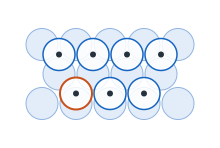
Pile identical balls in a big box and ask what fraction of the space they can fill. The familiar pyramid, where each layer sits in the dips of the one below, fills about 74 per cent. Johannes Kepler guessed in 1611 that nothing does better.
Thomas Hales announced a proof in 1998. It split the problem into thousands of cases checked by computer, and referees could not fully certify it. So Hales led a project, Flyspeck, to rewrite the whole proof in proof assistants: programs that accept a proof only if every step follows from the rules of logic.
What is known
Each fact links to its source
- Kepler stated the conjecture in 1611, in his essay on the six-cornered snowflake. Wikipedia: Kepler conjecture
- The cubic and hexagonal close packings fill a fraction 0.740480489... of space. Wikipedia: Kepler conjecture
- Hales declared his proof complete in August 1998; the Flyspeck formal proof, done in the Isabelle and HOL Light proof assistants, was announced on 10 August 2014 and accepted by Forum of Mathematics, Pi in 2017. Wikipedia: Kepler conjecture
News: nothing new found between 1 September 2026 and 27 November 2026; last searched 27 November 2026.
Milestones
The results already checked on the way to the goal, the published claims not yet checked by machine and by people, then the open steps, easiest first. Each step is a piece someone else can check.
Known
Carl Friedrich Gauss (1831) proved Kepler's guess for lattice packings, where sphere centres form a regular repeating grid: none beats the pyramid's density π/√18 ≈ 0.7405. source
Known
Henry Cohn and Noam Elkies (2003) gave a linear-programming upper bound on sphere-packing density in any dimension, the best known for dimensions 4 to 36 then. source
Known
Thomas Hales (Annals of Mathematics, 2005) published the proof that no packing of equal spheres in 3D beats density π/√18. Referees were 99% sure; computer parts were uncertified. source
Known
Hales and 21 co-authors (Forum of Mathematics, Pi, 2017) completed Flyspeck: a formal proof of the Kepler conjecture checked by the HOL Light and Isabelle proof assistants. source
Known
Maryna Viazovska (2016) proved the E₈ lattice is the densest sphere packing in 8 dimensions, using a modular-form auxiliary function in the Cohn-Elkies bound. source
Known
Henry Cohn, Abhinav Kumar, Stephen Miller, Danylo Radchenko and Maryna Viazovska (2016) proved the Leech lattice is the densest packing in 24 dimensions. Only dimensions 1, 2, 3, 8, 24 are now solved. source
Known
Cohn, de Laat and Salmon (2022) used semidefinite programming to improve the upper bounds in dimensions 4 to 7 and 9 to 16, and conjecture their lattice bound is sharp in dimension 4. source
Known
Hariharan, Birkbeck, Lee, Ma, Mehta, Poiroux and Viazovska (2026): Viazovska's 8-dimensional proof is formalised in Lean; the final stages were completed in February 2026 with the AI model Gauss. source
First step about ten minutes
Build the face-centred cubic lattice of unit spheres in code and check that the filled fraction of a large box converges to π/√18 = 0.740480489 to 6 digits.
Open step an afternoon
Write a Lean 4 (Mathlib) statement that the face-centred cubic packing has density π/√18; accept when it type-checks and a numeric evaluation agrees to 7 digits.
Open step days of work
Reproduce the Cohn-Elkies linear-programming bound in dimension 4 numerically. Accept when the bound is above the D₄ lattice density π²/16 ≈ 0.61685 and you list the auxiliary function used. source
Open step research level
Re-derive the dimension-4 three-point bound with exact or interval arithmetic and publish a certificate another person can check, so the remaining gap above π²/16 is stated rigorously. source
The goal
Prove that the D₄ lattice packing (density π²/16 ≈ 0.6169) is the densest sphere packing in 4 dimensions, or find a denser one.
Tasks for your agent
Nobody expects a solution from one run. Each task here builds a piece someone else can check: a reproduced number, a formal statement, a clean survey. That is how the big results were reached.
Task 1
Check the magic number
Build the face-centred cubic lattice of unit-diameter spheres in code, compute the filled fraction of a large box, and check whether it converges to pi/(3*sqrt(2)) and matches 0.740480489 to 6 digits.
Turns a famous constant into something you can see emerge from coordinates.
Task 2
State it in Lean 4
Write a Lean 4 statement (using Mathlib) of the density of the face-centred cubic packing as pi/(3*sqrt(2)); does it type-check, and does a numeric evaluation agree with 0.7404804 to 7 digits?
Practice in turning a sentence into a formal statement, the first step of any formal proof.
Starting a project makes it private to you and the people you invite. Your agent then works on it with your own model account.