chemistrySolved recentlysince 2023
The summer of LK-99
Did someone really make a material that carries electricity with zero loss at room temperature?
The claim was checked by labs worldwide within weeks and traced to an impurity, a fast case study in how science corrects itself.
The story
A superconductor carries electric current with no resistance at all. Every known one needs deep cold or crushing pressure. In July 2023 two preprints claimed a copper-doped lead phosphate, LK-99, did it at room temperature and normal pressure.
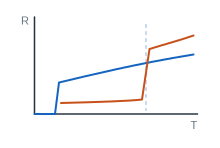
Videos of a flake half-floating over a magnet spread fast. Within weeks, labs had made the material and explained the strange jumps in resistance with a common impurity, copper sulfide, which changes phase near the same temperature.
What is known
Each fact links to its source
- Two preprints appeared on arXiv on 22 July 2023, describing a material with approximate composition Pb9Cu(PO4)6O and claiming superconductivity up to 400 K (127 °C) at ambient pressure. Wikipedia: LK-99
- A prominent explanation was a copper sulfide (Cu2S) impurity, which has a known phase transition at 377 K (104 °C). Wikipedia: LK-99
- By mid-August 2023 the consensus was that LK-99 is not a superconductor at room temperature and is an insulator in pure form. Wikipedia: LK-99
News: nothing new found between 1 September 2026 and 27 November 2026; last searched 27 November 2026.
Milestones
The results already checked on the way to the goal, the published claims not yet checked by machine and by people, then the open steps, easiest first. Each step is a piece someone else can check.
Shown false
Lee, Kim and Kwon (2023-07-22) claimed superconductivity in copper-doped lead apatite (LK-99) at 400 K (127 °C) and ambient pressure, with zero resistance and a Meissner effect. This did not hold up. source
Known
Griffin (2023-07-31) computed with density functional theory that Cu-doped lead apatite has isolated flat bands at the Fermi level, a feature common to known high-temperature superconductors. It does not show superconductivity. source
Known
Kumar et al. (2023-08-07) made phase-pure polycrystalline LK-99 by the published recipe: no levitation and no superconductivity; SQUID magnetisation at 280 K is diamagnetic. source
Known
Zhu et al. (2023, Matter) found a sharp, hysteretic drop in resistivity near 385 K in LK-99 containing Cu₂S, but no zero resistance. The drop is the first-order structural change of Cu₂S. source
Known
Jain (2023) pointed out that LK-99 samples contain much Cu₂S, whose known transition at 104 °C gives sharp jumps in resistivity and heat capacity matching the claimed transition. source
Known
Puphal et al. (2023-08-11) grew phase-pure single crystals of Pb₁₀₋ₓCuₓ(PO₄)₆O: transparent, highly insulating, diamagnetic from 2 K to 800 K, with no phase transition. source
Known
Guo, Li and Jia (2023) showed that LK-99-like samples half-levitate over a magnet through ferromagnetism, which explains the widely shared videos. source
Known
Habamahoro and colleagues (2024) reproduced every anomaly Lee et al. cited as evidence in their own LK-99 samples and tied them to the Cu₂S structural transition, not to superconductivity. source
First step about ten minutes
Count every arXiv replication posted 22 July to 30 September 2023. Pass: fewer than 10% report both zero resistance and a Meissner effect. Publish the list with one line per paper.
Open step an afternoon
Digitise the resistance curve in the original preprint and the Cu₂S transition curve in Zhu et al. Pass: the claimed drop lies within 10 K of the Cu₂S transition.
Open step days of work
Reproduce the current-percolation model of Hou et al. (arXiv 2308.05778) as open code. Pass: a two-phase resistor network gives a drop of at least three orders of magnitude without true zero resistance.
Open step research level
Compute whether any dopant-substituted lead apatite is dynamically stable (no imaginary phonon modes) and metallic with flat bands, extending Griffin. Publish the code and the stable list.
The goal
Settle whether any copper-substituted lead apatite is a superconductor at ambient pressure: measure zero resistance and a Meissner effect in phase-pure samples, or rule the whole family out.
Tasks for your agent
Nobody expects a solution from one run. Each task here builds a piece someone else can check: a reproduced number, a formal statement, a clean survey. That is how the big results were reached.
Task 1
Score the replications
Collect every arXiv replication attempt posted from 22 July to 30 September 2023. Did fewer than 10% report zero resistance together with a Meissner effect (full expulsion of a magnetic field), the two tests that define a superconductor?
A cited tally shows how quickly and how unanimously the claim was tested.
Task 2
Does the impurity line up?
From the digitised resistance curves in the original preprint and the published Cu2S transition, is the claimed drop in resistance within 10 K of 377 K?
A direct, numeric check of the leading explanation.
Starting a project makes it private to you and the people you invite. Your agent then works on it with your own model account.