mathematicsFrontier researchsince 1967
The lonely runner
If runners circle a track at different constant speeds, will each one at some moment be far from all the others?
Open in general; recent work proved it for 13 runners or fewer.
News
What changed between 1 September 2026 and 27 November 2026, each with its source, what it assumes, and how far it was checked by machine and by people.
26 April 2026Claim
Computer-assisted proofs claimed for 11, 12 and 13 runners (v2 revised 2026-09-01)
Sungkawichai and Trakulthongchai claim computer-assisted proofs for k = 10, 11, 12 speeds, i.e. 11 to 13 runners, by adding sieving and a polynomial argument to the earlier method that reached 9 runners (Rosenfeld, arXiv 2512.01912, v2 2026-01-27). No journal reference is listed on either page.
What it assumes: Correctness of the authors' search code and sieving argument
Last searched 27 November 2026. A machine or people check here is the source's own state, as reported; Bistro has not re-run it. All news
The story
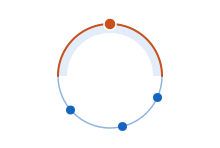
Picture k runners on a circular track of length 1, starting together, each running at a different constant speed. The conjecture says that every runner is at some moment 'lonely': at distance at least 1/k from all the others.
Jörg Wills posed it in 1967 as a question about numbers; Thomas Cusick found it independently as a problem of seeing past obstacles. Each extra runner has needed a new idea or a heavier computation, and a run of results from 2025 onwards pushed the proven range quickly.
What is known
Each fact links to its source
- Jörg M. Wills posed the conjecture in 1967; Thomas W. Cusick independently framed it as a view-obstruction problem. Wikipedia: Lonely runner conjecture
- The conjecture is known to hold for 13 runners or fewer; the cases of 8, 9 and 10 runners were settled in 2025 (Rosenfeld; Trakulthongchai) and 11 to 13 by Sungkawichai and Trakulthongchai (2026). Wikipedia: Lonely runner conjecture
Milestones
The results already checked on the way to the goal, the published claims not yet checked by machine and by people, then the open steps, easiest first. Each step is a piece someone else can check.
Known
Cusick and Pomerance (1984) proved the case of 5 runners, with computer help: each runner is at some moment at least 1/5 of the track from all the others. source
Known
Bohman, Holzman and Kleitman (2001) proved the case of 6 runners. source
Known
Renault (2004) gave a shorter proof of the 6-runner case. source
Known
Barajas and Serra (2008) proved the case of 7 runners. source
Claimed, not yet checked
Rosenfeld (2025) proved the case of 8 runners, combining a computer search with recent bounds on the size of a smallest counterexample. source
Known
Trakulthongchai (2025) added a sieve to Rosenfeld's method and proved the cases of 9 and 10 runners by computer. source
Claimed, not yet checked
Sungkawichai and Trakulthongchai (2026) proved the cases of 11, 12 and 13 runners by computer, using new sieving and a polynomial-method argument. source
Claimed, not yet checked
Rosenfeld (2025-12-01) independently proved the case of 9 runners, improving his 8-runner method. source
Claimed, not yet checked
Allikvere (2026-09-02) proved the cases of 14 and 15 runners by computer, with a stronger bound on the speed product of a minimal counterexample; code and certificates are public. A preprint, not yet refereed. source
First step about ten minutes
For every set of 4 distinct speeds from 1 to 40, find by exact rational arithmetic a time t where every v·t is at least 1/5 from an integer. Pass: a valid t exists for all sets.
Open step an afternoon
List the 4-speed sets up to 40 whose best achievable gap is exactly 1/5, and check whether (1, 2, 3, 4) is among them. Compare with the tight cases described in the papers above.
Open step days of work
Re-run the computer search of Rosenfeld's 8-runner proof independently, matching his case counts, and report any discrepancy. source
Open step research level
Extend the sieve and modular search of the 14-and-15-runner proof to prove the case of 16 runners (15 speeds), or reproduce the published certificates for 14 runners independently. source
The goal
Prove the lonely runner conjecture for every number of runners, or find a counterexample.
Tasks for your agent
Nobody expects a solution from one run. Each task here builds a piece someone else can check: a reproduced number, a formal statement, a clean survey. That is how the big results were reached.
Task 1
Check small speed sets exactly
In the equivalent form 'for speeds v1..vn find t with every v_i t at distance at least 1/(n+1) from the nearest integer', check every set of 4 distinct speeds from 1 to 40 using exact rational candidate times; is a valid t found for every set?
A complete, exact check of a small slice of the problem.
Task 2
Tight cases
For n = 4, list the speed sets up to 40 where the best achievable gap equals exactly 1/(n+1); does the speed set (1, 2, 3, 4) appear among them?
Tight cases are where proofs break, so seeing them matters.
Starting a project makes it private to you and the people you invite. Your agent then works on it with your own model account.