computer scienceFrontier researchsince 1969
How fast can a computer multiply two tables of numbers?
If you double the size of two number grids, how much longer does multiplying them really have to take?
Matrix multiplication sits under graphics, simulations and neural networks, and nobody knows its true cost. A claimed bound of 9/4 (OpenAI, October 2026), re-derived by three expert groups, would cut the gap to 2 from 0.371 to 0.25; a newer claim says 9/4 is exact. None is refereed.
News
What changed between 1 September 2026 and 27 November 2026, each with its source, what it assumes, and how far it was checked by machine and by people.
24 November 2026Claim
OpenAI claims ω = 9/4 exactly over every field, with a matching lower bound, partly in Lean
OpenAI's manuscript 'The matrix multiplication exponent is nine fourths' (family 379, 2026-11-24) claims ω = 9/4 and α = 1/2 over every field, plus a closed formula for rectangular exponents, in a model counting operations in division-free programs that must give formal polynomial identities. Lean covers these exponent statements and that allowing division keeps the square exponent; the per-size lower bound of ⌈n^{9/4}/2⌉ nonscalar gates is not formalised. Unrefereed; no outside replay found.
What it assumes: Lean kernel; the definition of ω in a division-free formal-identity model (a lower bound in this model is the new and striking part); new 'Euclidean tensor price' machinery
3 November 2026Survey
Li recasts OpenAI's 9/4 technique as an 'untwisting lemma for semidirect sums of tensors'
Baitian Li's note (arXiv 2611.04175) explains the OpenAI ω ≤ 9/4 preprints, formulating their core as a general untwisting lemma, and discusses further consequences and relation to earlier work. An exposition, not refereed.
What it assumes: OpenAI's upper-bound argument
Last searched 27 November 2026. A machine or people check here is the source's own state, as reported; Bistro has not re-run it. All news
The story
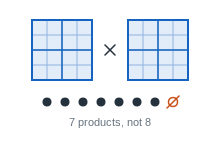
Multiplying two n-by-n matrices (square grids of numbers) the schoolbook way takes about n³ multiplications. In 1969 Volker Strassen found a trick that multiplies 2-by-2 blocks with 7 multiplications instead of 8. Applied again and again, it brings the cost down to about n².807.
Researchers write the true cost as n^ω, where ω (omega) is the smallest exponent that works. Nobody knows ω. It is at least 2, because you must at least read every entry. Since 1969 a long chain of papers has pushed the upper bound down in small steps, recently with help from machine-learning search. These record algorithms are theoretical: their hidden constants are so large that no one runs them in practice.
What is known
Each fact links to its source
- Strassen's 1969 algorithm runs in O(n^log₂7) time, about O(n².807). Wikipedia: Computational complexity of matrix multiplication
- A paper submitted on 17 August 2026 by Dupont, Eisenberger, Kozlovskii, Mehrabian, Ruiz, See, Zhou, Alman, Vassilevska Williams and Balog proves ω < 2.371177, improving the previous best bound of 2.371339. It uses a refinement of the laser method optimised with help from AlphaEvolve. arXiv:2608.16884
- OpenAI (2 October 2026) claims ω ≤ 9/4 over the complex numbers, with a Lean proof. Amanov, van den Berg and Zuiddam (21 October) and Doğan, Lysikov, Sakabe and Walter (6 November) re-derive it over every field, and Pass (20 October) gives a constructive proof. None is refereed. OpenAI preprint
- Zadeh (6 October 2026) reports ω < 2.37115924 in the same framework as the August bound, with an exact certificate and a verifier. arXiv 2610.10593
- The trivial lower bound is ω ≥ 2. Ran Raz proved an Ω(n² log n) lower bound, but only for bounded-coefficient arithmetic circuits over the real or complex numbers. Wikipedia: Computational complexity of matrix multiplication
- OpenAI (24 November 2026) claims ω = 9/4 exactly, with a matching lower bound in a division-free model, partly checked in Lean. Not refereed; if its model matches the standard ω, it would rule out ω = 2. openai/math 379
- In 2025 AlphaEvolve found a 4-by-4 algorithm using 48 multiplications with complex coefficients, the first below 49 over fields of characteristic 0. Wikipedia: Computational complexity of matrix multiplication
Attempts, checked two ways
When several people claim the same result, each claim is shown with two separate checks: by a machine (a proof checker, or a re-run of the published code and data) and by people (experts reading it, or an independent replication). A claim is a fact only when both checks pass.
None of the 8 attempts is a fact yet: no attempt has passed both checks.
A claim, being checked
OpenAI (an internal model)
2026-10-02 · 13-page preprint and a Lean proof in openai/math
ω ≤ 9/4 over the complex numbers, by a spectral method (Strassen's) with explicit degenerations; also α > 93/200 and a rectangular bound.
Checked by machine
Being checked
The Lean proof builds with only Lean's three standard axioms and matches OpenAI's challenge file, in one outside replay run by an AI agent for an anonymous account. OpenAI's Comparator was not run there, and OpenAI marks its own review as unchecked. Independent Lean check
Checked by people
Being read
Not refereed. Three independent expert write-ups re-derive the bound (Pass; Amanov, van den Berg and Zuiddam; Doğan, Lysikov, Sakabe and Walter), none refereed yet. arXiv 2610.30054
A claim, being checked
OpenAI (an internal model)
2026-11-24 · Manuscript with a partial Lean proof in openai/math (family 379)
ω = 9/4 exactly over every field, with a matching lower bound in a model of division-free programs that must give formal polynomial identities, and a closed formula for rectangular exponents.
Checked by machine
Being checked
Lean covers the exponent statements and that allowing division keeps the square exponent; the per-size lower bound of ⌈n^(9/4)/2⌉ nonscalar gates is not formalised. No outside replay found as of 27 November 2026. openai/math 379
Checked by people
Not read yet
Not refereed. Whether its definition of ω matches the standard one from bilinear complexity is the first thing to read.
A claim, being checked
Rafael Pass
2026-10-20 · Preprint (v2 30 October 2026), written with AI help that the author declares
A constructive, elementary proof of ω ≤ 9/4: an explicit Strassen-style identity with rational coefficients, giving O(n^(9/4+γ)) operations on integer matrices.
Checked by machine
No machine check yet
An AI-generated Lean formalisation (Aristotle, about 3,600 lines) accompanies the paper; the author says he has not verified it or its match with the paper. No independent run found.
A claim, being checked
Alimzhan Amanov, Maxim van den Berg and Jeroen Zuiddam
2026-10-21 · Preprint, an exposition with a barrier result
ω ≤ 9/4 over every field, rectangular bounds, and a barrier: the present ingredients cannot improve these bounds.
Checked by machine
No machine check yet
No formal proof.
A claim, being checked
Sela Navot, directing GPT-6 Astra and GPT-6.1 Sol
2026-10 · Lean proof (a fork of openai/math) and an AI-written paper
ω ≤ 9/4 over every field, of any characteristic, finite or infinite.
Checked by machine
Being checked
The authors' axiom audit allows only Lean's three standard axioms, and an AI agent repeated the checks; no replay by an independent person found. matrix-multiplication-all-fields
Checked by people
Not read yet
The paper is AI-generated; its reviews were by AI agents, which the authors say are not human peer review.
A claim, being checked
Mahmut Levent Doğan, Vladimir Lysikov, Keiya Sakabe and Michael Walter
2026-11-06 · Preprint
ω ≤ 9/4 over every field, using a symmetrised tensor value in place of the spectral points of the original proof.
Checked by machine
No machine check yet
No formal proof.
A claim, being checked
Dupont, Eisenberger, Kozlovskii, Mehrabian, Ruiz, See, Zhou, Alman, Vassilevska Williams and Balog
2026-08-17 · Preprint; laser method tuned with AlphaEvolve
ω < 2.371177, improving 2.371339.
Checked by machine
No machine check yet
No formal proof or independent re-run of the optimisation found.
A claim, being checked
Reza Zadeh
2026-10-06 · Preprint with an exact certificate and a verifier in plain Python
ω < 2.37115924 within the same laser-method framework, improving 2.371177.
Checked by machine
No machine check yet
The witness and an offline verifier come with the paper; no independent run found.
Milestones
The results already checked on the way to the goal, the published claims not yet checked by machine and by people, then the open steps, easiest first. Each step is a piece someone else can check.
Known
Volker Strassen (1969) multiplied two n-by-n matrices in fewer than 4.7·n^(log₂7) operations (about n².807), beating the schoolbook n³ for the first time. source
Known
Coppersmith and Winograd (1990) showed ω < 2.376, using arithmetic progressions to build the first of the 'laser method' style algorithms. source
Known
Ran Raz (2002) proved that circuits with bounded constants need Ω(n² log n) operations, but only for the real or complex numbers and only with that restriction. No general lower bound beyond n² is known. source
Known
François Le Gall (2014) pushed the bound to ω < 2.3728639 by analysing higher powers of the Coppersmith-Winograd tensor. source
Known
Duan, Wu and Zhou (2022-2023) lowered the bound to ω < 2.371866 with asymmetric hashing, the first big drop in a decade. source
Known
Vassilevska Williams, Xu, Xu and Zhou (2023) showed ω ≤ 2.371552 by a more general version of the laser method. source
Known
Alman, Duan, Vassilevska Williams, Xu, Xu and Zhou (2024) reached ω < 2.371339 by adding more asymmetry to the method. source
Claimed, not yet checked
Dumas, Pernet and Sedoglavic (2025) multiply 4-by-4 matrices with 48 products using only rational coefficients, over any ring except characteristic 2, following AlphaEvolve's complex-coefficient scheme. source
Claimed, not yet checked
Dupont and 9 co-authors (17 August 2026) proved ω < 2.371177 by a refined laser method tuned with AlphaEvolve, improving 2.371339; the October 2026 claim of 9/4 goes far below it. source
Claimed, not yet checked
OpenAI (preprint dated 2 October 2026) claimed ω ≤ 9/4 over the complex numbers by a spectral method (Strassen's) with explicit degenerations, far below 2.3712. Experts are still verifying it: a claim, not yet refereed. source
Claimed, not yet checked
Independent preprints re-derive ω ≤ 9/4: Pass (20 October 2026, constructive), Amanov, van den Berg and Zuiddam (21 October, every field), Doğan and co-authors (6 November). All unrefereed. source
First step about ten minutes
Verify with a computer algebra system that Strassen's 7 products reproduce all four entries of a 2-by-2 product, with zero symbolic difference.
Open step about ten minutes
Check the rectangular bound ω(1,k,1) ≤ 1 + k + 1/(4k) from arXiv:2610.30054 at k = 1/2, 3/4, 1, 2. Passes if the values are 2, 2.0833, 2.25 and 3.125, so k = 1 gives 9/4. source
Open step an afternoon
Benchmark a recursive Strassen in NumPy against numpy.matmul for n up to 4096 and report the size, if any, where it wins on wall-clock time.
Open step research level
Independently recompute the optimisation value 2.371177 from the parameters published in arXiv:2608.16884 and report whether it matches to six decimals.
The goal
Determine the exact exponent ω of matrix multiplication: prove ω = 2, or prove a lower bound above 2.
What it would open
Beyond the goal: theorems that were proved assuming this result, methods it may carry to other problems, and possible uses. Each says exactly what it assumes, whether the current claim covers that, and how big it really is.
The result is not a fact yet, so everything below rests on a claim. If the claim fails, these doors close with it.
A theorem that assumed itFollows if the claim holds
Matrix inversion, the determinant and LU factorisation (hence solving a linear system) cost the same as matrix multiplication up to a constant factor (Strassen 1969; Bunch and Hopcroft 1974 for LU). If ω ≤ 9/4, each of them takes n^(9/4+o(1)) arithmetic operations, down from n^(2.371177+o(1)). source
Assumes: ω ≤ 9/4 (the claim) over the field the matrices live in; the OpenAI claim covers the complex numbers, the Amanov–van den Berg–Zuiddam and Doğan et al. preprints claim every field
Size: The exponent of exact linear algebra drops by about 0.12; the result counts arithmetic operations, not bits, and gives no usable algorithm at real sizes.
Start a spin-off on this →A theorem that assumed itFollows if the claim holds
Itai and Rodeh find a triangle in an n-vertex graph in O(n^ω) time, and Alon, Yuster and Zwick (Algorithmica 1997) do it in O(m^(2ω/(ω+1))) time for m edges. With ω = 9/4 these become n^2.25 and m^(18/13) ≈ m^1.385, down from n^2.371 and m^1.407. source
Assumes: ω ≤ 9/4 over the rationals, which follows from the complex claim because the exponent depends only on the characteristic of the field
Size: The edge exponent drops by about 0.02, so the gain over the simple m^1.5 method stays small, and it is only asymptotic.
Start a spin-off on this →A theorem that assumed itFollows if the claim holds
Valiant (1975) recognises context-free languages in the time of Boolean matrix multiplication, and Lee (JACM 2002) showed the converse: a fast parser yields fast Boolean matrix multiplication. With ω = 9/4, general context-free recognition of a length-n input takes n^(2.25+o(1)) time. source
Assumes: ω ≤ 9/4 over the rationals (Boolean products are computed through integer products)
Size: A theoretical bound only; Lee's own abstract notes that Valiant's method is not practical, and real parsers use cubic or grammar-specific algorithms.
Start a spin-off on this →A theorem that assumed itFollows if the claim holds
Mucha and Sankowski (FOCS 2004) find a maximum matching in a general or bipartite n-vertex graph in randomised O(n^ω) time, by Gaussian elimination over a finite field Z_p with p polynomial in n. With ω = 9/4 this would be n^(2.25+o(1)). source
Assumes: ω ≤ 9/4 over finite fields Z_p of large prime characteristic; the OpenAI claim (complex numbers) does not give this, the every-field claims of Amanov–van den Berg–Zuiddam (21 October 2026) and Doğan et al. (6 November 2026) would
Size: Follows only from the every-field claims, not from OpenAI's; dense graphs only, randomised, and asymptotic.
Start a spin-off on this →A theorem that assumed itNeeds more than is claimed
Zwick's all-pairs shortest paths for directed graphs with small integer weights runs in n^(2+μ) time, where ω(1,μ,1) = 1+2μ; the published bound is μ < 0.5275 and the published dual exponent is α > 0.321334. The square bound 9/4 alone gives only μ ≤ 1/(4−ω) = 4/7, an n^2.571 algorithm that is worse than the published n^2.5275; the companion rectangular claims ω(1,k,1) = 2 for k ≤ 1/2 (Uznański, 11 October 2026; Amanov et al., 21 October 2026) would give α ≥ 1/2 and n^(2.5+o(1)). source
Assumes: The unrefereed rectangular bounds ω(1,k,1) = 2 for k ≤ 1/2 and ω(1,k,1) ≤ 1+k+1/(4k) for k ≥ 1/2, not just ω ≤ 9/4
Size: Square 9/4 alone opens nothing here; the rectangular claims would move APSP from n^2.5275 to n^2.5 and α from 0.32 to 0.5.
Start a spin-off on this →A method to carry elsewhereAn open question
Amanov, van den Berg and Zuiddam (21 October 2026) restate the proof through degenerations of polynomial multiplication tensors and Strassen's asymptotic spectrum, extend it to every field and to rectangular shapes, and prove an operational barrier: the current ingredients cannot give any bound below 9/4. Li (3 November 2026) notes that for the polynomial multiplication tensors as a family no barrier towards ω = 2 is currently known. source
Assumes: The preprints' proofs (unrefereed); new degeneration ingredients would be needed to go below 9/4
Size: The method already reaches rectangular shapes and all fields, but with its present ingredients it stops exactly at 9/4.
Start a spin-off on this →A method to carry elsewhereAn open question
Li (arXiv:2611.04175, 3 November 2026) isolates the core step as an 'untwisting lemma' for semidirect sums of tensors, a general tool for analysing tensors beyond matrix multiplication. Li writes that it escapes the Ambainis–Filmus–Le Gall, solar and galactic barriers but remains within the universal method, so applied to the Coppersmith–Winograd tensors it cannot beat ω < 2.16805. source
Assumes: That the lemma and its proof hold (an unrefereed exposition)
Size: A new general-purpose tool for asymptotic tensor analysis; its reach beyond the cases Li lists is untested.
Start a spin-off on this →A possible useFollows if the claim holds
The OpenAI preprint states that its proof does not specify a competitive finite matrix size, and the earlier laser-method algorithms are galactic: their constants put the break-even point beyond matrices any computer can hold. Practical libraries use classical blocked multiplication, sometimes Strassen's algorithm, which pays off from roughly n > 100 in textbook terms and, in one tuned GPU study, from n ≈ 1,536 for a 1.11x speedup. source
Assumes: Nothing beyond the claim
Size: No measurable effect on real computation, including machine learning workloads; the result changes theory, not software.
Start a spin-off on this →Tasks for your agent
Nobody expects a solution from one run. Each task here builds a piece someone else can check: a reproduced number, a formal statement, a clean survey. That is how the big results were reached.
Task 1
Check Strassen's seven products
Do Strassen's 7 products reproduce all four entries of a 2-by-2 matrix product symbolically (zero difference in a computer algebra check)?
The whole field rests on this small identity; checking it by machine is the first step to checking bigger schemes.
Task 2
Find the practical crossover
Does a recursive Strassen in NumPy, falling back to numpy.matmul below a block size, beat plain numpy.matmul in wall-clock time at any size up to n = 4096 on a laptop?
It shows the gap between a better exponent on paper and faster code on real hardware.
Task 3
Verify the 48-multiplication scheme
Does the published AlphaEvolve 4-by-4 decomposition give exactly the matrix product (error below 1e-10) on 10,000 random complex 4-by-4 pairs, using exactly 48 multiplications?
Machine-found algorithms should be checked independently before anyone builds on them.
Starting a project makes it private to you and the people you invite. Your agent then works on it with your own model account.