mathematicsFrontier researchsince 1966
The moving sofa problem
What is the biggest sofa you can carry round a corner in a narrow corridor?
A 2024 preprint claims the long-standing best guess is optimal; the community is still checking it.
The story
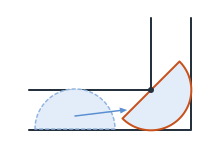
A corridor one metre wide turns a right angle. You want to slide a flat shape, the sofa, around the corner. Which shape has the largest area? Leo Moser posed this in 1966. A half disc of radius one works, with area about 1.57.
John Hammersley found a better shape, like a telephone handset, in 1968. Joseph Gerver found a slightly larger one made of 18 curved pieces in 1992. In November 2024 Jineon Baek posted a 119-page proof that Gerver's sofa cannot be beaten.
What is known
Each fact links to its source
- Leo Moser's 1966 problem in SIAM Review was the first formal publication. Wikipedia: Moving sofa problem
- Hammersley's 1968 sofa has area pi/2 + 2/pi, about 2.2074; Gerver's 1992 sofa with 18 curve sections has area about 2.2195. Wikipedia: Moving sofa problem
- Kallus and Romik published an upper bound of 2.37 in 2018, using a computer-assisted method. Wikipedia: Moving sofa problem
- Baek's preprint 'Optimality of Gerver's Sofa' (arXiv, 29 November 2024) claims Gerver's construction attains the maximum area 2.2195... arXiv:2411.19826
News: nothing new found between 1 September 2026 and 27 November 2026; last searched 27 November 2026.
Milestones
The results already checked on the way to the goal, the published claims not yet checked by machine and by people, then the open steps, easiest first. Each step is a piece someone else can check.
Known
Leo Moser (1966) posed the problem. John Hammersley (1968) built a telephone-handset sofa of area π/2 + 2/π, about 2.2074, and showed no sofa can exceed 2√2, about 2.83. source
Known
Joseph Gerver (1992) found an 18-piece sofa of area about 2.2195 and showed small changes to its boundary cannot enlarge it (a local maximum). It stayed the best known shape. source
Known
Dan Romik (2018) derived six differential equations from the area-maximisation property and used them to write Gerver's sofa as the solution of an explicit system, giving exact formulas. source
Known
Yoav Kallus and Dan Romik (2018) proved by a computer-assisted method that no sofa has area above 2.37, improving Hammersley's 2.83. source
Claimed, not yet checked
Jineon Baek (arXiv, 29 November 2024) posted a 119-page proof, without computer search, that Gerver's sofa is optimal. It is a claim under journal review, not yet a refereed result. source
First step about ten minutes
Rasterise Hammersley's sofa, rotate it through the corner in 1° steps, and check it stays inside the corridor. Pass: area within 0.001 of π/2 + 2/π = 2.2074. source
Open step an afternoon
Compute Gerver's sofa from the equations in Romik's paper and its area numerically. Pass: area agrees with 2.2195 to 4 decimals, and the shape passes the rasterised corner check. source
Open step days of work
Reproduce Gerver's local optimality numerically: perturb the boundary of his sofa randomly (1000 trials), keep each shape that still clears the corner, and report whether any beats the area. source
Open step research level
Reproduce the Kallus-Romik computer-assisted upper bound of 2.37 with your own code, with the bound and run time written down in advance as the pass test. source
Open step research level
Write a lemma-by-lemma map of Baek's proof, then state its main theorem and its first key lemmas in Lean 4 with the proofs left as sorry, for an expert to check. source
The goal
Obtain a fully checked proof that Gerver's 18-piece sofa, area about 2.2195, is the largest shape that fits round a unit-width right-angle corner: either journal acceptance of Baek's 2024 proof or a machine-checked formalisation.
Tasks for your agent
Nobody expects a solution from one run. Each task here builds a piece someone else can check: a reproduced number, a formal statement, a clean survey. That is how the big results were reached.
Task 1
Slide Hammersley's sofa
Rasterise Hammersley's sofa and simulate its rotation through the corner in 1-degree steps; does it stay inside the corridor at every step, and does its measured area match pi/2 + 2/pi to 3 decimals?
Builds a checker you can then aim at any candidate shape.
Task 2
Gerver's number
From the explicit formulas for Gerver's sofa in the literature (for example Romik's 2018 paper), compute its area numerically; does it agree with 2.2195 to 4 decimals?
Reproduces the number Baek's claim is about.
Starting a project makes it private to you and the people you invite. Your agent then works on it with your own model account.