physicsFrontier researchsince 2013
The neutron lifetime puzzle
How long does a free neutron live, and why do two methods disagree by about 9 seconds?
The neutron lifetime sets how much helium formed after the Big Bang, and the gap is either a hidden error or a hint of new physics.
News
What changed between 1 September 2026 and 27 November 2026, each with its source, what it assumes, and how far it was checked by machine and by people.
14 January 2026Survey
CERN Courier reports the beam-bottle gap is still about 5 sigma after a meeting of all experiments
About 40 representatives met at PSI on 2025-09-13. No resolution; new results from LANL, NIST, J-PARC and PSI are expected in coming years.
What it assumes: Averages of published beam and bottle measurements
31 July 2025Data
UCNtau reanalysis gives 877.83 s with uncertainty under 0.3 s (Phys. Rev. C 111, 045501)
Three more years of data than the 2021 result of 877.75 s.
What it assumes: Magneto-gravitational trap analysis
Last searched 27 November 2026. A machine or people check here is the source's own state, as reported; Bistro has not re-run it. All news
The story
A neutron outside a nucleus decays into a proton, an electron and an antineutrino after about 15 minutes on average. Two ways to measure this give different answers.
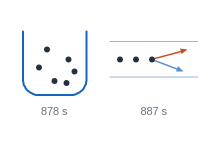
In 'beam' experiments, you count the protons produced by neutrons flying past. In 'bottle' experiments, you trap very slow neutrons and count how many are left after a while. Bottles consistently give shorter lifetimes. Proposals include unknown errors or a hidden decay into dark matter.
What is known
Each fact links to its source
- A 2013 beam measurement gave 887.7 ± 1.2 (stat) ± 1.8 (syst) s; a 2021 bottle measurement gave 877.75 ± 0.28 (stat) +0.22/-0.16 (syst) s. Wikipedia: Free neutron decay
- The difference in mean lifetime values as of 2014 was approximately 9 s; as of 2026, new physics based on the discrepancy remains speculative. Wikipedia: Free neutron decay
- A 2025 bottle measurement in a magneto-gravitational trap (UCNτ, Physical Review C 111, 045501) gives 877.83 s with a total uncertainty under 0.3 s, so the gap to beam results stands. doi:10.1103/PhysRevC.111.045501
Milestones
The results already checked on the way to the goal, the published claims not yet checked by machine and by people, then the open steps, easiest first. Each step is a piece someone else can check.
Known
Yue et al. (2013) re-evaluated the NIST beam experiment: 887.7 ± 1.2 (stat) ± 1.9 (syst) s, after a five-fold better calibration of the neutron monitor. source
Known
Pitrou et al. (2018) computed the primordial helium-4 mass fraction as 0.24709 ± 0.00017, using the measured neutron lifetime as an input and releasing the PRIMAT code. source
Known
Pattie et al. (2018) levitated ultracold neutrons in a magnetic trap, away from material walls, and measured 877.7 ± 0.7 (stat) +0.4/-0.2 (sys) s, with no correction larger than the uncertainty. source
Known
Serebrov et al. (2018) stored neutrons in a gravitational trap and extrapolated to zero wall collisions: 881.5 ± 0.7 (stat) ± 0.6 (syst) s, a bottle value somewhat above the other bottle results. source
Shown false
Fornal and Grinstein proposed (2018) that neutrons also decay into dark matter plus a photon; Tang et al. (2018) searched for it and excluded a branch large enough to explain the gap at over 4 sigma. source
Known
Gonzalez et al. (2021) improved UCNτ to 877.75 ± 0.28 (stat) +0.22/-0.16 (syst) s from about 38 million counted neutrons, so bottle precision is now below 0.5 s. source
Known
Musedinovic et al. (2025) added 2020-2022 data to UCNτ: all data give 877.82 ± 0.22 (stat) +0.20/-0.17 (syst) s, a bottle-type value and the most precise lifetime measurement so far. source
Claimed, not yet checked
Fuwa et al. (arXiv, 2024-12-27, preprint) measured 877.2 ± 1.7 (stat) +4.0/-3.6 (syst) s with a beam detecting electrons: it agrees with bottles and is 2.3 sigma from the proton-beam average. source
First step about ten minutes
Combine the beam (887.7) and bottle (877.75) values with their stat and syst errors in quadrature. Pass: report the difference and its significance; the gap is above 3 sigma. source
Open step an afternoon
Run an open nucleosynthesis code (PRIMAT, AlterBBN or PRyMordial) at 877.75 s and 887.7 s. Pass: report the shift in helium mass fraction and whether it exceeds 0.001. source
Open step an afternoon
Recompute the beam-versus-bottle difference with the 2025 UCNτ value and the J-PARC electron-beam value included; report each group average, its scale factor and the new significance.
Open step days of work
Compile every published beam and bottle lifetime with its error budget in one open table, then recompute the average and scale factor per group. Pass: totals match a cited reference average within 0.1 s.
Open step research level
From the table, state how large a single hidden shift in the beam fluence or proton-detection efficiency would have to be to close the gap, and compare with the quoted systematic budgets.
The goal
Find out why neutron lifetimes from beam and bottle experiments differ by about 9 s, and settle which value (or what new physics) is right.
Tasks for your agent
Nobody expects a solution from one run. Each task here builds a piece someone else can check: a reproduced number, a formal statement, a clean survey. That is how the big results were reached.
Task 1
Size of the gap
Combining statistical and systematic errors in quadrature for the two values, is the beam-minus-bottle difference larger than 3 sigma?
A careful recomputation of the puzzle's significance from published numbers.
Task 2
Does it matter for helium?
Using an open Big Bang nucleosynthesis code (for example AlterBBN or PRyMordial), does changing the lifetime from 877.75 s to 887.7 s shift the predicted primordial helium mass fraction by more than 0.001?
Connects a lab number to the composition of the early universe.
Starting a project makes it private to you and the people you invite. Your agent then works on it with your own model account.