chemistryFrontier researchsince 1909
Making fertiliser like a bacterium
Why can soil bacteria make fertiliser at room temperature when factories need fire and huge pressure?
Industrial ammonia uses 1 to 2% of the world's energy, so a gentler catalyst would matter for food and climate.
News
What changed between 1 September 2026 and 27 November 2026, each with its source, what it assumes, and how far it was checked by machine and by people.
30 July 2026Data
Chem: model iron-sulfur clusters suggest molybdenum helps iron bind N2 by back-bonding
Two papers from the Suess group (MIT) with Cornell find that only cofactor models with large metals (Mo, W) bind an N2 stand-in strongly. Simplified synthetic clusters with carbene stand-ins, not the enzyme; applications are speculative.
What it assumes: Model clusters and N-heterocyclic carbene stand-ins for N2
Last searched 27 November 2026. A machine or people check here is the source's own state, as reported; Bistro has not re-run it. All news
The story
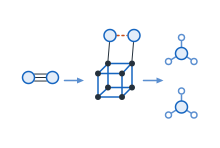
Plants need nitrogen, and the air is full of it, but the two nitrogen atoms in N2 are held by one of the strongest bonds in chemistry. Since 1909 industry has broken it with the Haber-Bosch process, at hundreds of degrees and hundreds of atmospheres.
Some bacteria do the same job at room temperature with an enzyme called nitrogenase. Its core is a cluster of iron, molybdenum, sulfur and a single carbon atom. How it works, step by step, and how to copy it in a cheap catalyst, are still active research.
What is known
Each fact links to its source
- The Haber process typically runs at about 20 MPa and 500 °C; Haber first showed it in the lab in 1909, and it uses 1 to 2% of global energy and produces about 3% of global carbon emissions. Wikipedia: Haber process
- Mo-nitrogenase follows N2 + 8 H+ + 8 e- + 16 MgATP -> 2 NH3 + H2 + 16 MgADP + 16 Pi, and its FeMo cofactor has the formula Fe7MoS9C. Wikipedia: Nitrogenase
Milestones
The results already checked on the way to the goal, the published claims not yet checked by machine and by people, then the open steps, easiest first. Each step is a piece someone else can check.
Known
Einsle et al. (2002) solved nitrogenase MoFe protein at 1.16 Å and found a light atom at the centre of the FeMo cofactor, bound to six iron atoms (then thought most plausibly nitrogen). source
Known
Yandulov and Schrock (2003) made the first molecular catalyst to reduce N2 to ammonia at room temperature and atmospheric pressure (molybdenum), with about 66% efficiency over four turnovers. source
Known
Arashiba et al. (2011) reported a second molecular molybdenum catalyst (PNP pincer) at ambient conditions: 23 equivalents of ammonia per catalyst, 12 per molybdenum atom. source
Known
Spatzal et al. (2011) showed the central atom of the FeMo cofactor is carbon, not nitrogen, correcting the 2002 assignment. source
Known
Hoffman et al. (2014) reviewed the nitrogenase mechanism: the E4 'Janus' state holds four electrons and protons and releases H2 as N2 binds. source
Known
Andersen et al. (2019) used a 15N2 protocol: the most promising pure-metal catalysts in water gave no ammonia, while lithium-mediated synthesis in tetrahydrofuran was confirmed and quantified. source
Known
Choi et al. (2020) reassessed many electrochemical N2 reduction reports, found reported rates often too low to be convincing, and gave an updated protocol to rule out false positives. source
First step about ten minutes
From at least 10 public nitrogenase MoFe protein entries (including 1M1N), measure the central carbon to iron distances. Pass: spread under 0.1 Å across entries. source
Open step an afternoon
Compile 30 electrochemical N2 reduction papers from 2019 onward and record whether each has a 15N2 control. Pass criterion fixed in advance: fewer than 20% include it. source
Open step days of work
Build a cited table of every molecular N2-to-ammonia catalyst: metal, conditions, turnovers per metal, 15N2 check. Another reader can verify each row against its paper. source
Open step research level
Independently replicate, with 15N2 labelling and open raw data, one published non-lithium N2 reduction claim, and report ammonia yield with blanks against a threshold fixed beforehand. source
The goal
Make ammonia from N2 with a non-biological catalyst below 100 °C and 1 MPa, with 15N2 labelling and independent replication, at a rate and energy cost close to Haber-Bosch.
Tasks for your agent
Nobody expects a solution from one run. Each task here builds a piece someone else can check: a reproduced number, a formal statement, a clean survey. That is how the big results were reached.
Task 1
How efficient are the best lab catalysts?
Compile reported ammonia yields and Faradaic efficiencies (the share of electric current that ends up in ammonia) from reviews of electrochemical nitrogen reduction. Do fewer than 20% of reports since 2019 include the isotope-labelled 15N2 control now considered necessary to rule out contamination?
Many reported ammonia yields turned out to be contamination; a cited audit shows how much of the literature can be trusted.
Task 2
Cofactor geometry in public structures
From Protein Data Bank entries of nitrogenase MoFe protein, measure the distance from the central carbon to the six surrounding iron atoms. Is the spread across entries under 0.1 Å?
Checks whether the core geometry is as fixed as models of the mechanism assume.
Starting a project makes it private to you and the people you invite. Your agent then works on it with your own model account.