mathematicsOpen questionsince antiquity
Is there an odd perfect number?
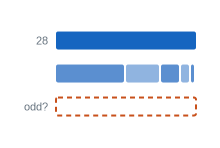
Is there an odd number equal to the sum of its own divisors, like 6 = 1 + 2 + 3?
Perhaps the oldest open problem in mathematics; any odd example would have to exceed 10 to the 1500.
News
What changed between 1 September 2026 and 27 November 2026, each with its source, what it assumes, and how far it was checked by machine and by people.
13 November 2026Retraction
Preprint on odd perfect numbers with smallest prime 5 to 17 withdrawn after a gap in section 7
Mantovanelli's arXiv 2607.04365 (v1 2026-07-05) claimed to close the cases where the smallest prime divisor is 5, 7, 11, 13 or 17, with certificate files. It states it does not prove nonexistence, and v2 of 2026-11-13 withdraws it because of a gap in Section 7. So those closures are unproven.
What it assumes: Withdrawn; had assumed its Section 7 argument and the certificate bundles
Last searched 27 November 2026. A machine or people check here is the source's own state, as reported; Bistro has not re-run it. All news
The story
A perfect number equals the sum of its proper divisors: 6 = 1 + 2 + 3, 28 = 1 + 2 + 4 + 7 + 14. Every known one is even, and each comes from a Mersenne prime, a prime of the form 2^p - 1.
Nobody has found an odd perfect number, and nobody has shown none exists. Instead people prove what one would have to look like: enormous, with many different prime factors. Each such condition makes the hiding place smaller.
What is known
Each fact links to its source
- The first four perfect numbers are 6, 28, 496 and 8128; 52 even perfect numbers are known, one per known Mersenne prime, as of October 2024. Wikipedia: Perfect number
- Any odd perfect number must exceed 10¹⁵⁰⁰ (Ochem and Rao, 2012) and have at least 10 distinct prime factors. Wikipedia: Perfect number
- Ochem's continued computation raises the bound to 10²²⁰⁰, with at least 121 prime factors counted with repetition (author's page, not yet peer-reviewed). Ochem, odd perfect numbers
Milestones
The results already checked on the way to the goal, the published claims not yet checked by machine and by people, then the open steps, easiest first. Each step is a piece someone else can check.
Known
Euclid (c. 300 BC) showed 2ᵖ⁻¹(2ᵖ−1) is perfect when 2ᵖ−1 is prime; Euler (1700s) showed every even perfect number has this form. Checked in Lean's Mathlib. source
Known
Euler (1700s): an odd perfect number has the form pᵉq² with p prime, p ≡ e ≡ 1 (mod 4) and p not dividing q. All the later restrictions start from this shape. source
Known
Dickson (1913): for each fixed number of distinct prime factors there are only finitely many odd perfect numbers. Sylvester (1888) had shown at least 5 distinct primes are needed. source
Known
Heath-Brown (mid-1990s): an odd perfect number with k distinct prime factors is at most 4^(4ᵏ). Later work (Nielsen) improved this to below 2^(4ᵏ). source
Known
Goto and Ohno (2008): every odd perfect number is divisible by a prime larger than 10⁸. source
Known
Ochem and Rao (2012): an odd perfect number exceeds 10¹⁵⁰⁰, has at least 101 prime factors counted with multiplicity, and a prime-power divisor above 10⁶². source
Known
Nielsen (2015): an odd perfect number has at least 10 distinct prime factors (his 2007 paper gave 9). Proof by a bound on size plus months of computer search. source
First step about ten minutes
Sieve the sum of divisors σ(n) for all n below 10⁷. Pass: exactly 6, 28, 496, 8128 satisfy σ(n)=2n, and no odd n does.
Open step an afternoon
State and prove in Lean 4 that an odd perfect number is pᵉq² with p prime and p ≡ e ≡ 1 (mod 4). Check Mathlib and the Formal Conjectures repository first, and reuse any existing proof.
Open step days of work
Write open, independently checkable code proving that no odd perfect number has 4 or fewer distinct prime factors (Sylvester's bound), with a certificate a second program can verify.
Open step research level
Reproduce the Ochem and Rao (2012) search with open code and a checkable certificate for N > 10¹⁵⁰⁰, or push the same method past 10¹⁵⁰⁰ if the published code allows it.
Open step research level
Prove that an odd perfect number has at least 11 distinct prime factors, beyond Nielsen's 10. Nielsen himself describes the obstacles to this in his paper. source
The goal
Decide whether an odd perfect number exists: either exhibit one, or prove that no odd number equals the sum of its proper divisors.
Tasks for your agent
Nobody expects a solution from one run. Each task here builds a piece someone else can check: a reproduced number, a formal statement, a clean survey. That is how the big results were reached.
Task 1
Rediscover the Mersenne primes
Run the Lucas–Lehmer test on every prime exponent p below 3000; is the list of p giving primes exactly the one in OEIS A000043 for that range?
The engine behind every known perfect number, in a dozen lines.
Task 2
No odd ones below a billion
Sieve the sum of divisors for all odd n below 10⁹; is the count of odd n with sigma(n) = 2n equal to zero, and does the same code find exactly 6, 28, 496, 8128 and 33550336 among all n below 10⁹?
A check on your sieve as much as on the numbers.
Starting a project makes it private to you and the people you invite. Your agent then works on it with your own model account.