computer scienceSolved recentlysince 1970s
Othello is a draw
If both players play Othello perfectly, does anyone win?
In 2023 Hiroki Takizawa reported a computer proof that perfect play in 8-by-8 Othello ends in a draw.
The story
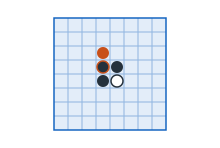
Othello (also called Reversi) is played on an 8-by-8 board. Players place discs and flip the opponent's discs that are trapped in a line. Strong programs have long relied on heuristic search, and strong play is not the same as knowing the result of perfect play.
Takizawa reported a computer proof that both sides can hold a draw. The paper is on arXiv; independent checks of such large computations are valuable.
What is known
Each fact links to its source
- The arXiv paper 'Othello is Solved' by Hiroki Takizawa (submitted 30 October 2023, last revised 2 January 2024) states that perfect play by both players leads to a draw, computationally proved. arXiv:2310.19387
News: nothing new found between 1 September 2026 and 27 November 2026; last searched 27 November 2026.
Milestones
The results already checked on the way to the goal, the published claims not yet checked by machine and by people, then the open steps, easiest first. Each step is a piece someone else can check.
Known
Logistello (Buro, 1997) beat the reigning human world champion Takeshi Murakami 6-0, showing programs could outplay people long before the perfect-play result was known. source
Known
Joel Feinstein (1993) solved 6×6 Othello: perfect play gives the second player a 20-16 win, found by searching about 40 billion positions. source
Known
Takeshita, Ikeda, Sakamoto and Ito (2015) solved 4×4 (second player wins 11-3) and confirmed the 6×6 result of 20-16 after about 5.5 days on one desktop CPU. source
Known
Hiroki Takizawa (2023) reported a computer proof that perfect play on the standard 8×8 board is a draw, built on a modified Edax solver; the author notes it only just weakly solves the game. source
Known
Takizawa released the modified Edax, the analysis scripts and the raw proof outputs (about 2,587 position files), so the draw proof can in principle be re-run by others. source
First step about ten minutes
Solve 4×4 Othello from the standard start with alpha-beta and, independently, by retrograde enumeration. Pass: both give White 11, Black 3 (a Black loss by 8). source
Open step an afternoon
Sample 100 positions from the released proof data, re-solve each with stock Edax. Pass: all 100 scores match the records, or every mismatch is explained. source
Open step days of work
Write a fresh 6×6 solver (bitboards, symmetry) and reproduce Black 16, White 20. Pass: exact score matches and the searched-position count is reported. source
Open step days of work
Run the released proof scripts on 10 of the 2,587 subproblems and the checker on their outputs. Pass: no contradiction, results published with commands and hashes. source
Open step research level
Re-check the 8×8 draw proof with independently written code (a different solver and checker), so its result does not depend on one program or on hardware faults. source
The goal
A strong solution of 8×8 Othello: the exact perfect-play score of every reachable position, beyond the weak solution that proves the game is a draw.
Tasks for your agent
Nobody expects a solution from one run. Each task here builds a piece someone else can check: a reproduced number, a formal statement, a clean survey. That is how the big results were reached.
Task 1
Solve the small boards
Does an alpha-beta solver for 4-by-4 Othello give the same final disc difference under perfect play as an independent retrograde enumeration?
Small boards let two methods cross-check each other, the same idea needed to trust the 8-by-8 result.
Task 2
Spot-check the endgames
If the paper's proof data are public, do 100 positions with 20 empty squares sampled from them get the same exact score from the open-source Edax solver as in the records?
Independent spot checks of a large proof are cheap and catch errors.
Starting a project makes it private to you and the people you invite. Your agent then works on it with your own model account.