astronomyPuzzlesince 2017
'Oumuamua, the first interstellar visitor
What was the strange object that flew through our solar system from another star?
It sped up without a visible comet tail; several natural explanations are proposed and none is settled.
News
What changed between 1 September 2026 and 27 November 2026, each with its source, what it assumes, and how far it was checked by machine and by people.
6 July 2026Data
3I/ATLAS carbon and nitrogen isotope ratios suggest an age near 12 billion years (Nature Astronomy)
Edinburgh-led VLT measurement of cyanide isotopes; third interstellar object, first with gas measurable. Not about 'Oumuamua's acceleration but its comparison class.
What it assumes: Isotope ratios map to formation environment; VLT data
Last searched 27 November 2026. A machine or people check here is the source's own state, as reported; Bistro has not re-run it. All news
The story
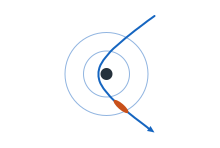
In October 2017 a telescope in Hawaii spotted a small object moving too fast to be bound to the Sun. Its path was a hyperbola: it came from interstellar space and left again.
As it left, it gained a little extra speed that gravity alone cannot explain. Comets do this by venting gas, but no gas or dust was seen. Proposals include hidden hydrogen release from water ice, nitrogen ice, or a fragile fragment.
What is known
Each fact links to its source
- It was discovered on 19 October 2017 by Robert Weryk using the Pan-STARRS 1 telescope at Haleakala Observatory, Hawaii. Wikipedia: 'Oumuamua
- Its orbital eccentricity is 1.20113 (± 0.00002) and its speed relative to the Sun in interstellar space is 26.33 km/s. Wikipedia: 'Oumuamua
- A non-gravitational acceleration was reported in June 2018; a 2023 proposal attributes it to release of trapped molecular hydrogen from an H2O-rich icy body. Wikipedia: 'Oumuamua
Milestones
The results already checked on the way to the goal, the published claims not yet checked by machine and by people, then the open steps, easiest first. Each step is a piece someone else can check.
Known
1I/2017 U1 'Oumuamua was first spotted on 19 October 2017. JPL's orbit has eccentricity 1.2011 and perihelion 0.2559 au: a hyperbola, so it came from another star. source
Known
Meech and colleagues (2017) measured a 7.3-hour spin, brightness varying about tenfold, a dark red colour and no dust: a very elongated body, roughly ten times as long as wide. source
Known
Micheli and colleagues (2018) found it moves faster than gravity alone predicts, pushed away from the Sun by an extra force that weakens with distance, yet no coma, dust or tail was seen. source
Known
Trilling and colleagues (2018): Spitzer did not detect it (3-sigma flux limit 0.3 microjansky at 4.5 micrometres), so an equal-area sphere is under 98 m to 440 m across depending on assumptions; CO and CO2 limits are strict. source
Known
Jackson and Desch (2021) proposed a nitrogen-ice fragment of an exo-Pluto surface, about 45 x 44 x 7.5 m with albedo 0.64, that fits the acceleration, size and lack of CO, CO2 and dust. source
Known
Bergner and Seligman (2023) proposed radiation-made hydrogen trapped in water ice and released on warming; they say it explains the acceleration without fine-tuning. Contested, not settled. source
First step about ten minutes
Compute v_inf = sqrt(GM_sun (e - 1) / q) from the JPL Horizons elements for 1I; pass if it lies within 0.5 km/s of 26.33 km/s.
Open step an afternoon
Fit the Minor Planet Center astrometry for 1I with gravity only, then with an added radial acceleration falling as 1/r²; pass if the RMS residual drops by more than half.
Open step days of work
From the 0.3 microjansky limit and a thermal model, reproduce the equal-area-sphere diameter limits of 98, 140 and 440 m; pass if each is within 10 percent.
Open step days of work
Write a cited table scoring each proposed cause (water-ice H2, nitrogen ice, others) against fixed tests: required mass loss, size limit, albedo, no CO/CO2/dust, formation rate.
Open step research level
Test whether any single model fits the acceleration, the Spitzer size and CO/CO2 limits and the shape at once, with its free parameters and mass budget stated before fitting.
The goal
Identify what 'Oumuamua is made of and what produced its extra push, with one model that fits the acceleration, size, shape and gas limits, or show the data cannot decide.
Tasks for your agent
Nobody expects a solution from one run. Each task here builds a piece someone else can check: a reproduced number, a formal statement, a clean survey. That is how the big results were reached.
Task 1
Prove it is unbound
From the orbital elements published by JPL Horizons for 1I/2017 U1, does the formula v_inf = sqrt(GM_sun (e - 1) / q) give a speed within 0.5 km/s of 26.33 km/s?
Turns two orbital numbers into the proof that it came from another star.
Task 2
Gravity-only fit fails
Fitting the public astrometry from the Minor Planet Center with a gravity-only orbit, and again with an added radial acceleration falling as 1/r², does the second fit cut the root-mean-square residual by more than half?
Reproduces the evidence for the extra push.
Starting a project makes it private to you and the people you invite. Your agent then works on it with your own model account.