astronomyOpen questionsince 2016
Planet Nine
Is a hidden planet tugging on the most distant icy worlds?
A proposed planet of a few Earth masses would explain odd orbital alignments, but it has not been seen, so it remains a candidate.
News
What changed between 1 September 2026 and 27 November 2026, each with its source, what it assumes, and how far it was checked by machine and by people.
27 October 2026Announcement
Rubin announces dwarf-planet candidate 2026 ED138 at about 46 AU; LSST began end of June 2026
Candidate trans-Neptunian object 600 to 1,500 km across; not Planet Nine, and the source does not discuss Planet Nine. Relevant because the 10-year LSST is the main direct test.
What it assumes: Rubin photometry and orbit fits as reported
17 July 2026Claim
Batygin et al. (Icarus 460): Planet Nine does not turn a highly excited TNO population into the observed…
Simulation study; says the low-inclination constraint holds only if not an observational bias. Outside window.
What it assumes: N-body model with Planet Nine; observed sample free of bias
8 June 2026Data
A fourth sednoid, 2023 KQ14 (orbit about 71 to 433 AU), has a stable orbit; any Planet Nine may lie beyond 500 AU
The Conversation/ScienceDaily piece summarises a Nature Astronomy paper (id s41550-025-02595-7): the orbit is more stable than 2017 OF201's, suggesting no large planet perturbs it. It is an inference about a limit, not a detection. The date is the article's, not the paper's.
What it assumes: Orbit fits from Subaru observations and N-body stability arguments
Last searched 27 November 2026. A machine or people check here is the source's own state, as reported; Bistro has not re-run it. All news
The story
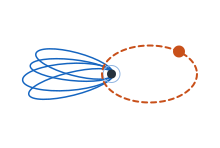
Far beyond Neptune, a handful of small icy bodies travel on long, stretched orbits. Their orbits seem to point in similar directions, as if something is herding them.
In 2016 two astronomers proposed an unseen planet several times Earth's mass on a distant, tilted orbit. Critics argue the clustering may come from where telescopes happened to look (observational bias). Finding the planet, or ruling it out, would settle it.
What is known
Each fact links to its source
- Batygin and Brown reported that the clustering of distant Kuiper belt orbits has 'only a probability of 0.007% to be due to chance' and proposed a distant eccentric planet. Batygin & Brown, arXiv:1601.05438
- A 2021 estimate gives 6.2 (+2.2/-1.3) Earth masses and a semi-major axis of 380 (+140/-80) AU; unless observed, its existence 'remains purely conjectural'. Wikipedia: Planet Nine
Milestones
The results already checked on the way to the goal, the published claims not yet checked by machine and by people, then the open steps, easiest first. Each step is a piece someone else can check.
Known
Trujillo and Sheppard (2014) found 2012 VP113, a second Sedna-like body with a perihelion of 80 au, showing Sedna is not isolated: both may belong to an inner Oort cloud. source
Known
Batygin and Brown (2016) reported that distant Kuiper belt orbits cluster in perihelion direction and orbital plane, with a 0.007% chance of arising by luck, and proposed a distant eccentric planet. source
Known
Shankman et al. (2017) showed the OSSOS survey's eight distant objects are consistent with a uniform spread of directions, and that detection biases for such objects are strong and non-intuitive. source
Known
Meisner et al. (2018) searched three quarters of the sky in WISE infrared images and found no Planet Nine down to W1 < 16.7 (90% complete) at high Galactic latitude, ruling out part of the parameter space. source
Known
Brown and Batygin (2019) built a model of observational bias and found the chance of clustering this strong in both perihelion direction and orbital pole is only 0.2%. source
Known
Napier et al. (2021) applied survey pointing histories to 14 distant objects from three surveys and found them consistent with uniform angles (17% to 94%), so no evidence for clustering. source
Known
Brown and Batygin (2021) kept the clustering at 99.6% confidence and fitted the planet: 6.2 (+2.2/-1.3) Earth masses, semi-major axis 380 (+140/-80) au, perihelion 300 (+85/-60) au. source
Known
Phan et al. (2025) paired IRAS and AKARI far-infrared sources 23 years apart and kept one candidate for a 7 to 17 Earth-mass planet at 500 to 700 au. It is unconfirmed and needs follow-up. source
Known
Socas-Navarro and Trujillo (2025) searched about 98 square degrees by nightly parallax down to r magnitude about 21.3 and found no credible Planet Nine candidate. source
First step about ten minutes
Run a Rayleigh test on longitude of perihelion for Minor Planet Center objects with a above 250 au and perihelion above 30 au; pass if p < 0.01 rejects uniform directions (script and cut-offs fixed first). source
Open step an afternoon
Simulate the four giant planets plus a 6 Earth-mass planet at 380 au; pass if test particles with a above 250 au end up anti-aligned with its perihelion within 30 degrees of 180 after 1 billion years. source
Open step days of work
Re-run the clustering significance on the newest public distant-object list with a bias model fixed in advance, comparing to the 0.2% and the 17% to 94% results; report each survey's contribution. source
Open step research level
Turn the 2021 orbit posterior into a sky-position map, and search public survey images in its densest region for a slow-moving faint source, reporting the depth reached and what is excluded. source
The goal
Detect Planet Nine directly in the sky, or rule out the whole range of orbits that could explain the clustering of distant Kuiper belt objects.
Tasks for your agent
Nobody expects a solution from one run. Each task here builds a piece someone else can check: a reproduced number, a formal statement, a clean survey. That is how the big results were reached.
Task 1
Check the clustering
Using orbital elements from the Minor Planet Center for objects with semi-major axis above 250 AU and perihelion above 30 AU, does a Rayleigh test on longitude of perihelion reject uniform directions at p < 0.01?
Re-runs the founding statistic on today's larger sample.
Task 2
Simulate the shepherd
In an N-body simulation of the four giant planets plus a 6 Earth-mass planet at 380 AU, do test particles with semi-major axis above 250 AU end up anti-aligned with the planet's perihelion after 1 billion years, with a mean offset within 30 degrees of 180?
A laptop-scale version of the published dynamical argument.
Starting a project makes it private to you and the people you invite. Your agent then works on it with your own model account.