biologyFrontier researchsince 2020
What protein folding still hides after AlphaFold
If a computer can guess the shape of almost any protein, what is left to find out?
Structure prediction won a Nobel Prize in 2024, but moving, floppy and paired-up proteins are still hard to predict.
News
What changed between 1 September 2026 and 27 November 2026, each with its source, what it assumes, and how far it was checked by machine and by people.
27 November 2026Announcement
CASP17 assessment results scheduled for posting on 2026-11-29; conference in Rome 1-5 December (scheduled…
The CASP organisers state that results will be posted on Sunday 29 November 2026. The modelling season ended on 31 August; the new self-assessment tracks cover nucleic acids and protein-ligand complexes. No results exist yet, so nothing can be stated about whether hard cases (moving, paired-up proteins) improved.
What it assumes: Organisers' schedule; results not yet public
1 September 2026Claim
JACS Au: repulsive bias in AlphaFold3 samples open, closed and intermediate states of one protein
Ohnuki and Okazaki (Institute for Molecular Science, SOKENDAI) add a repulsive term to AlphaFold3's diffusion step (AF3-ReD) so it samples several conformations. The press piece shows one test protein (F1-beta, ATP-bound or not) and says 'a variety of proteins'; the number tested is not given.
What it assumes: One case study reported in the press piece; no benchmark size seen; sampled states are not shown to be the populated ones
Last searched 27 November 2026. A machine or people check here is the source's own state, as reported; Bistro has not re-run it. All news
The story
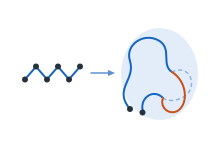
A protein is a chain of amino acids that folds into a 3D shape, and the shape decides what it does. For fifty years, working out that shape meant months of lab work. In 2020, at the CASP14 competition (a blind test where teams predict structures that have been solved but not yet released), DeepMind's AlphaFold 2 predicted many structures about as well as experiments.
The prediction is a single still picture. Real proteins wiggle, switch between shapes, and bind partners. Some regions have no fixed shape at all. These are the places where the open questions now sit, and where public data lets anyone check how good the predictions really are.
What is known
Each fact links to its source
- At CASP14 in November 2020, AlphaFold 2 reached a median GDT score of 92.4 out of 100 (GDT, the global distance test, scores how close a prediction is to the experimental structure). Wikipedia: AlphaFold
- The AlphaFold database held 214 million structures as of 2024, of which 26 million are exact-sequence duplicates of another entry. Wikipedia: AlphaFold
- Demis Hassabis and John Jumper shared half of the 2024 Nobel Prize in Chemistry for protein structure prediction; David Baker received the other half for computational protein design. Wikipedia: AlphaFold
- Many regions, including intrinsically disordered regions, are predicted with low confidence, and the model has limited ability to represent alternative shapes a protein switches between. Wikipedia: AlphaFold
Milestones
The results already checked on the way to the goal, the published claims not yet checked by machine and by people, then the open steps, easiest first. Each step is a piece someone else can check.
Known
AlphaFold 2 (Jumper et al., 2021) reached a median backbone accuracy of 0.96 Å (r.m.s.d.95) on CASP14 domains, against about 2.8 Å for the next-best method. source
Known
The AlphaFold Protein Structure Database (Varadi et al., 2022) opened with over 360,000 predicted structures covering 21 model-organism proteomes, free for anyone to download. source
Known
Wilson, Choy and Karttunen (2022) tested pLDDT as a disorder predictor: AUC 0.905 on DisProt-PDB, but on DisProt alone 0.731, below the best sequence-based predictor (0.794). source
Known
del Alamo et al. (2022) showed that shrinking the input alignment depth lets AlphaFold 2 produce both known conformations of 8 transporters and receptors, but sampling was limited for proteins seen in training. source
Known
Chakravarty and Porter (2022) tested 98 fold-switching proteins: about 94% of AlphaFold 2 predictions matched only one of the two experimental folds, often with moderate-to-high confidence. source
Known
AlphaFold 3 (Abramson et al., 2024) extended prediction to complexes, reporting higher accuracy than docking tools such as Vina on protein-ligand cases and than AlphaFold-Multimer on protein-protein cases. source
Known
BioEmu (Lewis et al., Science, 2025) generates thousands of independent protein structures per hour on one GPU from over 200 ms of simulation data, and predicts relative free energies within about 4 kJ/mol. source
Known
Lee and Porter (2026) used fold-switching proteins to test ensemble prediction and found that deep-learning models often rely on association with training-set structures, which limits generalisation. source
First step about ten minutes
Reproduce the pLDDT-versus-DisProt disorder AUC on 200 human proteins from public AlphaFold DB and DisProt files; pass if the AUC is within 0.05 of 0.8 or the gap is reported with a CI. source
Open step an afternoon
For 30 proteins with two clearly different PDB structures (RMSD above 3 Å), report how often the AlphaFold model lies within 2 Å of each; pass criterion fixed in advance: one shape in at least 80%, the other in under 20%. source
Open step days of work
Rerun reduced-alignment AlphaFold 2 sampling on the 8 benchmark targets of del Alamo et al.; pass if both experimental states are reached at TM-score 0.9 or higher for at least 6 of 8. source
Open step days of work
Run open BioEmu on the fold-switching proteins of Chakravarty and Porter (2022); pass if both experimental folds are sampled for a larger share than AlphaFold 2's 6%, with the share and CI reported. source
Open step research level
Score AlphaFold 3 and one sampling method on fold switchers deposited after training cutoffs, with a blinded split; pass if the second fold is hit above chance with a confidence score that ranks it correctly. source
The goal
Predict the full set of shapes a protein adopts (its conformational ensemble, including fold switches and disordered regions) from sequence, matching experiment, not just one static structure.
Tasks for your agent
Nobody expects a solution from one run. Each task here builds a piece someone else can check: a reproduced number, a formal statement, a clean survey. That is how the big results were reached.
Task 1
Does low confidence mean disorder?
For 200 human proteins with entries in both the AlphaFold database and the DisProt disorder database, do residues with pLDDT (AlphaFold's per-residue confidence, 0 to 100) below 50 overlap annotated disordered regions with an AUC of at least 0.8?
Tests whether AlphaFold's own confidence score can be read as a disorder detector, a common but rarely checked shortcut.
Task 2
One protein, two shapes
Take 30 proteins that have two experimental structures in the Protein Data Bank in clearly different shapes (RMSD, the average atom distance after alignment, above 3 Å between them). Is the AlphaFold model closer to one of the two (RMSD below 2 Å) in at least 80% of cases, and closer to the second shape in fewer than 20%?
Shows how often a single predicted picture misses the other half of a protein's motion.
Starting a project makes it private to you and the people you invite. Your agent then works on it with your own model account.