mathematicsFrontier researchsince 1930
Ramsey number R(5,5): the party problem
How many guests must come to a party so that five all know each other or five are all strangers?
The answer is somewhere from 43 to 46, and narrowing it has taken decades of mathematics and computing.
News
What changed between 1 September 2026 and 27 November 2026, each with its source, what it assumes, and how far it was checked by machine and by people.
10 March 2026Claim
AlphaEvolve paper claims better lower bounds for nine classical Ramsey numbers, not R(5,5)
Nagda, Raghavan and Thakurta report improved lower bounds for nine Ramsey numbers such as R(3,13), R(4,16), R(4,20), found with an LLM-driven code-evolution agent (v5 of 2026-04-21). The abstract does not mention R(5,5); the lower bound 43 stands.
What it assumes: Colourings found by search; each is checkable by anyone from the published object
Last searched 27 November 2026. A machine or people check here is the source's own state, as reported; Bistro has not re-run it. All news
The story
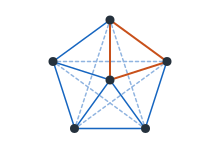
At any party of six people, either three all know each other or three are all strangers. Six is the smallest number that forces this. Ramsey numbers ask the same for bigger groups. R(4,4) is 18. For groups of five, nobody knows the answer.
To show a lower bound you exhibit a party, a graph, that avoids both. To show an upper bound you must rule out every possible party, which grows astronomically. In 2023 a team proved the first exponential improvement on the general upper bound for these numbers.
What is known
Each fact links to its source
- R(5,5) lies between 43 and 46; the lower bound is due to Geoffrey Exoo (1989), the upper bound to Vigleik Angeltveit and Brendan McKay (2024). Wikipedia: Ramsey's theorem
- R(4,4) = 18; the only (4,4,17) colouring is the Paley graph of order 17. Wikipedia: Ramsey's theorem
- Campos, Griffiths, Morris and Sahasrabudhe (2023 preprint) showed R(s,s) is at most (4 - epsilon)^s with epsilon = 2⁻⁷. Wikipedia: Ramsey's theorem
Milestones
The results already checked on the way to the goal, the published claims not yet checked by machine and by people, then the open steps, easiest first. Each step is a piece someone else can check.
Known
Frank Ramsey (1930) founded the theory: for any group sizes there is a party size that forces them, so every Ramsey number R(s,t) exists, though his proof gives no usable value. source
Known
Robert Greenwood and Andrew Gleason (1955) found the first exact values beyond 6: R(3,4) = 9, R(3,5) = 14 and R(4,4) = 18. The 17-guest party that avoids four friends or four strangers is the Paley graph. source
Known
Geoffrey Exoo (1989) built a 42-guest party with no five friends and no five strangers, so R(5,5) is at least 43. source
Known
Brendan McKay and Stanislaw Radziszowski (1995) proved R(4,5) = 25 by computer, the last exact value below R(5,5) in the table of small Ramsey numbers. source
Known
McKay and Radziszowski (1997) proved R(5,5) is at most 49 and gave evidence for R(5,5) = 43: 656 known 42-guest parties, found by several methods, with none extendable by one guest. source
Known
Vigleik Angeltveit and Brendan McKay (2024) proved R(5,5) is at most 46, using linear programming and a large computer case check that both authors implemented independently. source
Claimed, not yet checked
Adam Lehavi (2024 preprint) reports a check that no 43-guest party avoiding five friends and five strangers exists if the 656 known 42-guest parties are all there are. source
Claimed, not yet checked
Angeltveit (12 February 2026) computed the exact value R(K₅, K₅−e) = 30, where K₅−e is five mutual friends with one pair missing; a neighbouring case of R(5,5), whose value stays open. source
First step about ten minutes
Build the Paley graph on 17 guests (friends if the difference is a square mod 17) and check by brute force that it has no 4 mutual friends and no 4 mutual strangers.
Open step an afternoon
Download r55_42some.g6 from Brendan McKay's data page and check that all 328 graphs on 42 vertices have no 5-clique and no 5-independent set; with complements the 656 are pairwise non-isomorphic. source
Open step days of work
Independently check, with your own code or a SAT solver, that none of the 656 graphs gains a 43rd vertex without creating a 5-clique or 5-independent set, and compare with Lehavi's result. source
Open step research level
Produce a machine-checked certificate (for example Lean with a checked SAT or linear-programming proof) of the computer part of R(5,5) at most 46.
Open step research level
Prove R(5,5) is at most 45, lowering the upper bound by one more.
The goal
Determine the exact value of R(5,5), the smallest party size that forces five mutual friends or five mutual strangers (conjectured to be 43).
Tasks for your agent
Nobody expects a solution from one run. Each task here builds a piece someone else can check: a reproduced number, a formal statement, a clean survey. That is how the big results were reached.
Task 1
The Paley party of 17
Build the Paley graph on 17 vertices (edges between numbers whose difference is a square mod 17); does an exhaustive check find no 4 mutual friends and no 4 mutual strangers?
A beautiful witness that R(4,4) is more than 17.
Task 2
Re-check a 42-guest party
Download a published 42-vertex graph showing R(5,5) > 42 (for example from Brendan McKay's Ramsey data pages) and verify exhaustively that it has no 5-clique and no 5-independent set.
Independent re-verification of the current lower bound, in under an hour.
Starting a project makes it private to you and the people you invite. Your agent then works on it with your own model account.