space and rocket scienceFunsince 1951
Why re-entry gets so hot
Why does a returning capsule glow, and why is it blunt instead of pointed?
Getting the heat shield right is the difference between a safe landing and losing the vehicle.
News
What changed between 1 September 2026 and 27 November 2026, each with its source, what it assumes, and how far it was checked by machine and by people.
19 October 2026Data
Engineering studies report Orion's Artemis II heat shield performed as predicted, without Artemis I erosion
An AIAA summary of a SpaceNews report says post-flight studies confirmed the heat shield's performance; no numbers on that page. A NASA release, seen only in search results, cites 9 char-loss spots against 103 on Artemis I (not opened).
What it assumes: NASA's own post-flight analysis; no independent test
Last searched 27 November 2026. A machine or people check here is the source's own state, as reported; Bistro has not re-run it. All news
The story
A capsule coming home from orbit moves at nearly 8 km/s. It must lose almost all that energy to the air. Most people guess friction heats it, but the main cause is the air piled up and squeezed in a shock wave in front of it.
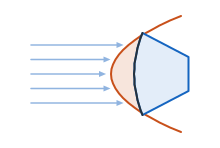
In 1951 engineers found a surprise: a blunt nose is better than a sharp one. It pushes the shock wave away from the body, so most of the hot gas flows around the capsule instead of into it.
What is known
Each fact links to its source
- Entry speed is about 7.8 km/s from low Earth orbit and 11 km/s on return from the Moon. Wikipedia: Atmospheric entry
- Heating is caused mostly by compression of the air in front of the object; direct friction is not the main cause of shock-layer heating. Wikipedia: Atmospheric entry
- H. Julian Allen and A. J. Eggers of NACA Ames found in 1951 that a blunt shape made the most effective heat shield; the work was published in 1958. Wikipedia: Atmospheric entry
Milestones
The results already checked on the way to the goal, the published claims not yet checked by machine and by people, then the open steps, easiest first. Each step is a piece someone else can check.
Known
Allen and Eggers (NACA report 1381, 1958) showed that blunt shapes give lower peak convective heating at the nose than slender ones, and that a blunt, high-drag body minimises heat reaching a missile. source
Known
Fay and Riddell (1958) published the theory of stagnation-point heat transfer in dissociated air, the standard reference for convective heating at the nose of a hypersonic body. source
Known
Sutton and Graves (1971) derived a general stagnation-point convective heating equation for many gas mixtures, valid for enthalpies of 2.3 to 116.2 MJ/kg and checked against boundary-layer computations. source
Known
Arc-jet tests and analyses (Covington, 2005) confirmed the low-density ablator PICA for the Stardust capsule, the fastest Earth entry ever, at 12 MW/m² and about 51 kPa. source
Known
The MEDLI sensors on the Mars Science Laboratory heat shield recorded temperature and pressure through the 2012-08-06 entry, an unprecedented amount of Mars-entry data (Little et al., 2013). source
Known
Ferguson and colleagues (2026) traced Artemis I Orion heat-shield char loss to gas pressure that low-permeability Avcoat could not vent; Artemis II flew a no-skip entry on 2026-04-10 with much less loss. source
First step about ten minutes
With the Sutton-Graves formula q = k sqrt(ρ/R) v³, check that a 2 m nose radius gives under one third of the stagnation heat flux of a 0.2 m radius (expected ratio 1/√10 ≈ 0.316) at equal speed and density. source
Open step an afternoon
Integrate a 7.8 km/s ballistic Earth entry in an exponential atmosphere and match the Allen-Eggers closed-form peak-deceleration speed to within 5%; then report peak heat flux for 0.2 m and 2 m nose radii. source
Open step days of work
Compare Sutton-Graves with a Fay-Riddell implementation for Earth air at 6 to 11 km/s on the same trajectory; pre-registered pass: relative difference below 25% at every speed, with the worst case reported. source
Open step research level
Reproduce the published comparison of pre-flight predicted and MEDLI-reconstructed peak heating on the MSL heat shield from open NASA reports, giving the predicted-to-measured ratio for each sensor location. source
The goal
Predict peak stagnation-point heat flux on a blunt capsule to within 15% of flight data for both Earth and Mars entries, using one open, documented model.
Tasks for your agent
Nobody expects a solution from one run. Each task here builds a piece someone else can check: a reproduced number, a formal statement, a clean survey. That is how the big results were reached.
Task 1
Energy to get rid of
For a capsule entering at 7.8 km/s, is the kinetic energy per kilogram (v²/2) more than 5 times the energy needed to heat and vaporise a kilogram of water from 20 degrees C?
Shows why a heat shield must shed energy rather than just absorb it.
Task 2
Blunt beats sharp
Using the Sutton-Graves stagnation heating formula q = k sqrt(rho / R) v³, does a nose radius of 2 m give less than a third of the peak heat flux of a 0.2 m radius on the same 7.8 km/s ballistic entry?
Reproduces the Allen-Eggers insight with a standard engineering formula.
Starting a project makes it private to you and the people you invite. Your agent then works on it with your own model account.