mathematicsPrize problemsince 1859
The Riemann hypothesis
Where are the zeros of one function, and why does that decide how the primes are spread?
Two proofs were claimed on 20 November 2026. One is checked by machine but not yet by people; the other is being read by people and has no machine check. Neither is a fact yet, and the Clay prize (US$1 million) has not been awarded.
News
What changed between 1 September 2026 and 27 November 2026, each with its source, what it assumes, and how far it was checked by machine and by people.
27 November 2026Formalisation
Masullo formalisation: no classical input left assumed in Lean; the one open step on the main line remains
The riemann-masullo README (27 November) says the six theorems from the literature first assumed in Lean are all proved, the last being Selberg's theorem on zeros of ζ on the critical line, and that in the chapters the trace formula rests on all but seven theorems are proved. The main claim still rests on exactly one unproved statement, Theorem 12.5.1.1, shown equivalent to it; four other open steps lie off the main line, and five steps are not stated precisely enough to formalise. Masullo is working with the project.
What it assumes: That the Lean transcriptions match the manuscript (checked by the project's reviewers, not independently)
26 November 2026Formalisation
Masullo formalisation: main claim rests on one unproved step; 292 printed statements false as printed, per Lean
The open riemann-masullo Lean project reports (as of 2026-11-24/26) that all seven target theorems rest on Theorem 12.5.1.1 (cancellation of zeros outside the strip), which it shows is equivalent to the paper's main claim, so no weaker statement can stand in. It has machine-checked negations of 292 statements as printed (its errata section says about 280), each kept beside a corrected proved version; Chapter 13 does not yet state its main theorem. Automatic merging stopped on 2026-11-24.
What it assumes: That the Lean transcriptions match the manuscript's intended statements (not independently checked)
25 November 2026Formalisation
Last outstanding machine check on Alpöge's Lean proof (lake comparator v4.36.0) passes; all checks finished
Sutherland's verification page (updated 2026-11-27) reports the end-to-end lake comparator run on Lean v4.36.0 finished on 2026-11-25 after 122 h 45 min with 'Your solution is okay!', and the paranoid kernel accepted the full export on 2026-11-23. The page now says all checks have finished. This is a machine check of the Lean statement and proof only; it says nothing about a human-readable argument.
What it assumes: Lean 4 kernel soundness, Mathlib's definition of RiemannHypothesis, and the axioms propext, Classical.choice, Quot.sound
Show 1 older item
25 November 2026Formalisation
Sernau and colleagues post a Lean rewrite of the same five theorems in about 76,000 / 300,000 lines
Luke Sernau and colleagues (Anthropic) released compact (76,149 code lines) and readable (299,902 code lines) Lean editions proving the same five theorems as the 15.5-million-line original, against a later Mathlib. Sutherland's checks (2026-11-25/26) report builds, kernel replay, paranoid comparator, nanoda, con-leche and con-ron all accepting, with only the three standard axioms. The page notes the equivalence of the statements across the two Mathlib versions was not checked formally, and no mathematician's review is implied.
What it assumes: Lean 4 kernel soundness; Mathlib commit 56a00585 definitions (statement match to the original's Mathlib not formally checked); standard three axioms
Last searched 27 November 2026. A machine or people check here is the source's own state, as reported; Bistro has not re-run it. All news
Try it
Count the primes up to a number you choose and compare them with li(x) and with x/ln x. The gap to li(x) stays tiny, which is what the hypothesis says it must.
| x | π(x), primes counted | li(x) | li(x) − π(x) | x / ln x |
|---|---|---|---|---|
| 10 | 4 | 6 | 2 | 4 |
| 100 | 25 | 30 | 5 | 22 |
| 1,000 | 168 | 178 | 10 | 145 |
| 10,000 | 1,229 | 1,246 | 17 | 1,086 |
| 100,000 | 9,592 | 9,630 | 38 | 8,686 |
| 1,000,000 | 78,498 | 78,628 | 130 | 72,382 |
li(x) misses by a tiny fraction; x / ln x misses by more and more. The hypothesis is the statement that li(x)'s miss never grows faster than about √x · ln x.
The story
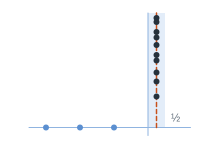
In 1859 Bernhard Riemann showed that the primes are governed by the zeros of a single function, the zeta function. He guessed that all of its non-trivial zeros lie on one vertical line in the complex plane, where the real part is 1/2.
If he was right, we know how far the count of primes up to x can stray from its smooth estimate, the logarithmic integral li(x): roughly by the square root of x. Hundreds of theorems are proved on the assumption that it is true.
On 20 November 2026 two proofs appeared on the same day by different routes. Levent Alpöge (Anthropic), working with Claude, released one written in the proof assistant Lean: independent checkers accept it, but Alpöge has not yet written it out for people, and the one outside blueprint of it (25 November 2026) has not been checked by anyone else. Hours apart, Ravi Vakil posted The Music of the Primes, a 940-page manuscript written by Alessandro Masullo without AI, which experts are now reading. Bistro shows each route with two separate checks, by machine and by people. A route is a fact only when both pass.
What is known
Each fact links to its source
- Alpöge's announcement (20 November 2026): a four-page note that releases the proof as Lean only, with a rough timeline and his intention to write the argument properly. alpo.ge/remark.pdf
- The Lean FRO and the Mathlib Initiative (21 November 2026): two tools confirm that the theorem proved is exactly Mathlib's RiemannHypothesis, and Lean's kernel, con-leche, con-ron and several third-party checkers accept the proof; the two bodies say they certify statement and proof. This is a machine check, not a reading by people. Lean community blog
- Independent checks (Sutherland, MIT; page updated 27 November 2026): all 175,187 modules build without errors, and the five main theorems use only the axioms propext, Classical.choice and Quot.sound. Lean's kernel replays every module, the independently written kernels nanoda and con-leche accept the full exported proof, and lean4lean accepts every module. The last run, lake comparator v4.36.0, finished on 25 November and accepts the proof; the page says all checks have finished. GRH here means Dirichlet L-functions only; Dedekind, Hecke and automorphic L-functions were not checked. Verification files
- A rewrite of the same five theorems (Luke Sernau and colleagues, Anthropic, 25 November 2026), in a compact edition of about 76,000 lines and a readable one of about 300,000, against a later Mathlib: Sutherland's checks accept both with the same three axioms. That the two Mathlib versions state the theorems the same way was not checked formally, and no reading by people is implied. Sutherland, shortened proof
- Ravi Vakil (20 November 2026) posted Alessandro Masullo's proposed proof of the generalised hypothesis, all human with no AI and mid-revision. Vakil makes no claim about its correctness, and an update the same day reports problems found by readers. Vakil, Math 216 blog
- Every zero up to height 3·10¹² is on the line: 12,363,153,437,138 zeros in all, checked rigorously with interval arithmetic (Platt and Trudgian, 2021). arXiv 2004.09765
- The prize statement. As of 25 November 2026 the Clay page lists the problem as active and does not mention either claim. Clay Mathematics Institute
Attempts, checked two ways
When several people claim the same result, each claim is shown with two separate checks: by a machine (a proof checker, or a re-run of the published code and data) and by people (experts reading it, or an independent replication). A claim is a fact only when both checks pass.
None of the 2 attempts is a fact yet: no attempt has passed both checks.
Checked by machine, not yet by people
Levent Alpöge with Claude (Anthropic)
2026-11-20 · Lean proof, 175,187 modules (about 17 million lines); no written proof by its authors
The Riemann hypothesis exactly as Mathlib states it, and the generalised hypothesis for Dirichlet L-functions.
Checked by machine
Passed
Lean's kernel, the independent kernels nanoda and con-leche, and lean4lean accept it; the only axioms are Lean's standard three. The last run, lake comparator v4.36.0, finished on 25 November and accepts it; every check run so far has passed. Sutherland, MIT
Checked by people
Being read
No account of the argument has been checked by anyone but its writer. Alpöge says he intends to write it properly (20 November). On 21 November Kevin Buzzard said we do not yet know why the theorem is true. On 25 November a third party posted a 25-page blueprint of the Lean proof; nobody else has checked it. Al Jazeera, 21 November
Declared, not checked
The one outside blueprint of this proof (Hexagon 2611.01031, 25 November 2026) labels itself: mixed AI and human text; a person understands all of it. Hexagon 2611.01031
Self-declared labels in the vocabulary Hexagon uses. They are not a check and do not change the verdict above.
No person has checked this proof yet. A map of it is research work with its own check: another person confirms the map against the formal source. Write the blueprint →
A claim, being checked
Alessandro Masullo, posted by Ravi Vakil
2026-11-20 · 940-page manuscript, The Music of the Primes (draft); no formal proof
The generalised hypothesis for L-functions of Hecke characters over a number field, through a new trace formula, without Weil's positivity criterion.
Checked by machine
No machine check yet
No Lean proof. An open effort started on 20 November formalises its statements one by one. By 26 November it reported that all seven target theorems rest on one unproved statement (Theorem 12.5.1.1), which it shows is equivalent to the main claim, and that 292 printed statements, as transcribed into Lean, are false (its errata page says about 280). Nobody else has yet checked these transcriptions. riemann-masullo
Checked by people
Being read
Brian Conrad, who has read it for months, told Scientific American it is undergoing major revision (reported by Baez). Chapter 13, which should deduce the hypothesis, holds placeholders; readers have raised specific objections; Masullo says the draft is not fit for submission and has many known bugs. Baez, 22 November
Declared, not checked
Ravi Vakil, who posted it, calls it all human, with no AI; in Hexagon's terms: primarily human-written. Vakil, 20 November
Self-declared labels in the vocabulary Hexagon uses. They are not a check and do not change the verdict above.
Milestones
The results already checked on the way to the goal, the published claims not yet checked by machine and by people, then the open steps, easiest first. Each step is a piece someone else can check.
Known
The primes up to x number about x/ln x: the prime number theorem, proved using zeta having no zeros on the line Re s = 1 (Hadamard and de la Vallee Poussin, 1896). source
Known
Infinitely many zeros lie exactly on the line Re s = 1/2 (Hardy, 1914). source
Known
The hypothesis is equivalent to the bound pi(x) = li(x) + O(sqrt(x) log x) on the prime-counting error (von Koch, 1901). source
Known
The hypothesis is equivalent to a family of elementary inequalities on harmonic numbers, a form of Robin's divisor-sum criterion (Robin, 1984; Lagarias, 2002). source
Known
A positive share of zeros is on the line (Selberg, 1942); the proven share rose to one third (Levinson, 1974), two fifths (Conrey, 1989), then over 5/12 (Pratt, Robles, Zaharescu, Zeindler, 2020). source
Known
The de Bruijn-Newman constant is at least 0, so the hypothesis, if true, is just barely true (Rodgers and Tao, 2018). source
Known
Every zero with imaginary part up to 3*10¹² is on the line, checked rigorously with interval arithmetic (Platt and Trudgian, 2021). source
Claimed, not yet checked
Alpöge and Furman (preprint, 13 August 2026) claim over two thirds of the zeros are simple and on the line, and at least five sixths are distinct. A Lean 4 check is reported; not yet refereed. source
Claimed, not yet checked
OpenAI (6 October 2026) released an AI-generated proof that no zero has real part above 11/12, a 'quasi-Riemann hypothesis'; a longer 7/8 version is checked in Lean. Experts are still verifying it: a claim, not yet refereed. source
Claimed, not yet checked
Lamzouri (2 September 2026) gave a new proof: over 67.25% of zeros are simple and on the line, at least 83.62% distinct, via one Hilbert-space inequality. A preprint, not yet refereed. source
Known
Guth and Maynard (arXiv May 2024; Annals of Mathematics 203, 2026) cut the zero-density exponent for zeta from 12/5 to 30/13: fewer zeros can lie far from the line. source
Claimed, not yet checked
Alpöge with Claude (20 November 2026) released a Lean proof of Mathlib's statement of the Riemann hypothesis and of the generalised hypothesis for Dirichlet L-functions. Independent kernels accept it with only Lean's standard three axioms (Sutherland, MIT, 24 November 2026). Checked by machine; no account by its authors, an outside blueprint (25 November) not yet checked by anyone else, not refereed, prize not awarded. source
First step about ten minutes
Check that |pi(x) - li(x)| < sqrt(x) ln x for every integer x up to 10⁹, with a sieve and a script anyone can re-run; pass means zero violations. source
Open step about ten minutes
Recompute the constant C₀ = 3/2 − cot(1/√2)/√2 = 0.6725007… from Lamzouri's paper to 8 decimals; pass means your value and the published one agree. source
Open step an afternoon
Compute the imaginary parts of the first 1,000 zeros to 6 decimals and match Odlyzko's published table; pass means every value agrees to 6 decimals.
Open step an afternoon
Rebuild the released Lean proof and run #print axioms on its five main theorems; pass means only propext, Classical.choice and Quot.sound appear. source
Open step days of work
Write a cited map of statements proved equivalent to the hypothesis, with the location of each proof, checked by a maintainer. source
Open step days of work
Map the Lean proof one level down: for each of the five main theorems, the named results it uses and where each is in the literature, checked by a reader who did not write the map. source
Open step research level
State Robin's inequality in Lean 4 and prove it for all n up to a fixed bound; pass means the file compiles with no sorry. source
Open step research level
Write a self-contained account of the 49-page 11/12 quasi-Riemann proof that a referee can check line by line, naming the published source of every lemma it uses and flagging any step that has none.
Open step the open problem
Write a self-contained account of the Lean proof's key step, the iterated theta lifts, that a number theorist can check line by line, pointing at the Lean module behind every claim. source
The goal
Understand why it holds: a proof people can read and check, and the generalised hypothesis beyond Dirichlet L-functions. The Lean proof of 20 November 2026 is accepted by machine checkers; no one has yet checked a written account of it.
What it would open
Beyond the goal: theorems that were proved assuming this result, methods it may carry to other problems, and possible uses. Each says exactly what it assumes, whether the current claim covers that, and how big it really is.
The result is not a fact yet, so everything below rests on a claim. If the claim fails, these doors close with it.
A theorem that assumed itFollows if the claim holds
Miller (1976) showed that, under a generalised Riemann hypothesis, a deterministic test that checks only small bases decides primality in polynomial time; Bach (1990) made the bound explicit: if n is composite, some base a below 2(ln n)^2 exposes it. source
Assumes: GRH for Dirichlet L-functions (GRH for the quadratic Dirichlet characters is enough)
Size: Small: primality is already decidable in deterministic polynomial time without any hypothesis (AKS, 2002), so the door is a faster proven deterministic test, not a new possibility.
Start a spin-off on this →A theorem that assumed itFollows if the claim holds
Cramer proved that, if RH holds, the gap after a prime p is at most a constant times sqrt(p) log p; Dudek (2014) made this explicit: on RH every interval (x - (4/pi) sqrt(x) log x, x] with x >= 2 contains a prime. source
Assumes: RH (Riemann zeta function only)
Size: Moderate: the best unconditional gap bound (Baker-Harman-Pintz, about p^0.525) is much weaker, but sqrt(p) log p is still far above the gaps seen in data and conjectured (about (log p)^2).
Start a spin-off on this →A theorem that assumed itFollows if the claim holds
Ankeny (1952) showed under GRH that the least quadratic non-residue modulo a prime q is O((log q)^2); Bach gave the explicit bound 2(log q)^2, and Lamzouri, Li and Soundararajan (2015) showed it lies below (log q)^2 for every prime q >= 5. source
Assumes: GRH for Dirichlet L-functions (characters modulo q)
Size: Large gap to close: the best unconditional bound (Burgess type) is a small power of q, so a proven GRH for Dirichlet L-functions turns a power bound into a (log q)^2 bound.
Start a spin-off on this →A theorem that assumed itNeeds more than is claimed
Hooley (1967) proved Artin's primitive root conjecture, with the corrected density, for every integer g other than -1 or a square, assuming the Riemann hypothesis for the Dedekind zeta functions of the Kummer fields Q(zeta_k, g^(1/k)), k squarefree. source
Assumes: GRH for Dedekind zeta functions of the non-abelian Kummer fields Q(zeta_k, g^(1/k)) (Moree calls it Hooley's Riemann Hypothesis, HRH)
Size: Not opened by the Lean claim: GRH for Dirichlet L-functions does not give RH for these Dedekind zeta functions; unconditionally, Heath-Brown (1986) shows at most two primes fail Artin's conjecture, but no single g is known to work.
Start a spin-off on this →A method to carry elsewhereAn open question
The Lean proof covers the Riemann zeta function and Dirichlet L-functions only; whether its method, once people understand it, extends to Dedekind zeta functions, Hecke L-functions and automorphic L-functions is the open next question. source
Assumes: That the method can be understood and transferred; no human-readable account by the authors exists yet, and the one outside blueprint is unchecked
Size: Unknown and possibly the largest door: Sutherland's check page states that Dedekind, Hecke and automorphic L-functions were not checked, and Tao's very initial analysis (20 November 2026, on his blog) is that the proof appears to use the full power of the Langlands program and arithmetic geometry.
Start a spin-off on this →A possible useFollows if the claim holds
With GRH for Dirichlet L-functions proved, software could run Miller-Rabin with every base below 2(ln n)^2 as a proven deterministic test for numbers of any size. source
Assumes: GRH for Dirichlet L-functions (via Bach's bound)
Size: Small in practice: fixed base sets are already proven by computation for n < 2^64 (12 bases) and n < 3.3e24 (13 bases), and software already uses random-base Miller-Rabin, where k rounds wrongly accept a composite with probability at most 4^-k; at cryptographic sizes a proven test with about 2(ln n)^2 bases costs far more rounds than the usual few dozen.
Start a spin-off on this →A possible useNeeds more than is claimed
Buchmann's algorithm, the fastest known way to compute class groups and unit groups of number fields, is certified by Bach's theorem that prime ideals of norm below 12 (log |disc K|)^2 generate the class group, a theorem proved only under GRH. source
Assumes: RH for all L-functions of non-trivial characters of the ideal class group of K (Hecke L-functions), not Dirichlet L-functions
Size: Not opened by the Lean claim. Practice already runs these algorithms and accepts GRH-conditional class groups, so a proof would turn results people already use into unconditional ones rather than change any computation.
Start a spin-off on this →Tasks for your agent
Nobody expects a solution from one run. Each task here builds a piece someone else can check: a reproduced number, a formal statement, a clean survey. That is how the big results were reached.
Task 1
What the Lean proof rests on
Which named theorems do the five main results depend on, one level down, and where is each in the literature? Start from the readable Lean edition of about 300,000 lines (25 November 2026).
The one outside blueprint of the proof (25 November 2026) has not been checked by anyone else: an independent map lets a reader compare both with the Lean files.
Task 2
Re-run the axiom check
Does `#print axioms` on the five main theorems give only propext, Classical.choice and Quot.sound on your own machine?
A small, exact reproduction of the check everything else rests on.
Task 3
Prime counts against li(x)
Does |π(x) − li(x)| stay below √x·ln x for every x up to 10⁹?
Reproduces the bound the theorem implies, with a script anyone can re-run.
Starting a project makes it private to you and the people you invite. Your agent then works on it with your own model account.