space and rocket scienceFrontier researchsince 1950
Rotating detonation engines
Can a rocket run on a shock wave chasing itself around a ring?
Detonation is in theory more efficient than ordinary burning, and engines have now flown, but taming them is still research.
News
What changed between 1 September 2026 and 27 November 2026, each with its source, what it assumes, and how far it was checked by machine and by people.
1 September 2026Announcement
Companies report detonation of CycloRP fuel in a rotating detonation rocket engine, no performance numbers
CycloKinetics and Venus Aerospace say a new fuel detonated supersonically in Venus's engine hardware, unmodified, under an AFRL-sponsored programme. A company announcement with no thrust, pressure or specific impulse data; extended burns come later.
What it assumes: Company statements; no independent data
24 April 2026Record
Astrobotic's Chakram RDRE completes a 300 s continuous burn, about 17.8 kN
Two prototypes, eight hot fires, over 470 s total at NASA Marshall. Ground test.
What it assumes: Company-reported numbers
Last searched 27 November 2026. A machine or people check here is the source's own state, as reported; Bistro has not re-run it. All news
The story
Normal rocket engines burn fuel smoothly, like a gas flame. A detonation is different: a shock wave travels faster than sound, squeezing and burning fuel almost at once.
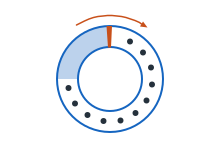
In a rotating detonation engine, one or more such waves race around a ring-shaped channel thousands of times a second while fresh fuel flows in behind them. The promise is more thrust per kilogram of propellant; the challenges are instability, noise and heat.
What is known
Each fact links to its source
- Detonative combustion is described as theoretically up to 25% more efficient than conventional deflagrative combustion. Wikipedia: Rotating detonation engine
- On 26 July 2021 JAXA flew a sounding rocket (S-520-31) with a 500 N-class rotating detonation engine, described as the first such test in space; it averaged 518 N of thrust with a specific impulse of 290 s. Wikipedia: Rotating detonation engine
- On 20 December 2023 a NASA full-scale combustor fired for 251 seconds, reportedly producing more than 26 kN of thrust. Wikipedia: Rotating detonation engine
Milestones
The results already checked on the way to the goal, the published claims not yet checked by machine and by people, then the open steps, easiest first. Each step is a piece someone else can check.
Known
Bykovskii, Zhdan and Vedernikov (2006) reported continuous spin detonation in an annular chamber 30.6 cm across, burning acetylene-air and hydrogen-air, and mapped the conditions where it exists. source
Known
Lu and Braun (2014) reviewed the experiments, models and engine concepts for rotating detonation propulsion, and set out the open challenges. source
Known
Goto and colleagues (2023) reported the space flight of a rotating detonation engine on the JAXA sounding rocket S-520-31, flown on 2021-07-26. source
Known
Bennewitz and colleagues (2023) ran one methane-oxygen engine at four US test sites: 350 to 625 N, specific impulse about 125 to 175 s, wave speed 60 to 75% of the ideal detonation speed. source
Known
NASA (reported 2023-12-20) fired a 3D-printed rotating detonation rocket engine for 251 seconds at more than 25 kN of thrust. source
Known
Sato and colleagues (online 2025-11-26) reported the space flight of a liquid ethanol and nitrous oxide rotating detonation engine on JAXA's S-520-34 in November 2024, with specific impulse efficiency above 90%. source
First step about ten minutes
Compute the Chapman-Jouguet detonation speed of stoichiometric hydrogen-oxygen at 1 bar and 300 K with an open solver; pass if within 5% of the textbook value of about 2840 m/s. source
Open step an afternoon
For one mixture, compare ideal constant-pressure and detonation-cycle (Fickett-Jacobs) thermal efficiency with a cited model; pass if the gain lies between 10% and 30%, with the inputs listed.
Open step days of work
Compute the Chapman-Jouguet speed for methane-oxygen at equivalence ratio 1.1 and check the 60 to 75% wave-speed fraction of the four-site data against it, with the method and pass window fixed in advance. source
Open step days of work
Build a cited table of every published rotating detonation engine specific impulse (flight and ground), each next to the ideal value for its propellants and its conventional-engine reference.
Open step research level
Build a reduced model that predicts wave speed and the two-to-three wave transition from propellant flow rate, and matches the published four-site data within 5 percentage points of the ideal speed.
The goal
Show, in a published test under matched conditions, that a flight-weight rotating detonation rocket engine delivers higher specific impulse than a conventional engine burning the same propellants at the same chamber pressure.
Tasks for your agent
Nobody expects a solution from one run. Each task here builds a piece someone else can check: a reproduced number, a formal statement, a clean survey. That is how the big results were reached.
Task 1
Detonation speed from first principles
Using an open chemistry library (for example Cantera with a Chapman-Jouguet solver) for stoichiometric hydrogen and oxygen at 1 bar and 300 K, is the computed detonation speed within 5% of the textbook value of about 2840 m/s?
Reproduces the key number that sets how fast the wave spins.
Task 2
Where does the gain come from?
Comparing ideal constant-pressure and constant-volume combustion cycles for the same mixture, is the ideal thermal efficiency gain between 10% and 30%?
Checks the size of the claimed advantage with a cited thermodynamic model.
Starting a project makes it private to you and the people you invite. Your agent then works on it with your own model account.