space and rocket scienceFunsince 2010
Sailing on sunlight
Can light alone push a spaceship?
Sails need no fuel, so a tiny but endless push could make some long missions possible.
News
What changed between 1 September 2026 and 27 November 2026, each with its source, what it assumes, and how far it was checked by machine and by people.
2 October 2026Announcement
NASA: 1,653 m2 sail for S5 is built, all four quadrants done in January 2026; no launch date
Largest sail built; not launched.
What it assumes: Programme status as NASA states
Last searched 27 November 2026. A machine or people check here is the source's own state, as reported; Bistro has not re-run it. All news
The story
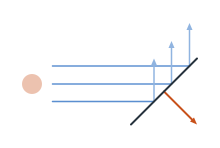
Light carries momentum. When it bounces off a mirror it gives a small push. Near Earth, sunlight presses on a mirror with a force of a few micronewtons per square metre.
That is tiny, but it never stops. In 2010 Japan's IKAROS unfolded a thin plastic sail on its way to Venus and showed that sunlight could steer and speed up a real spacecraft.
What is known
Each fact links to its source
- IKAROS launched on 20 May 2010 with a 14 m x 14 m sail made of 7.5 micrometre thick polyimide. Wikipedia: IKAROS
- IKAROS measured a thrust of 1.12 millinewtons from solar radiation pressure and was the first spacecraft to demonstrate solar sail technology in interplanetary space. Wikipedia: IKAROS
Milestones
The results already checked on the way to the goal, the published claims not yet checked by machine and by people, then the open steps, easiest first. Each step is a piece someone else can check.
Known
IKAROS (Japan, launched 2010) deployed a large thin-film sail on its way to Venus and passed Venus with the help of solar sailing, the first sail flown in interplanetary space (Tsuda et al., 2013). source
Known
LightSail 2 (The Planetary Society, 2019) raised its Earth-orbit apogee by about 2 km in four days (26 to 30 July 2019) using sunlight alone, the first CubeSat to do so. source
Known
Lubin (2016) proposed pushing gram-scale probes on light sails with a ground laser to above a quarter of light speed, reaching the nearest star in about 20 years. source
Known
In the 2025 trajectory-design competition GTOC13, teams planned solar-sail tours with over a hundred flybys; the third-placed team scored 337.878 from 133 flybys using convex optimisation (Yarndley et al., 2026). source
Known
NASA's ACS3 CubeSat (launched 2024-04-24) deployed an 80 m² sail on composite booms on 2024-08-28, its primary objective; the 2026 mission report notes challenges in all mission phases (Shih and Wilkie). source
First step about ten minutes
With solar constant 1361 W/m², sail area 196 m² and a perfect mirror facing the Sun, F = 2SA/c. Pass: the prediction is within a factor of 2 of the measured 1.12 mN; explain the gap. source
Open step an afternoon
Simulate a sail with characteristic acceleration 1 mm/s², starting at 1 au and tilted 35° from the Sun line. Pass: it reaches 1.52 au within 2 years, or the simulation shows by how much it misses.
Open step days of work
Reproduce LightSail 2's apogee rise with an orbit propagator that includes sunlight pressure, drag and a sail turned twice per orbit. Pass: modelled rise within 25% of the published 2 km over 26 to 30 July 2019. source
Open step days of work
Compute the minimum-time sail transfer from Earth's orbit to Mars's orbit as a function of characteristic acceleration, with the optimiser and code published so another person can re-run it.
Open step research level
Rebuild one solar-sail flyby leg with sequential convex programming as in the GTOC13 entry, and compare its transfer time and sail angles with the paper's reported leg. source
The goal
Design a solar-sail trajectory, with sail mass and area that existing materials could build, that leaves the Sun's neighbourhood and passes 100 au within 20 years of launch.
Tasks for your agent
Nobody expects a solution from one run. Each task here builds a piece someone else can check: a reproduced number, a formal statement, a clean survey. That is how the big results were reached.
Task 1
Predict IKAROS's push
Using the solar constant (about 1361 W/m², the sail area of 196 m² and a perfect mirror facing the Sun, F = 2 S A / c; is the predicted force within a factor of 2 of the measured 1.12 mN?
A one-line physics check against a real flight measurement, and a prompt to explain the gap.
Task 2
Sail to Mars orbit
Simulating a sail with characteristic acceleration 1 mm/s² starting at 1 AU and tilted 35 degrees to the Sun, does it reach 1.52 AU within 2 years?
Shows how small pushes add up and why tilt angle matters.
Starting a project makes it private to you and the people you invite. Your agent then works on it with your own model account.