mathematicsFunsince 2005
The fewest clues in a Sudoku
What is the smallest number of starting digits a Sudoku can have and still have only one answer?
Answered as 17 by an exhaustive computer search posted in 2012; there is no 16-clue puzzle.
The story
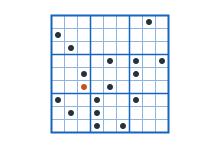
A good Sudoku has exactly one solution. Puzzle fans collected tens of thousands with only 17 given digits but never found one with 16. Was that luck, or a law?
Gary McGuire, Bastian Tugemann and Gilles Civario checked every essentially different completed grid for a 16-clue puzzle hiding inside it. There was none. The answer is 17.
What is known
Each fact links to its source
- The minimum number of clues is 17, proved by McGuire, Tugemann and Civario in a 2014 paper (arXiv 1201.0749) using an exhaustive computer search. Wikipedia: Mathematics of Sudoku
- There are 6,670,903,752,021,072,936,960 completed grids, of which 5,472,730,538 are essentially different (Russell and Jarvis). Wikipedia: Mathematics of Sudoku
- Gordon Royle's collection holds more than 36,000 distinct 17-clue sudokus. Wikipedia: Mathematics of Sudoku
News: nothing new found between 1 September 2026 and 27 November 2026; last searched 27 November 2026.
Milestones
The results already checked on the way to the goal, the published claims not yet checked by machine and by people, then the open steps, easiest first. Each step is a piece someone else can check.
Known
Bertram Felgenhauer and Frazer Jarvis (2005) counted all completed 9×9 Sudoku grids: 6,670,903,752,021,072,936,960 (about 6.7 × 10²¹). source
Known
Ed Russell and Frazer Jarvis (2006) showed that, counting grids that differ by relabelling, rotating or shuffling as the same, there are 5,472,730,538 essentially different grids. source
Known
The fewest clues is 4 for 4×4, 8 for 6×6 (Russell, 2006) and 14 for 8×8 (Lass, 2011), each found by computer search. source
Known
By 2012 about 49,151 different 17-clue puzzles had been collected (Gordon Royle's list); none with 16 was found, and the list is thought to hold almost all of them. source
Known
McGuire, Tugemann and Civario (2012) proved no 9×9 puzzle with 16 clues has a unique solution, using about 7.1 million core hours: the minimum is 17. source
Known
Eppstein and Zhang (2026) showed most large sudoku grids need nearly every cell as a clue, and built a 9×9 grid that needs 18 clues and a 16×16 grid that needs 80 (one grid each, not the 16×16 minimum). source
First step about ten minutes
Count all completed 4×4 Sudoku grids (2×2 boxes) by exhaustive search; the answer must be 288, matching OEIS A107739 a(2). source
Open step an afternoon
Count the 28,200,960 completed 6×6 grids (2×3 boxes) and check that no 7-clue puzzle has a unique solution while an 8-clue one does, reproducing Russell's value 8. source
Open step days of work
Independently find all 17-clue puzzles in the one 9×9 grid with 29 of them and confirm none with 16 clues exists in it, as reported in the 2012 paper. source
Open step days of work
Find a 16×16 puzzle with as few clues as possible and a uniqueness check by two independent solvers, giving a verified upper bound on the 16×16 minimum.
Open step research level
Prove, by exhaustive or SAT-based argument that others can re-run, a lower bound on the 16×16 minimum clearly above the general bound.
The goal
Determine the exact minimum number of clues for a 16×16 Sudoku (4×4 boxes) with a unique solution, the next size beyond the solved 9×9 case.
Tasks for your agent
Nobody expects a solution from one run. Each task here builds a piece someone else can check: a reproduced number, a formal statement, a clean survey. That is how the big results were reached.
Task 1
Seventeen is enough, sixteen is not
Take 100 published 17-clue puzzles; does an exact solver find exactly one solution for each, and at least two solutions after removing any single clue?
Shows minimal puzzles are knife-edge: every clue matters.
Task 2
Count small grids
Count all completed 4x4 Sudoku grids (2x2 boxes) by exhaustive search, and check the count with a second, independent method such as a SAT model counter; do they agree?
The same counting problem as the big one, at a size you can verify twice.
Starting a project makes it private to you and the people you invite. Your agent then works on it with your own model account.